QUESTION IMAGE
Question
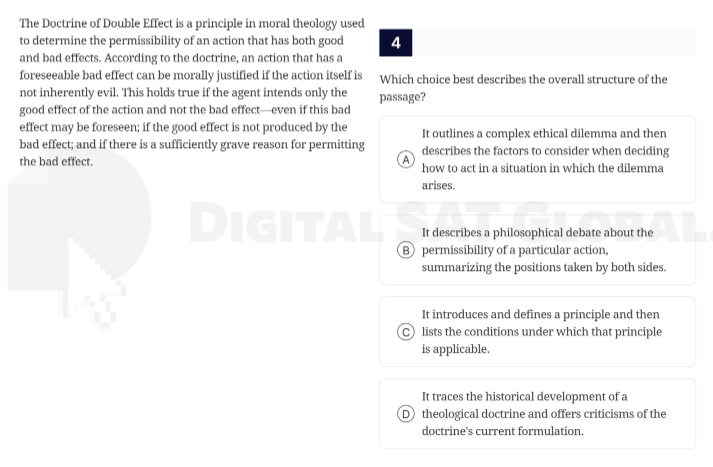
the doctrine of double effect is a principle in moral theology used to determine the permissibility of an action that has both good and bad effects. according to the doctrine, an action that has a foreseeable bad effect can be morally justified if the action itself is not inherently evil. this holds true if the agent intends only the good effect of the action and not the bad effect—even if this bad effect may be foreseen; if the good effect is not produced by the bad effect; and if there is a sufficiently grave reason for permitting the bad effect.
4
which choice best describes the overall structure of the passage?
a it outlines a complex ethical dilemma and then describes the factors to consider when deciding how to act in a situation in which the dilemma arises.
b it describes a philosophical debate about the permissibility of a particular action, summarizing the positions taken by both sides.
c it introduces and defines a principle and then lists the conditions under which that principle is applicable.
d it traces the historical development of a theological doctrine and offers criticisms of the doctrine’s current formulation.
The passage first introduces the Doctrine of Double Effect as a moral theology principle, defines its purpose, then lists the specific conditions that justify an action under this principle. Option C matches this structure exactly, while the other options do not: the passage does not present an ethical dilemma (A), a debate with opposing positions (B), or a historical development with criticisms (D).

Snap & solve any problem in the app
Get step-by-step solutions on Sovi AI
Photo-based solutions with guided steps
Explore more problems and detailed explanations
C. It introduces and defines a principle and then lists the conditions under which that principle is applicable.