QUESTION IMAGE
Question
document - based question
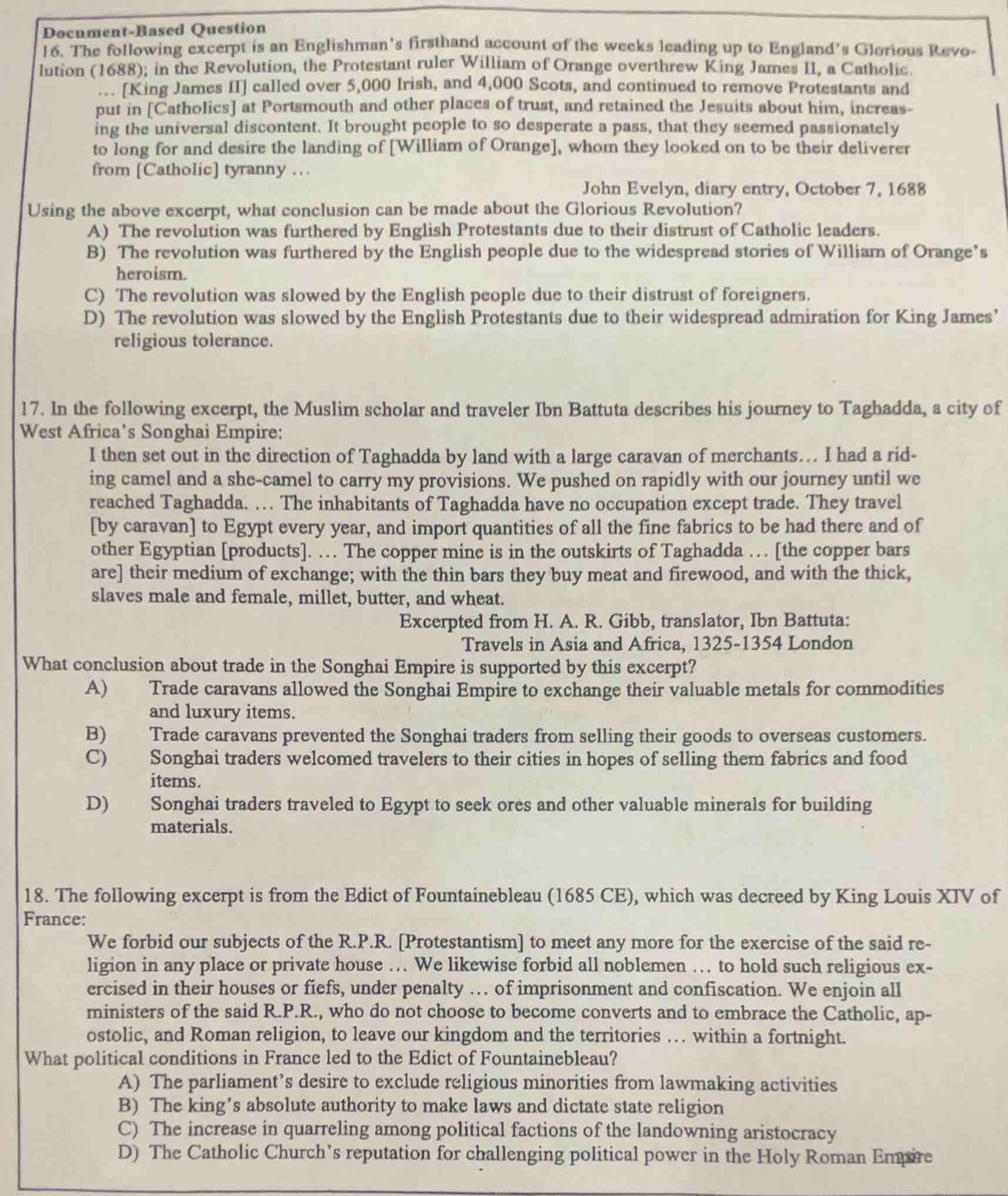
- the following excerpt is an englishman’s firsthand account of the weeks leading up to england’s glorious revolution (1688); in the revolution, the protestant ruler william of orange overthrew king james ii, a catholic.
... king james ii called over 5,000 irish, and 4,000 scots, and continued to remove protestants and put in catholics at portsmouth and other places of trust, and retained the jesuits about him, increasing the universal discontent. it brought people to so desperate a pass, that they seemed passionately to long for and desire the landing of william of orange, whom they looked on to be their deliverer from catholic tyranny...
john evelyn, diary entry, october 7, 1688
using the above excerpt, what conclusion can be made about the glorious revolution?
a) the revolution was furthered by english protestants due to their distrust of catholic leaders.
b) the revolution was furthered by the english people due to the widespread stories of william of orange’s heroism.
c) the revolution was slowed by the english people due to their distrust of foreigners.
d) the revolution was slowed by the english protestants due to their widespread admiration for king james’ religious tolerance.
- in the following excerpt, the muslim scholar and traveler ibn battuta describes his journey to taghadda, a city of west africa’s songhai empire:
i then set out in the direction of taghadda by land with a large caravan of merchants... i had a riding camel and a she - camel to carry my provisions. we pushed on rapidly with our journey until we reached taghadda.... the inhabitants of taghadda have no occupation except trade. they travel by caravan to egypt every year, and import quantities of all the fine fabrics to be had there and of other egyptian products.... the copper mine is in the outskirts of taghadda... the copper bars are their medium of exchange; with the thin bars they buy meat and firewood, and with the thick, slaves male and female, millet, butter, and wheat.
excerpted from h. a. r. gibb, translator, ibn battuta: travels in asia and africa, 1325 - 1354 london
what conclusion about trade in the songhai empire is supported by this excerpt?
a) trade caravans allowed the songhai empire to exchange their valuable metals for commodities and luxury items.
b) trade caravans prevented the songhai traders from selling their goods to overseas customers.
c) songhai traders welcomed travelers to their cities in hopes of selling them fabrics and food items.
d) songhai traders traveled to egypt to seek ores and other valuable minerals for building materials.
- the following excerpt is from the edict of fountainebleau (1685 ce), which was decreed by king louis xiv of france:
we forbid our subjects of the r.p.r. protestantism to meet any more for the exercise of the said religion in any place or private house... we likewise forbid all noblemen... to hold such religious exercised in their houses or fiefs, under penalty... of imprisonment and confiscation. we enjoin all ministers of the said r.p.r., who do not choose to become converts and to embrace the catholic, apostolic, and roman religion, to leave our kingdom and the territories... within a fortnight.
what political conditions in france led to the edict of fountainebleau?
a) the parliament’s desire to exclude religious minorities from lawmaking activities
b) the king’s absolute authority to make laws and dictate state religion
c) the increase in quarreling among political factions of the landowning aristocracy
d) the catholic church’s reputation for challenging political power in the holy roman empire
- For question 16: The excerpt states James II replaced Protestants with Catholics in trusted positions, sparking discontent and a desire for William of Orange to deliver them from Catholic tyranny. This shows Protestant distrust of Catholic leadership fueled the revolution.
- For question 17: The excerpt notes Taghadda's inhabitants trade via caravan to Egypt for fine fabrics, and use copper bars (local metal) as currency for goods including slaves and food. This matches the idea of using valuable metals/trade caravans to get commodities and luxury items.
- For question 18: The edict is directly decreed by King Louis XIV, who bans Protestant religious practice, orders non-converting ministers to leave, and sets penalties. This demonstrates the king's absolute power to set state religion and make such laws.

Snap & solve any problem in the app
Get step-by-step solutions on Sovi AI
Photo-based solutions with guided steps
Explore more problems and detailed explanations
- A) The revolution was furthered by English Protestants due to their distrust of Catholic leaders.
- A) Trade caravans allowed the Songhai Empire to exchange their valuable metals for commodities and luxury items.
- B) The king's absolute authority to make laws and dictate state religion