QUESTION IMAGE
Question
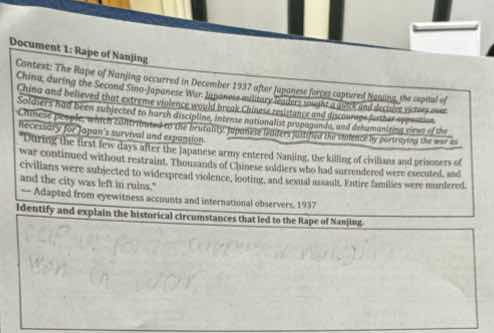
document 1: rape of nanjing
context: the rape of nanjing occurred in december 1937 after japanese forces captured nanjing, the capital of china during the second sino - japanese war. thousands of chinese soldiers who had surrendered were executed, and chinese and foreign civilians were subject to murder, torture, and systematic mass rape. japanese soldiers had been told extreme violence would break chinese resistance and discourage intervention of the western powers. to impose discipline, intense indoctrination in racism and ultranationalism assured the soldiers that china’s survival was not the priority. the brutality continued without restraint.
“during the first few days after the japanese army entered nanjing, the killing of civilians and prisoners of war was widespread. thousands of innocent civilians were shot down or stabbed to death. the city was subjected to widespread violence, looting, and sexual assault. entire families were murdered, and the city was left in ruins.”
— adapted from eyewitness accounts and international observers, 1937
identify and explain the historical circumstances that led to the rape of nanjing.
- Military Context of the Second Sino-Japanese War: The Second Sino-Japanese War began in 1937, and by December of that year, Japanese forces advanced on Nanjing, the then-capital of China. After weeks of intense fighting, the Chinese military defending Nanjing collapsed, leaving the city vulnerable.
- Japanese Military Culture and Discipline Failures: The Imperial Japanese Army had a culture of extreme militarism, with a lack of strict oversight for troops in occupied areas. Commanders either encouraged or failed to stop acts of violence, viewing Chinese civilians and surrendering soldiers as enemies and obstacles to their campaign.
- Dehumanization and Strategic Intimidation: Japanese forces sought to break Chinese resistance through terror. They dehumanized Chinese people, seeing them as inferior, and used mass violence, rape, and destruction to intimidate the remaining population and discourage further opposition to their invasion.

Snap & solve any problem in the app
Get step-by-step solutions on Sovi AI
Photo-based solutions with guided steps
Explore more problems and detailed explanations
The historical circumstances leading to the Rape of Nanjing are:
- The 1937 advance of Imperial Japanese forces on Nanjing during the Second Sino-Japanese War, following the collapse of Chinese military defenses around the city.
- A culture of extreme militarism and lack of disciplinary control within the Imperial Japanese Army, where commanders permitted or enabled unregulated violence against the city's population.
- A deliberate strategy of terror and dehumanization of Chinese civilians and surrendering soldiers, intended to break Chinese national resistance to the Japanese invasion through mass violence, destruction, and intimidation.