QUESTION IMAGE
Question
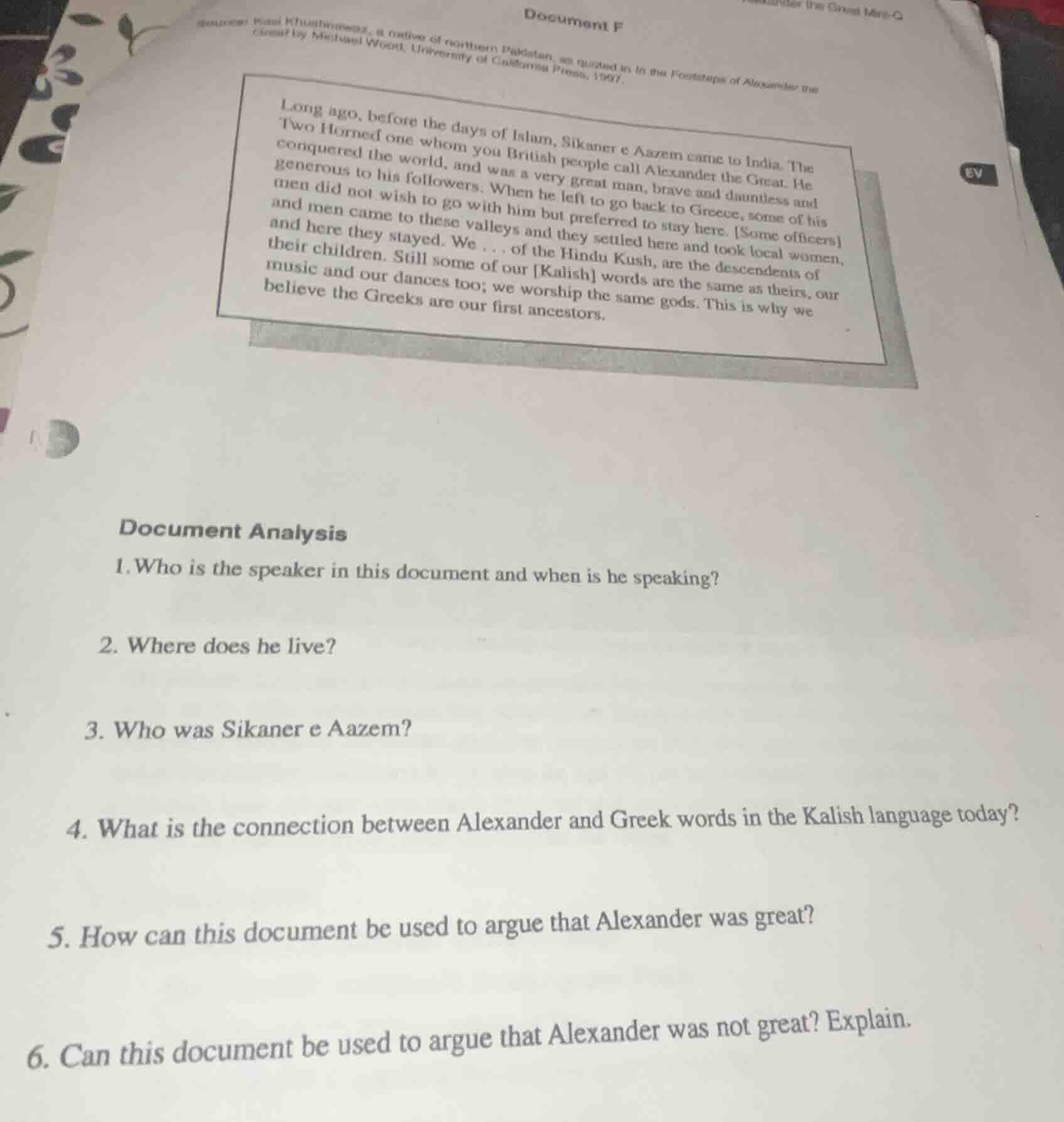
document f
source: massi khtushkhewaei, a native of northern pakistan, as quoted in in the footsteps of alexander the great by michael wood, university of california press, 1997.
long ago, before the days of islam, sikaner - e - aazem came to india. the two horned one whom you british people call alexander the great. he conquered the world, and was a very great man, brave and dauntless and generous to his followers. when he left to go back to greece, some of his men did not wish to go with him but preferred to stay here. some officers and men came to these valleys and they settled here and took local women, and here they stayed. we... of the hindu kush, are the descendants of their children. still some of our kalash words are the same as theirs, our music and our dances too; we worship the same gods. this is why we believe the greeks are our first ancestors.
document analysis
- who is the speaker in this document and when is he speaking?
- where does he live?
- who was sikaner - e - aazem?
- what is the connection between alexander and greek words in the kalash language today?
- how can this document be used to argue that alexander was great?
- can this document be used to argue that alexander was not great? explain.
1. Who is the speaker in this document and when is he speaking?
The speaker is a native of northern Pakistan (likely a Kalash person), speaking in a time after Islam's arrival (since he refers to "before the days of Islam") and in a context where British people exist (as he mentions how British call Alexander the Great), so probably in a modern or post - Islamic era when the British had contact with the region.
From the document, he mentions living in the valleys of the Hindu Kush (as his ancestors settled there and he is part of the Kalash community which is in the Hindu Kush region of northern Pakistan).
The document says "the Two Horned one whom you British people call Alexander the Great", so Sikaner e Aazem is Alexander the Great.

Snap & solve any problem in the app
Get step-by-step solutions on Sovi AI
Photo-based solutions with guided steps
Explore more problems and detailed explanations
The speaker is a native of northern Pakistan (likely a Kalash individual). He is speaking in a time after the advent of Islam (as he references "before the days of Islam") and when the British were present (given the reference to how the British refer to Alexander the Great), so in a period with British contact and post - Islamic in the region.