QUESTION IMAGE
Question
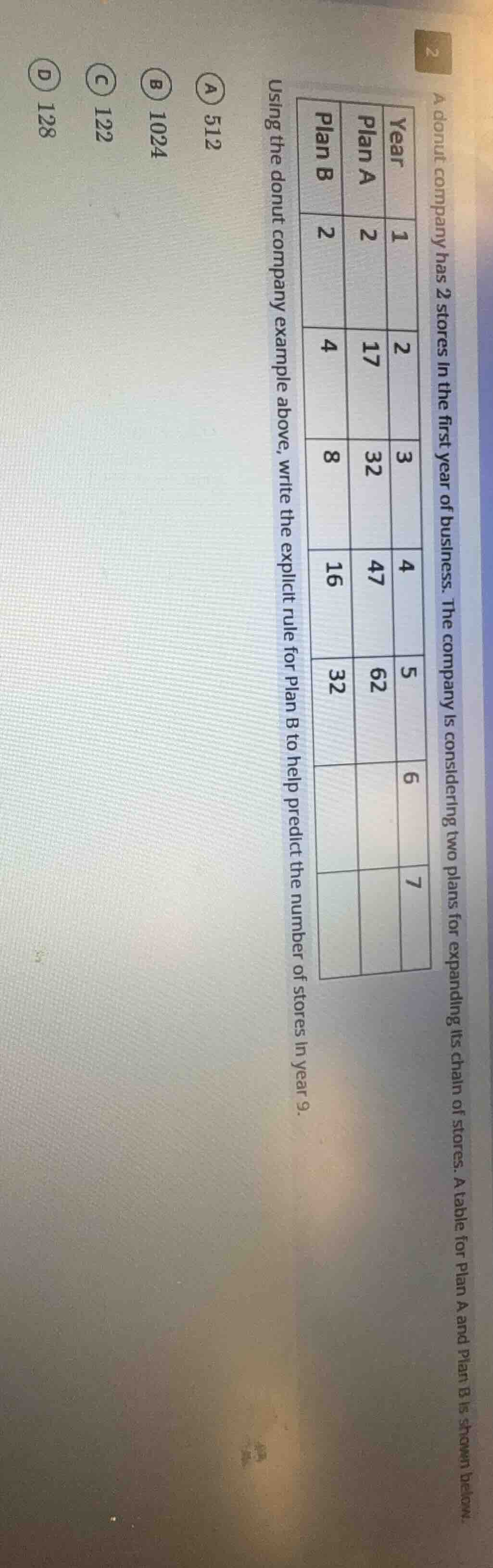
a donut company has 2 stores in the first year of business. the company is considering two plans for expanding its chain of stores. a table for plan a and plan b is shown below.
| year | plan a | plan b |
|---|---|---|
| 2 | 17 | 4 |
| 3 | 32 | 8 |
| 4 | 47 | 16 |
| 5 | 62 | 32 |
| 6 | ||
| 7 |
using the donut company example above, write the explicit rule for plan b to help predict the number of stores in year 9.
a 512
b 1024
c 122
d 128
Step1: Identify the pattern for Plan B
Looking at the values of Plan B for each year:
- Year 1: \(2 = 2^1\)
- Year 2: \(4 = 2^2\)
- Year 3: \(8 = 2^3\)
- Year 4: \(16 = 2^4\)
- Year 5: \(32 = 2^5\)
So the explicit rule for Plan B is \(a_n = 2^n\), where \(n\) is the year.
Step2: Calculate the number of stores in Year 9
Using the explicit rule \(a_n = 2^n\), for \(n = 9\):
\(a_9 = 2^9\)
\(2^9 = 512\)? Wait, no, wait: Wait, Year 1 is \(2^1 = 2\), Year 2 is \(2^2 = 4\), so Year \(n\) is \(2^n\). Wait, but let's check again. Wait, Year 1: 2, Year 2: 4, Year 3: 8, Year 4: 16, Year 5: 32. So the pattern is that each year, the number of stores doubles, which is a geometric sequence with first term \(a_1 = 2\) and common ratio \(r = 2\). The explicit formula for a geometric sequence is \(a_n = a_1 \times r^{n - 1}\). Wait, but in our case, for Year 1, \(n = 1\), \(a_1 = 2 \times 2^{1 - 1}= 2 \times 1 = 2\), Year 2: \(2 \times 2^{2 - 1}= 4\), Year 3: \(2 \times 2^{3 - 1}= 8\), so actually the explicit formula is \(a_n = 2^n\) (since \(2 \times 2^{n - 1}= 2^n\)). So for Year 9, \(n = 9\), so \(a_9 = 2^9 = 512\)? Wait, but let's check the options. Option A is 512. Wait, but wait, maybe I made a mistake. Wait, Year 1: 2, Year 2: 4, Year 3: 8, Year 4: 16, Year 5: 32, Year 6: 64, Year 7: 128, Year 8: 256, Year 9: 512. Yes, that's correct. So the number of stores in Year 9 for Plan B is \(2^9 = 512\).

Snap & solve any problem in the app
Get step-by-step solutions on Sovi AI
Photo-based solutions with guided steps
Explore more problems and detailed explanations
A. 512