QUESTION IMAGE
Question
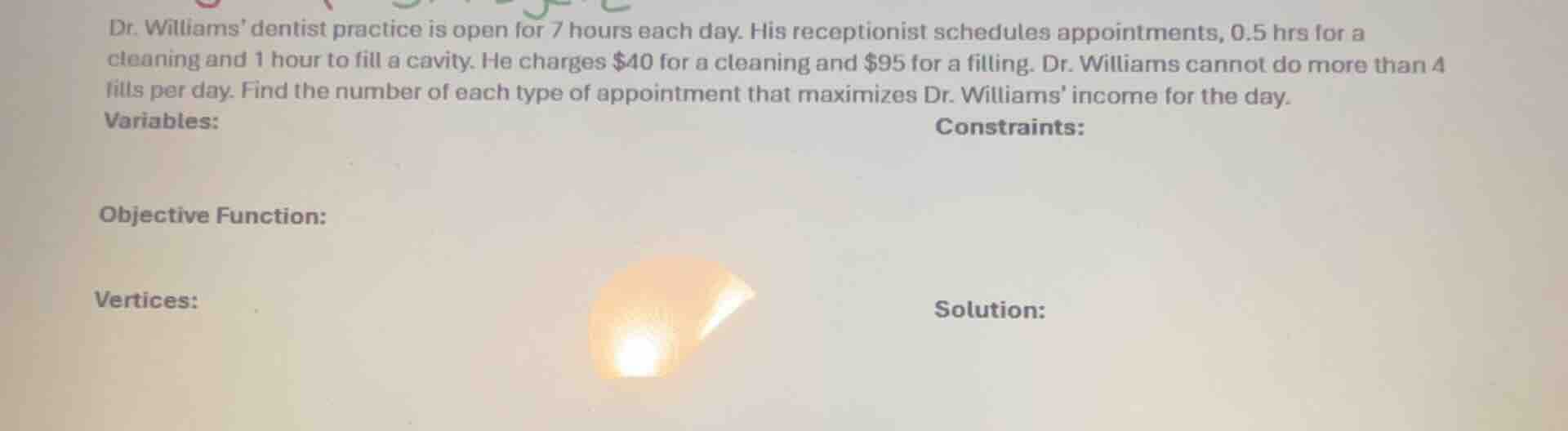
dr. williams dentist practice is open for 7 hours each day. his receptionist schedules appointments, 0.5 hrs for a cleaning and 1 hour to fill a cavity. he charges $40 for a cleaning and $95 for a filling. dr. williams cannot do more than 4 fills per day. find the number of each type of appointment that maximizes dr. williams income for the day.
variables:
constraints:
objective function:
vertices:
solution:
Variables:
Let \( x \) be the number of cleanings and \( y \) be the number of fillings.
Constraints:
- Time constraint: Each cleaning takes \( 0.5 \) hours and each filling takes \( 1 \) hour. The total time per day is \( 7 \) hours. So, \( 0.5x + y \leq 7 \).
- Filling limit: Dr. Williams cannot do more than \( 4 \) fills per day. So, \( y \leq 4 \).
- Non - negativity: The number of cleanings and fillings cannot be negative. So, \( x\geq0 \) and \( y\geq0 \), and \( x,y \) are non - negative integers (since we can't have a fraction of an appointment).
Objective Function:
The income from cleanings is \( 40x \) dollars and from fillings is \( 95y \) dollars. The objective function to maximize is \( I = 40x+95y \), where \( I \) is the total income.
Vertices:
To find the vertices of the feasible region, we consider the intersection of the constraint lines:
- Intersection of \( y = 0 \) and \( 0.5x + y=7 \):
Substitute \( y = 0 \) into \( 0.5x + y = 7 \), we get \( 0.5x=7\Rightarrow x = 14 \). So, one vertex is \( (14,0) \).
- Intersection of \( y = 4 \) and \( 0.5x + y=7 \):
Substitute \( y = 4 \) into \( 0.5x + y=7 \), we have \( 0.5x+4 = 7\Rightarrow0.5x=3\Rightarrow x = 6 \). So, another vertex is \( (6,4) \).
- Intersection of \( y = 4 \) and \( x = 0 \): The vertex is \( (0,4) \).
- Intersection of \( x = 0 \) and \( y = 0 \): The vertex is \( (0,0) \).
Solution:
We evaluate the objective function \( I = 40x + 95y \) at each vertex:
- At \( (14,0) \): \( I=40\times14 + 95\times0=560\)
- At \( (6,4) \): \( I = 40\times6+95\times4=240 + 380=620\)
- At \( (0,4) \): \( I=40\times0+95\times4 = 380\)
- At \( (0,0) \): \( I=40\times0 + 95\times0=0\)
Since \( 620>560>380>0 \), the maximum income occurs when \( x = 6 \) (number of cleanings) and \( y = 4 \) (number of fillings).

Snap & solve any problem in the app
Get step-by-step solutions on Sovi AI
Photo-based solutions with guided steps
Explore more problems and detailed explanations
The number of cleanings is \( 6 \) and the number of fillings is \( 4 \) to maximize the income. The maximum income is \( \$620 \).