QUESTION IMAGE
Question
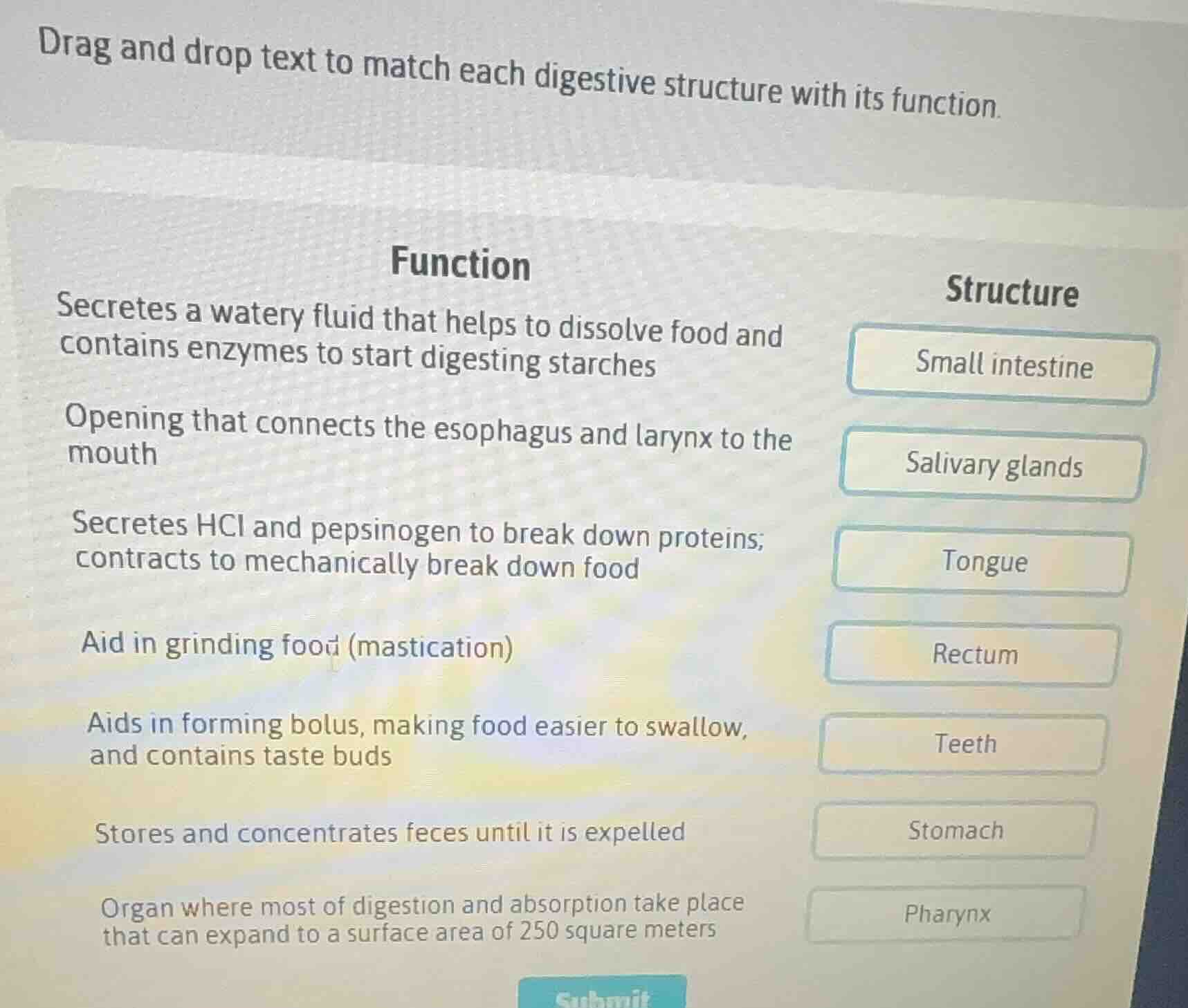
drag and drop text to match each digestive structure with its function.
function
secretes a watery fluid that helps to dissolve food and contains enzymes to start digesting starches
opening that connects the esophagus and larynx to the mouth
secretes hcl and pepsinogen to break down proteins; contracts to mechanically break down food
aid in grinding food (mastication)
aids in forming bolus, making food easier to swallow, and contains taste buds
stores and concentrates feces until it is expelled
organ where most of digestion and absorption take place that can expand to a surface area of 250 square meters
structure
small intestine
salivary glands
tongue
rectum
teeth
stomach
pharynx
Each digestive structure is matched to its core, defined biological function based on human digestive system anatomy:
- Salivary glands produce saliva, a watery fluid with amylase (starch-digesting enzyme).
- The pharynx is the shared passage connecting the mouth to the esophagus and larynx.
- The stomach secretes HCl and pepsinogen for protein breakdown, and contracts to churn food mechanically.
- Teeth are the hard structures responsible for chewing/grinding food (mastication).
- The tongue manipulates food into a bolus for swallowing and houses taste buds.
- The rectum stores feces until they are eliminated from the body.
- The small intestine is the primary site of nutrient digestion and absorption, with a large expanded surface area.

Snap & solve any problem in the app
Get step-by-step solutions on Sovi AI
Photo-based solutions with guided steps
Explore more problems and detailed explanations
- Secretes a watery fluid that helps to dissolve food and contains enzymes to start digesting starches: Salivary glands
- Opening that connects the esophagus and larynx to the mouth: Pharynx
- Secretes HCl and pepsinogen to break down proteins; contracts to mechanically break down food: Stomach
- Aid in grinding food (mastication): Teeth
- Aids in forming bolus, making food easier to swallow, and contains taste buds: Tongue
- Stores and concentrates feces until it is expelled: Rectum
- Organ where most of digestion and absorption take place that can expand to a surface area of 250 square meters: Small intestine