QUESTION IMAGE
Question
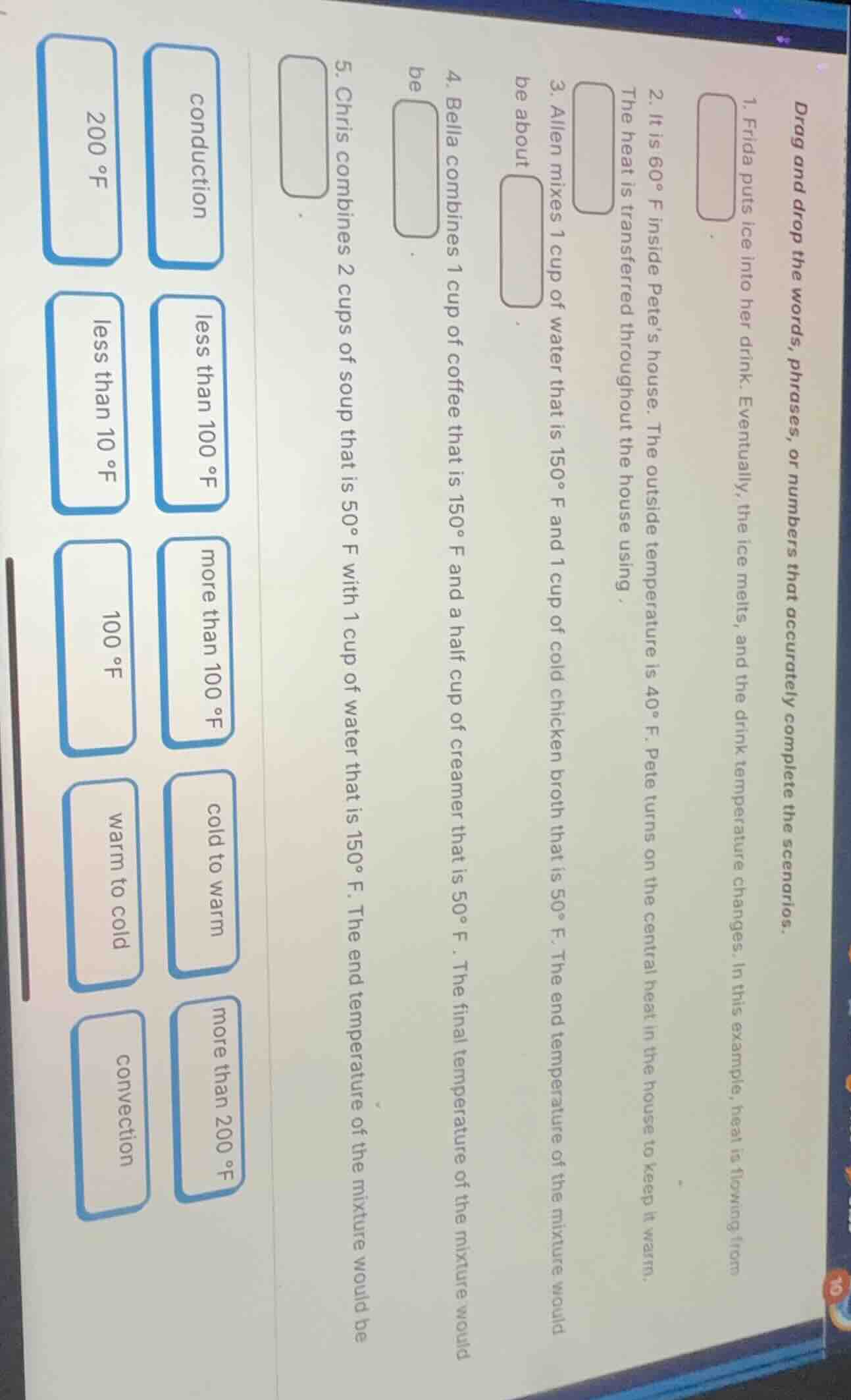
drag and drop the words, phrases, or numbers that accurately complete the scenarios. 1. frida puts ice into her drink. eventually, the ice melts, and the drink temperature changes. in this example, heat is flowing from. 2. it is 60°f inside petes house. the outside temperature is 40°f. pete turns on the central heat in the house to keep it warm. the heat is transferred throughout the house using. 3. allen mixes 1 cup of water that is 150°f and 1 cup of cold chicken broth that is 50°f. the end temperature of the mixture would be about. 4. bella combines 1 cup of coffee that is 150°f and a half cup of creamer that is 50°f. the final temperature of the mixture would be. 5. chris combines 2 cups of soup that is 50°f with 1 cup of water that is 150°f. the end temperature of the mixture would be. conduction 200°f less than 10°f less than 100°f 100°f more than 100°f cold to warm warm to cold convection more than 200°f
Question 1:
When ice melts in a drink, heat flows from the warmer drink to the colder ice (since ice is cold and the drink is warmer initially, but after melting, we consider the direction of heat flow for the temperature change: heat flows from warm to cold to reach equilibrium, but in terms of the ice melting, the heat is from the drink to the ice, so the direction of heat flow described here is from warm to cold? Wait, no—when ice melts, the drink is losing heat (cooling) and the ice is gaining heat (melting). So the heat is flowing from the drink (which is warm relative to the ice) to the ice (cold). So the phrase should be "warm to cold" as the direction of heat flow (from the warmer drink to the colder ice). Wait, the options include "cold to warm" or "warm to cold"? Wait the left options: looking at the blue boxes, one is "cold to warm" and "warm to cold". Wait, heat flows from higher temperature to lower temperature. The drink is at a higher temperature than the ice (before melting, the drink is, say, room temp or warmer, ice is 32°F). So heat flows from the drink (warm) to the ice (cold), so the direction is warm to cold? Wait no—wait, the question says "heat is flowing from"—so Frida puts ice into her drink. The drink is warmer than the ice. So heat flows from the drink (warm) to the ice (cold), so the heat is flowing from warm to cold? Wait the options: the blue boxes have "cold to warm" and "warm to cold". Wait, maybe I got it reversed. Wait, heat transfer is from high temp to low temp. So if the drink is warmer than the ice, heat goes from drink (warm) to ice (cold), so the direction is warm to cold? Wait no—wait, "cold to warm" would be heat going from cold to warm, which is impossible. So the correct phrase is "warm to cold"? Wait no, wait: when you have a cold object (ice) and a warm object (drink), heat flows from warm to cold. So the answer is "warm to cold"? Wait the blue boxes: one of them is "warm to cold". So for question 1, the answer is "warm to cold"? Wait no, let's check the options. The blue boxes include "cold to warm" and "warm to cold". Wait, maybe the question is phrased as "heat is flowing from"—so when ice melts, the ice is cold, the drink is warm, so heat flows from the drink (warm) to the ice (cold), so from warm to cold. So the answer is "warm to cold"? Wait no, maybe I made a mistake. Wait, the options: looking at the left, the blue boxes are: conduction, less than 100°F, 100°F, warm to cold, convection; and the other column: less than 100°F, more than 100°F, cold to warm, more than 200°F, conduction? Wait no, the left blue boxes (the ones to drag) are:
Wait the image: the left (blue) boxes are:
- conduction
- less than 100°F
- 100°F
- warm to cold
- convection
And the right (brown) boxes (the ones to fill) are:
- cold to warm
- more than 100°F
- more than 200°F
Wait no, the first question's blank: Frida puts ice into her drink. Eventually, the ice melts, and the drink temperature changes. In this example, heat is flowing from ____.
Heat flows from higher temperature to lower temperature. The drink is at a higher temperature than the ice (before melting, the drink is warmer, ice is 32°F). So heat flows from the drink (warm) to the ice (cold), so the direction is warm to cold. So the answer is "warm to cold".
Pete’s house is 60°F inside, outside is 40°F. He turns on central heat to keep it warm. The heat transfer method for central heating (like forced air or radiators) is convection (since convection is heat transfer by fluid movement, like air or water in heating systems). Conduction is direct contact, convection is through fluids. So the heat is transferred throughout the house using "convection" (if it's forced air) or "conduction"? Wait, central heat systems: if it's a furnace with air ducts, it's convection (air moving). If it's radiators, it's conduction and radiation, but the options include "conduction" and "convection". The blue boxes have "conduction" and "convection". So for central heat (like heating the air and circulating it), the method is convection. Wait, but maybe the answer is "convection"? Wait the options: the blue boxes include "conduction" and "convection". So question 2: "The heat is transferred throughout the house using ____." So central heating (like forced air) uses convection (air currents). So the answer is "convection"? Wait no—wait, maybe it's conduction? No, conduction is direct contact. Convection is fluid movement. So the correct answer is "convection".
Step 1: Determine the average temperature logic.
Allen mixes 1 cup of water (150°F) and 1 cup of cold chicken broth (50°F). When mixing equal volumes (assuming same density, so equal mass), the final temperature is the average of the two temperatures. The formula for mixing two substances of equal mass (m) with temperatures \( T_1 \) and \( T_2 \) is \( T_{final} = \frac{mT_1 + mT_2}{m + m} = \frac{T_1 + T_2}{2} \).
Step 2: Calculate the average.
Here, \( T_1 = 150^\circ F \), \( T_2 = 50^\circ F \). So \( T_{final} = \frac{150 + 50}{2} = \frac{200}{2} = 100^\circ F \). Wait, but the options: the blue boxes have "less than 100°F", "100°F", "more than 100°F". Wait, but if we mix equal amounts, the average is 100°F. But wait, is there a catch? No, assuming no heat loss, equal mass (1 cup each, same density), so the final temperature is 100°F? Wait but the question says "be about"—so the answer is 100°F? Wait the blue boxes include "100°F" as an option.

Snap & solve any problem in the app
Get step-by-step solutions on Sovi AI
Photo-based solutions with guided steps
Explore more problems and detailed explanations
warm to cold