QUESTION IMAGE
Question
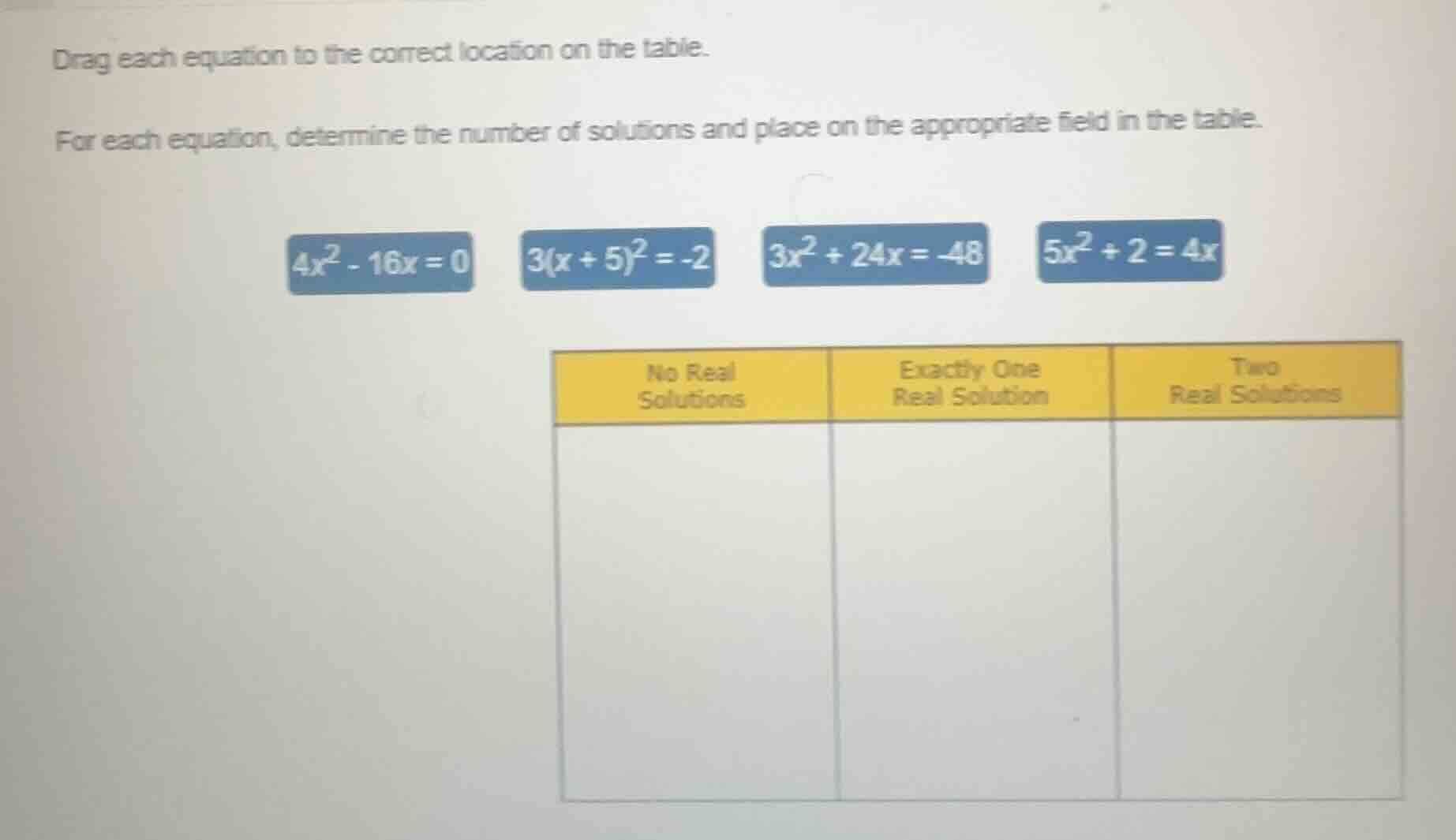
drag each equation to the correct location on the table. for each equation, determine the number of solutions and place on the appropriate field in the table. 4x² - 16x = 0, 3(x + 5)² = -2, 3x² + 24x = -48, 5x² + 2 = 4x. table with columns: no real solutions, exactly one real solution, two real solutions.
Step1: Recall discriminant rule
For quadratic $ax^2+bx+c=0$, discriminant $\Delta = b^2-4ac$:
- $\Delta < 0$: No real solutions
- $\Delta = 0$: One real solution
- $\Delta > 0$: Two real solutions
Step2: Analyze $4x^2 - 16x = 0$
Rewrite: $4x^2-16x+0=0$, $a=4, b=-16, c=0$
$\Delta = (-16)^2 - 4(4)(0) = 256 > 0$
Step3: Analyze $3(x+5)^2 = -2$
Expand: $3(x^2+10x+25)=-2 \to 3x^2+30x+77=0$
$a=3, b=30, c=77$
$\Delta = 30^2 - 4(3)(77) = 900 - 924 = -24 < 0$
Step4: Analyze $3x^2 + 24x = -48$
Rewrite: $3x^2+24x+48=0$, $a=3, b=24, c=48$
$\Delta = 24^2 - 4(3)(48) = 576 - 576 = 0$
Step5: Analyze $5x^2 + 2 = 4x$
Rewrite: $5x^2-4x+2=0$, $a=5, b=-4, c=2$
$\Delta = (-4)^2 - 4(5)(2) = 16 - 40 = -24 < 0$

Snap & solve any problem in the app
Get step-by-step solutions on Sovi AI
Photo-based solutions with guided steps
Explore more problems and detailed explanations
| No Real Solutions | Exactly One Real Solution | Two Real Solutions |
|---|