QUESTION IMAGE
Question
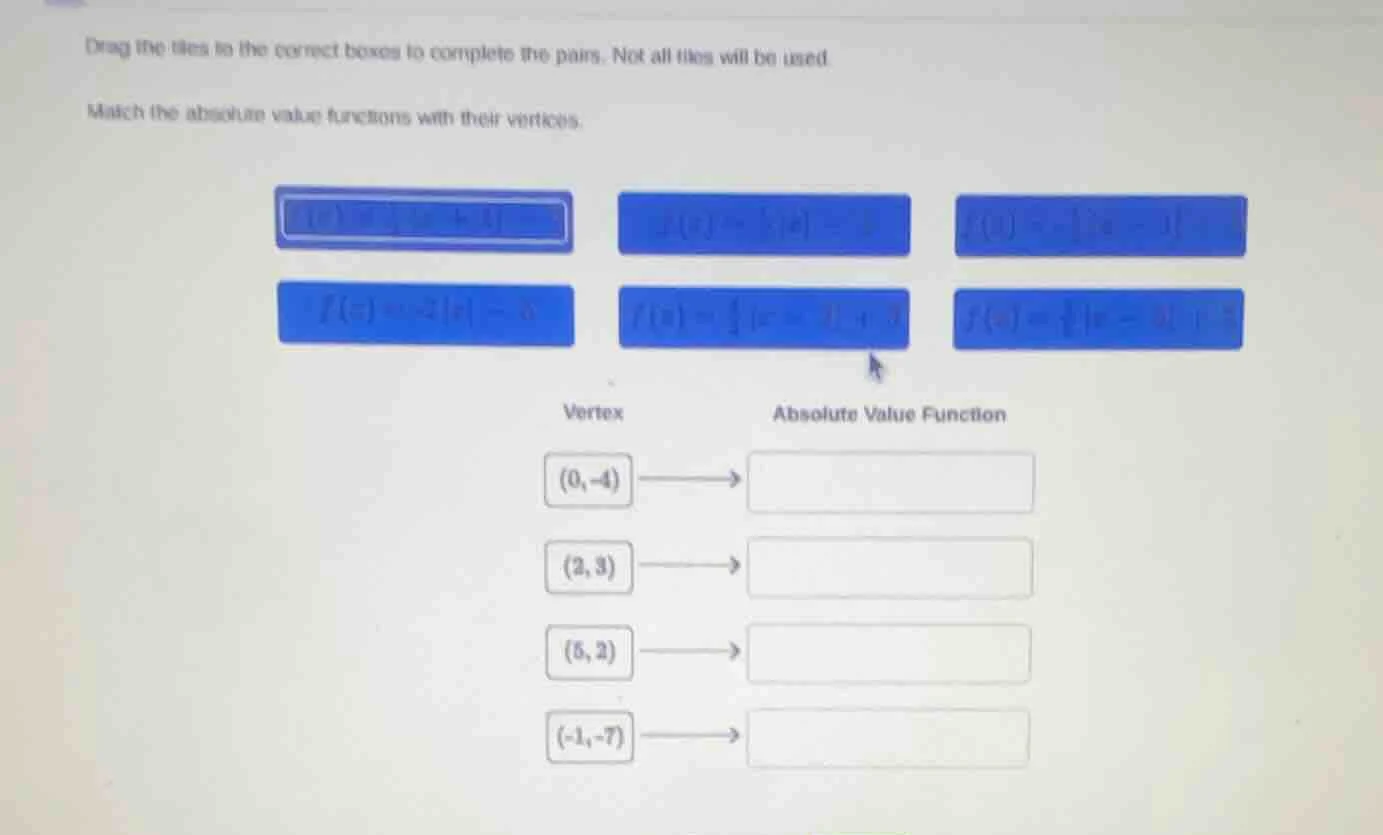
drag the tiles to the correct boxes to complete the pairs. not all tiles will be used. match the absolute value functions with their vertices. f(x) = 1/2|x + 1| - 7, g(x) = 1/2|x| - 4, h(x) = -1/2|x - 1| + 5, k(x) = -2|x| - 6, l(x) = 1/2|x - 2| + 3, j(x) = 1/2|x - 6| + 2. vertex: (0, -4) → absolute value function blank, (2, 3) → blank, (6, 2) → blank, (-1, -7) → blank
The general form of an absolute value function is \( f(x) = a|x - h| + k \), where \((h, k)\) is the vertex of the function. We will use this form to determine the vertex of each given function and then match it with the corresponding vertex.
Step 1: Analyze the function \( g(x) = \frac{1}{2}|x| - 2 \)
The general form is \( f(x) = a|x - h| + k \). Here, \( h = 0 \) (since there's no horizontal shift) and \( k = -2 \)? Wait, no, let's re-express. Wait, the function is \( \frac{1}{2}|x| - 2 \), which can be written as \( \frac{1}{2}|x - 0| + (-2) \). Wait, but the vertex for \( (0, -4) \)? Wait, maybe I made a mistake. Wait, another function: \( f(x) = -2|x| - 4 \). Let's check that. \( f(x) = -2|x - 0| + (-4) \), so the vertex is \( (0, -4) \). Yes, that's correct. So \( f(x) = -2|x| - 4 \) has vertex \( (0, -4) \).
Step 2: Analyze the function \( f(x) = \frac{1}{4}|x - 2| + 3 \)
Using the general form \( f(x) = a|x - h| + k \), here \( h = 2 \) and \( k = 3 \), so the vertex is \( (2, 3) \). So this function matches the vertex \( (2, 3) \).
Step 3: Analyze the function \( f(x) = \frac{2}{3}|x - 5| + 2 \)
Using the general form, \( h = 5 \) and \( k = 2 \), so the vertex is \( (5, 2) \). So this function matches the vertex \( (5, 2) \).
Step 4: Analyze the function \( f(x) = \frac{1}{3}|x + 1| - 7 \)
Rewrite \( |x + 1| \) as \( |x - (-1)| \), so the function is \( \frac{1}{3}|x - (-1)| - 7 \), which is \( \frac{1}{3}|x - (-1)| + (-7) \). So \( h = -1 \) and \( k = -7 \), so the vertex is \( (-1, -7) \).
Now let's summarize:
- Vertex \( (0, -4) \): Matches \( f(x) = -2|x| - 4 \) (since \( h = 0 \), \( k = -4 \))
- Vertex \( (2, 3) \): Matches \( f(x) = \frac{1}{4}|x - 2| + 3 \) (since \( h = 2 \), \( k = 3 \))
- Vertex \( (5, 2) \): Matches \( f(x) = \frac{2}{3}|x - 5| + 2 \) (since \( h = 5 \), \( k = 2 \))
- Vertex \( (-1, -7) \): Matches \( f(x) = \frac{1}{3}|x + 1| - 7 \) (since \( h = -1 \), \( k = -7 \))

Snap & solve any problem in the app
Get step-by-step solutions on Sovi AI
Photo-based solutions with guided steps
Explore more problems and detailed explanations
- \( (0, -4) \): \( f(x) = -2|x| - 4 \)
- \( (2, 3) \): \( f(x) = \frac{1}{4}|x - 2| + 3 \)
- \( (5, 2) \): \( f(x) = \frac{2}{3}|x - 5| + 2 \)
- \( (-1, -7) \): \( f(x) = \frac{1}{3}|x + 1| - 7 \)