QUESTION IMAGE
Question
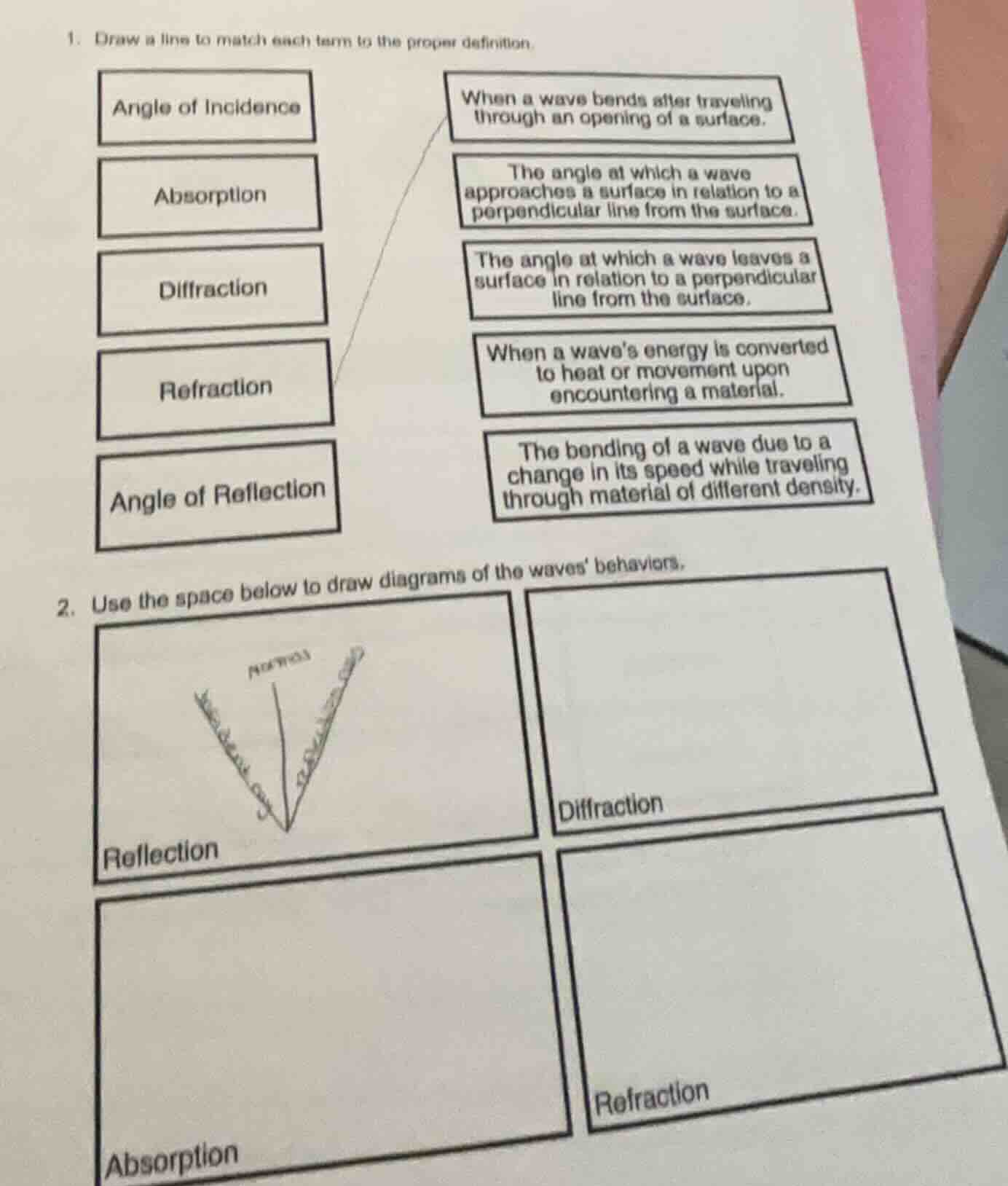
- draw a line to match each term to the proper definition.
angle of incidence
absorption
diffraction
refraction
angle of reflection
when a wave bends after traveling through an opening of a surface.
the angle at which a wave approaches a surface in relation to a perpendicular line from the surface.
the angle at which a wave leaves a surface in relation to a perpendicular line from the surface.
when a waves energy is converted to heat or movement upon encountering a material.
the bending of a wave due to a change in its speed while traveling through material of different density.
- use the space below to draw diagrams of the waves behaviors.
reflection
diffraction
absorption
refraction
Brief Explanations
Part 1 (Matching):
- Angle of Incidence: Defined as the angle between an incoming wave and the perpendicular (normal) to a surface.
- Absorption: Occurs when wave energy is converted to other forms like heat when hitting a material.
- Diffraction: Is the bending of waves as they pass through an opening or around an edge.
- Refraction: Happens when waves bend due to a speed change in a different density medium.
- Angle of Reflection: Is the angle between a reflected wave and the perpendicular (normal) to a surface.
Part 2 (Diagrams):
- Diffraction: Draw straight incoming waves bending outward after passing through a narrow opening.
- Absorption: Draw incoming waves hitting a solid material, with no outgoing waves (label that energy is converted to heat).
- Refraction: Draw incoming waves hitting a boundary between two media, bending toward/away from the normal (show a change in wave speed/wavelength).

Snap & solve any problem in the app
Get step-by-step solutions on Sovi AI
Photo-based solutions with guided steps
Explore more problems and detailed explanations
1. Matching Answers:
- Angle of Incidence → The angle at which a wave approaches a surface in relation to a perpendicular line from the surface.
- Absorption → When a wave's energy is converted to heat or movement upon encountering a material.
- Diffraction → When a wave bends after traveling through an opening of a surface.
- Refraction → The bending of a wave due to a change in its speed while traveling through material of different density.
- Angle of Reflection → The angle at which a wave leaves a surface in relation to a perpendicular line from the surface.
2. Diagram Descriptions (to draw):
- Diffraction: A set of parallel straight waves approaching a narrow slit, with waves spreading out (bending) on the other side of the slit.
- Absorption: Parallel incoming waves striking a thick, solid surface; no waves reflect or transmit, with a note indicating energy is absorbed as heat/movement.
- Refraction: Parallel incoming waves hitting a diagonal boundary between two media (e.g., air to water). The waves bend toward the perpendicular (normal) line on the second medium, with shorter wavelength to show reduced speed.