QUESTION IMAGE
Question
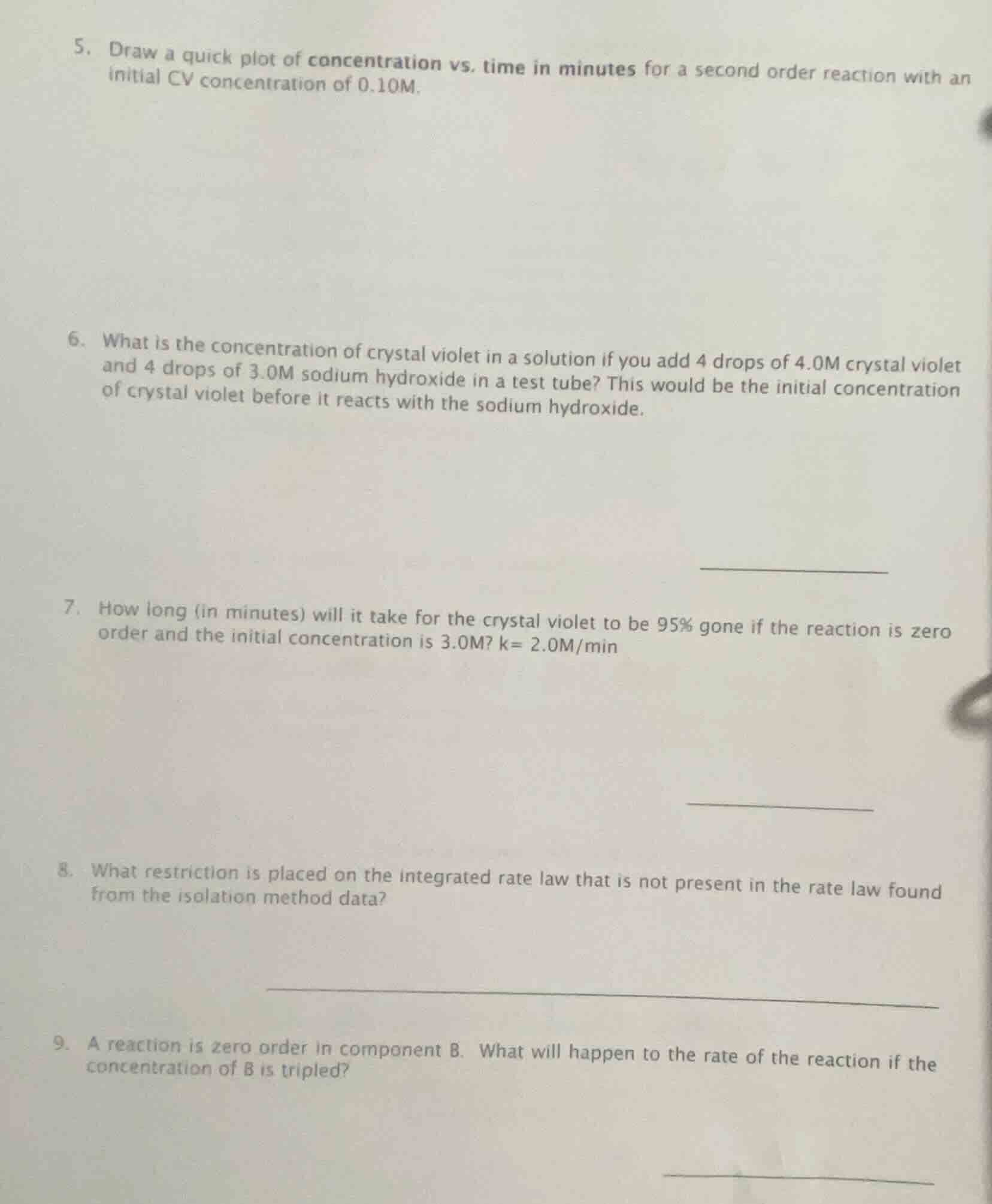
- draw a quick plot of concentration vs. time in minutes for a second order reaction with an initial cv concentration of 0.10m.
- what is the concentration of crystal violet in a solution if you add 4 drops of 4.0m crystal violet and 4 drops of 3.0m sodium hydroxide in a test tube? this would be the initial concentration of crystal violet before it reacts with the sodium hydroxide.
- how long (in minutes) will it take for the crystal violet to be 95% gone if the reaction is zero order and the initial concentration is 3.0m? k= 2.0m/min
- what restriction is placed on the integrated rate law that is not present in the rate law found from the isolation method data?
- a reaction is zero order in component b. what will happen to the rate of the reaction if the concentration of b is tripled?
Question 6
Step1: Define dilution principle
Use $C_1V_1 = C_2V_2$, assume 1 drop = $V$
Step2: Calculate total moles of CV
Moles = $4.0M \times 4V = 16V$
Step3: Calculate total volume
Total volume = $4V + 4V = 8V$
Step4: Solve for final concentration
$C_2 = \frac{16V}{8V} = 2.0M$
Question 7
Step1: Define zero-order integrated law
$[A]_t = [A]_0 - kt$
Step2: Find remaining concentration
95% gone → 5% left: $[A]_t = 0.05 \times 3.0M = 0.15M$
Step3: Rearrange for time $t$
$t = \frac{[A]_0 - [A]_t}{k}$
Step4: Substitute values
$t = \frac{3.0M - 0.15M}{2.0M/min} = 1.425$ min
Question 8
Step1: Identify key restriction
Integrated rate laws require the reaction conditions (temperature, catalyst presence, etc.) to remain constant for the entire duration of the reaction, while the isolation method only requires constant conditions during individual rate measurements.
Question 9
Step1: Recall zero-order rate dependence
For zero-order in B, rate law is $rate = k[A]^m[B]^0 = k[A]^m$
Step2: Analyze concentration change
Tripling $[B]$ has no effect on the rate, as $[B]^0 = 1$ regardless of concentration.

Snap & solve any problem in the app
Get step-by-step solutions on Sovi AI
Photo-based solutions with guided steps
Explore more problems and detailed explanations
- (Question 5 plot description): The plot of concentration vs. time for a second-order reaction will be a downward-curving hyperbola, starting at [CV] = 0.10 M at t=0, decreasing rapidly at first and approaching 0 M asymptotically as time increases.
- (Question 6): $\boldsymbol{2.0M}$
- (Question 7): $\boldsymbol{1.425}$ minutes
- (Question 8): The integrated rate law requires that reaction conditions (temperature, catalyst, etc.) remain constant for the entire time course of the reaction, a restriction not required for the rate law determined by the isolation method (which only needs constant conditions during individual rate trials).
- (Question 9): The reaction rate will remain unchanged; tripling the concentration of component B has no effect on the rate because the reaction is zero-order in B.