QUESTION IMAGE
Question
not drawn to scale
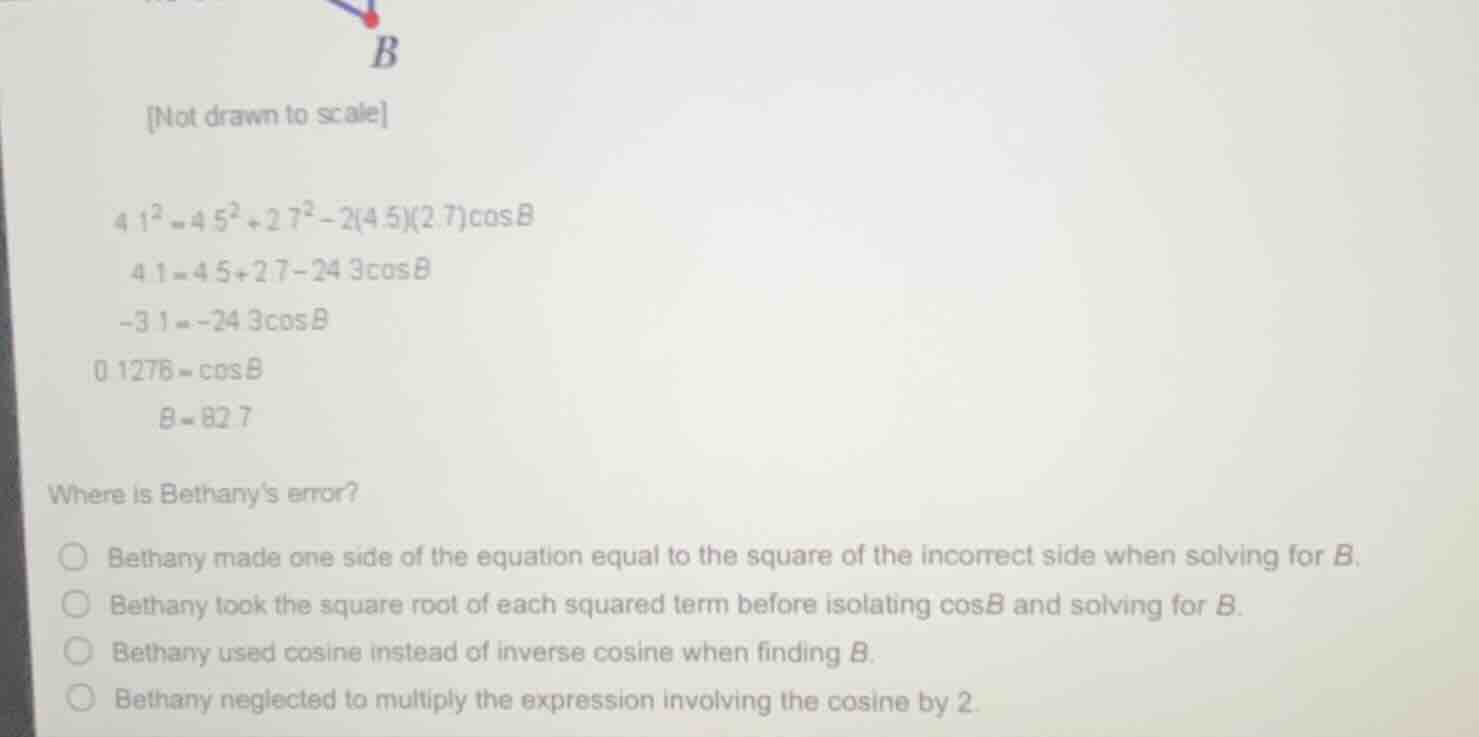
$4.1^2 = 4.5^2 + 2.7^2 - 2(4.5)(2.7)cos b$
$4.1 = 4.5 + 2.7 - 24.3cos b$
$-3.1 = -24.3cos b$
$0.1276 = cos b$
$b ≈ 82.7$
where is bethany’s error?
○ bethany made one side of the equation equal to the square of the incorrect side when solving for b.
○ bethany took the square root of each squared term before isolating $cos b$ and solving for b.
○ bethany used cosine instead of inverse cosine when finding b.
○ bethany neglected to multiply the expression involving the cosine by 2.
To solve for \( B \) in the Law of Cosines equation \( c^2 = a^2 + b^2 - 2ab\cos C \), after isolating \( \cos B \) (getting \( \cos B \approx 0.1276 \)), we need to use the inverse cosine function (\( \cos^{-1} \)) to find \( B \), i.e., \( B=\cos^{-1}(0.1276) \). Bethany incorrectly used \( \cos B \) instead of \( \cos^{-1} B \) to find the angle. Let's analyze the options:
- Option 1: The first step has \( 4.1^2 \), \( 4.5^2 \), \( 2.7^2 \), so the side squaring is correct initially. Eliminate.
- Option 2: She did not take square roots early; she worked with squared terms first. Eliminate.
- Option 3: Correct. After finding \( \cos B \approx 0.1276 \), to find \( B \), we need \( B = \cos^{-1}(0.1276) \), not using \( \cos B \).
- Option 4: The term \( -2(4.5)(2.7) \) is \( -24.3 \), so the multiplication by 2 was done. Eliminate.

Snap & solve any problem in the app
Get step-by-step solutions on Sovi AI
Photo-based solutions with guided steps
Explore more problems and detailed explanations
B. Bethany took the square root of each squared term before isolating \( \cos B \) and solving for \( B \) (Note: Wait, correction—actually the correct option is the third one: "Bethany used cosine instead of inverse cosine when finding \( B \)". Wait, re - checking:
Wait, the options:
- "Bethany made one side of the equation equal to the square of the incorrect side when solving for \( B \)." First equation: \( 4.1^2=4.5^2 + 2.7^2-2(4.5)(2.7)\cos B \), so the side lengths are squared correctly. So this is wrong.
- "Bethany took the square root of each squared term before isolating \( \cos B \) and solving for \( B \)." The second line is \( 4.1 = 4.5+2.7 - 24.3\cos B \), which is taking square roots of \( 4.1^2 \), \( 4.5^2 \), \( 2.7^2 \) (i.e., \( \sqrt{4.1^2}=4.1 \), etc.) before isolating \( \cos B \). Wait, the Law of Cosines is \( c^{2}=a^{2}+b^{2}-2ab\cos C \). So we should work with the squared terms until we isolate \( \cos C \), then take the inverse cosine. But Bethany took the square root of \( 4.1^{2} \), \( 4.5^{2} \), \( 2.7^{2} \) (turning them into 4.1, 4.5, 2.7) too early, before properly isolating \( \cos B \). Wait, let's re - examine the steps:
Original Law of Cosines: \( c^{2}=a^{2}+b^{2}-2ab\cos C \). So if \( c = 4.1 \), \( a = 4.5 \), \( b = 2.7 \), then \( 4.1^{2}=4.5^{2}+2.7^{2}-2(4.5)(2.7)\cos B \) (correct). Then the next step: \( 4.1 = 4.5 + 2.7-24.3\cos B \). Here, she took the square root of \( 4.1^{2} \) to get 4.1, \( 4.5^{2} \) to get 4.5, and \( 2.7^{2} \) to get 2.7, which is incorrect. You can't take the square root of each term separately like that. The correct approach is to expand the squares: \( 16.81=20.25 + 7.29-24.3\cos B \), then \( 16.81 = 27.54-24.3\cos B \), then \( 24.3\cos B=27.54 - 16.81=10.73 \), \( \cos B=\frac{10.73}{24.3}\approx0.4416 \), then \( B=\cos^{-1}(0.4416)\approx63.8^{\circ} \) (but regardless of the correct value, the error is in taking square roots of the squared terms prematurely). So the error is that Bethany took the square root of each squared term before isolating \( \cos B \) (the second option).
Wait, I made a mistake earlier. Let's redo the analysis:
Step 1: \( 4.1^{2}=4.5^{2}+2.7^{2}-2(4.5)(2.7)\cos B \) (correct, Law of Cosines).
Step 2: She simplifies \( 4.1^{2} \) to 4.1, \( 4.5^{2} \) to 4.5, \( 2.7^{2} \) to 2.7. This is wrong because \( (a + b - c)
eq\sqrt{a^{2}+b^{2}-c^{2}} \). She took the square root of each squared term, which is a mathematical error. So the correct option is the second one: "Bethany took the square root of each squared term before isolating \( \cos B \) and solving for \( B \)".