QUESTION IMAGE
Question
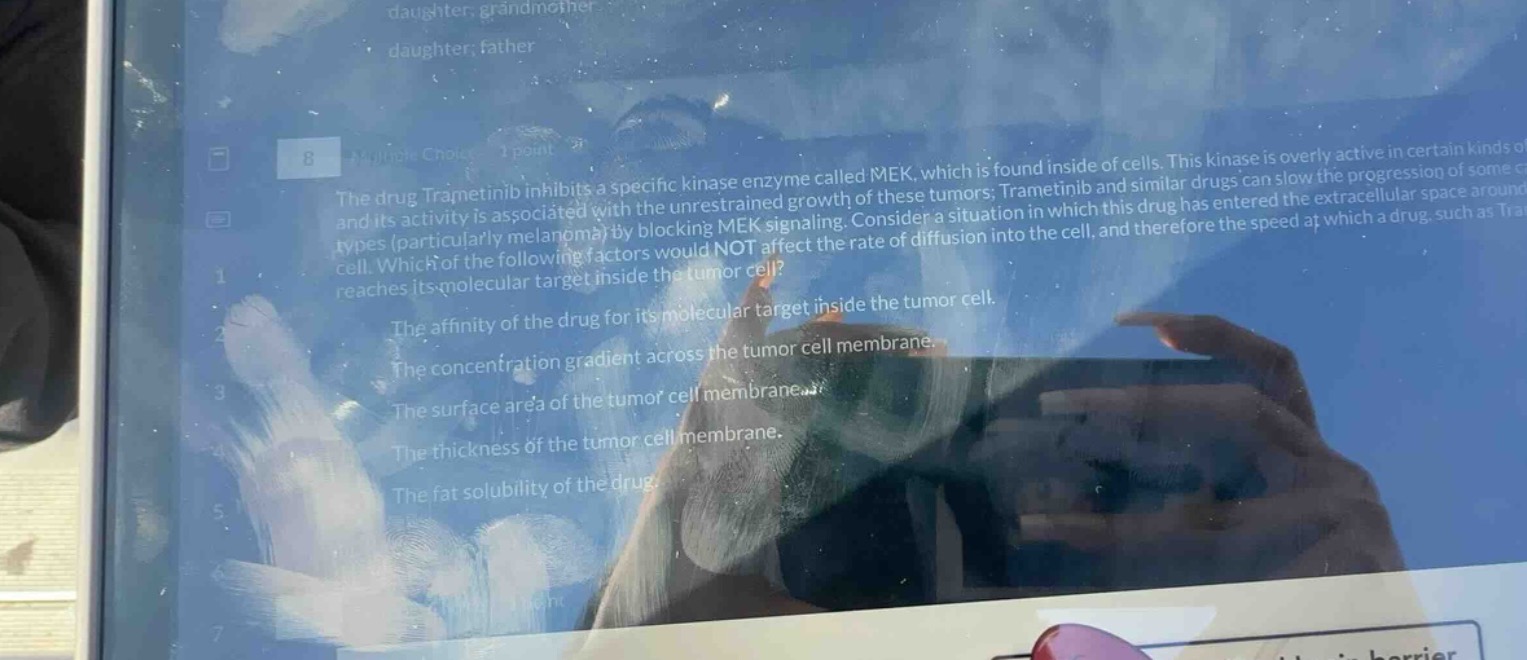
the drug trametinib inhibits a specific kinase enzyme called mek, which is found inside of cells. this kinase is overly active in certain kinds of and its activity is associated with the unrestrained growth of these tumors; trametinib and similar drugs can slow the progression of some c types (particularly melanoma) by blocking mek signaling. consider a situation in which this drug has entered the extracellular space around cell. which of the following factors would not affect the rate of diffusion into the cell, and therefore the speed at which a drug, such as tra reaches its molecular target inside the tumor cell? the affinity of the drug for its molecular target inside the tumor cell. the concentration gradient across the tumor cell membrane. the surface area of the tumor cell membrane. the thickness of the tumor cell membrane. the fat solubility of the drug.
To determine which factor does not affect the rate of diffusion of the drug into the tumor cell, we analyze each option based on the principles of diffusion (passive transport):
- Concentration gradient across the tumor cell membrane: A steeper concentration gradient (higher difference in drug concentration between extracellular and intracellular spaces) increases the rate of diffusion. So this affects diffusion rate.
- Surface area of the tumor cell membrane: Larger surface area provides more space for diffusion to occur, increasing the rate. So this affects diffusion rate.
- Thickness of the tumor cell membrane: Thicker membranes increase the distance the drug must travel, slowing diffusion. So this affects diffusion rate.
- Fat solubility of the drug: Fat - soluble (lipophilic) drugs can cross the lipid - bilayer cell membrane more easily, affecting diffusion rate (e.g., via simple diffusion).
- Affinity of the drug for its molecular target inside the tumor cell: Diffusion is the movement of the drug from the extracellular space to the intracellular space (driven by concentration gradients, membrane properties, etc.). The drug’s affinity for its target occurs after diffusion (once the drug is inside the cell and binds to the target). Affinity relates to binding, not the rate of diffusion across the membrane.

Snap & solve any problem in the app
Get step-by-step solutions on Sovi AI
Photo-based solutions with guided steps
Explore more problems and detailed explanations
The affinity of the drug for its molecular target inside the tumor cell.