QUESTION IMAGE
Question
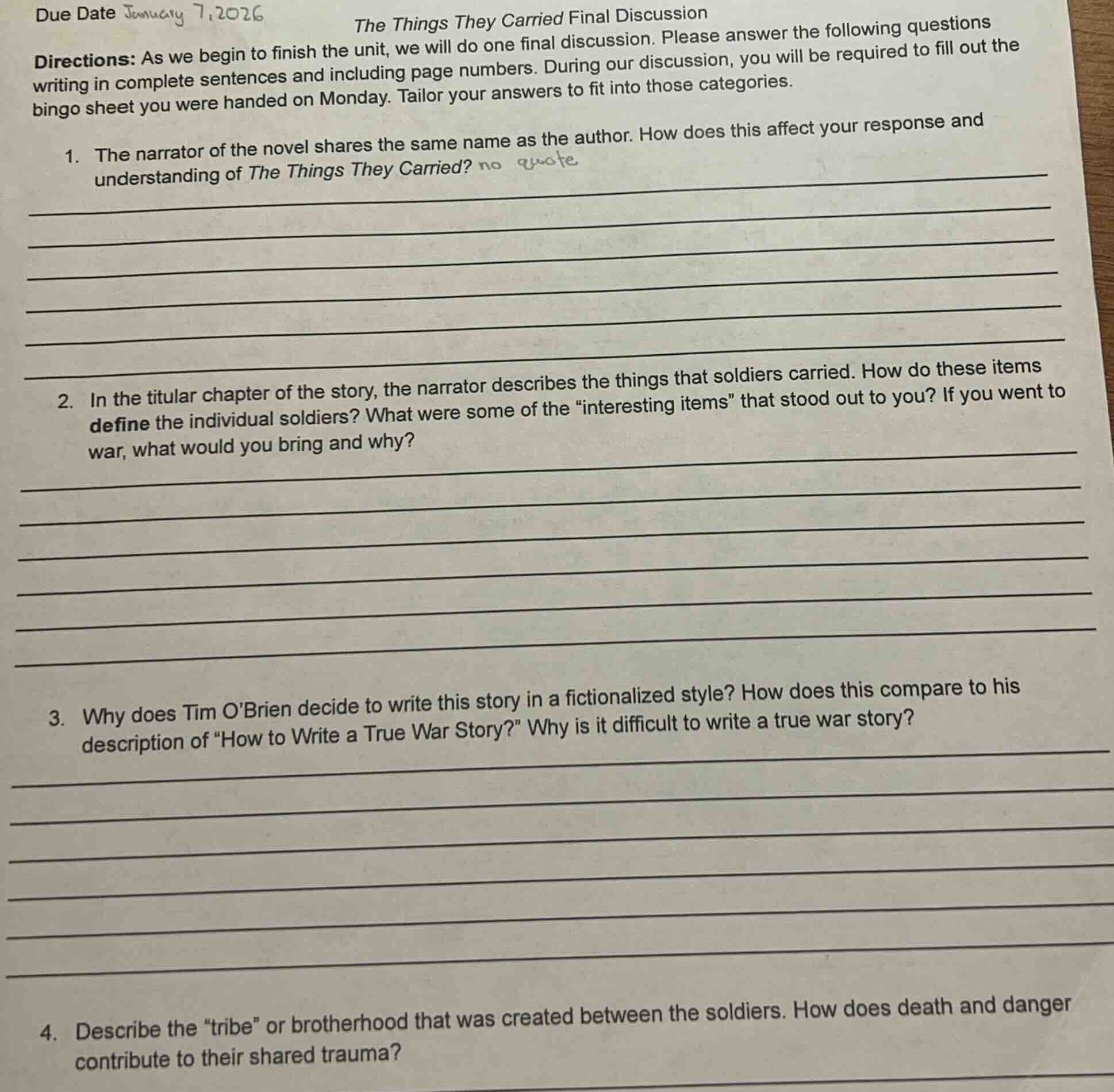
due date january 7, 2026
the things they carried final discussion
directions: as we begin to finish the unit, we will do one final discussion. please answer the following questions writing in complete sentences and including page numbers. during our discussion, you will be required to fill out the bingo sheet you were handed on monday. tailor your answers to fit into those categories.
- the narrator of the novel shares the same name as the author. how does this affect your response and understanding of the things they carried?
- in the titular chapter of the story, the narrator describes the things that soldiers carried. how do these items define the individual soldiers? what were some of the \interesting items\ that stood out to you? if you went to war, what would you bring and why?
- why does tim obrien decide to write this story in a fictionalized style? how does this compare to his description of \how to write a true war story?\ why is it difficult to write a true war story?
- describe the \tribe\ or brotherhood that was created between the soldiers. how does death and danger contribute to their shared trauma?
Question 1
When the narrator (Tim O'Brien) shares the author's name, it blurs the line between fiction and non - fiction. This makes readers feel a stronger sense of authenticity, as if the stories are more personal and real. It also makes us more inclined to believe the emotional and experiential aspects of the war narrative, as we associate the narrator's voice with the author's possible real - life perspectives on the Vietnam War. For example, when the narrator talks about the guilt of surviving or the weight of memories, we might interpret it as the author's own internal struggles, deepening our empathy and understanding of the psychological toll of war.
- Defining Soldiers: The items soldiers carry define them in multiple ways. Tangible items like weapons show their military role, while personal items (e.g., a letter from home, a photo) reveal their identities, relationships, and what they hold dear. For example, a soldier carrying a Bible might be seen as religious, and one with a girlfriend's picture as romantic or family - oriented.
- Interesting Items: Items like Norman Bowker's diary (showing his need to record thoughts), or Kiowa's religious items (reflecting his spirituality) stand out. These non - standard military items give depth to their characters.
- Personal Choice: If I went to war, I'd bring a small notebook and pen. The notebook would let me record my thoughts, feelings, and experiences to process the trauma and stay connected to my sense of self. The pen is for writing, and it's a lightweight, personal item that can also be used to communicate with others.
- Fictionalized Style Reason: Tim O'Brien uses a fictionalized style to capture the emotional truth of war. War is not just about facts but about the chaos, trauma, and subjective experiences. Fiction allows him to blend real events with imaginative retellings to convey the complexity of war, like the blurred lines between memory and reality.
- Comparison to "How to Write a True War Story": In "How to Write a True War Story", he says a true war story is not about heroism but about the darkness and moral confusion. The fictionalized style aligns with this, as it doesn't present a clear - cut, factual account but instead focuses on the emotional and moral ambiguities, showing that truth in war is more about feeling than facts.
- Difficulty of True War Story: It's difficult to write a true war story because war is chaotic, with multiple perspectives and conflicting truths. Also, the trauma of war makes it hard to recall events accurately, and the emotional impact distorts memory. Moreover, the moral complexity (no clear good/evil) is hard to capture in a straightforward, factual narrative.

Snap & solve any problem in the app
Get step-by-step solutions on Sovi AI
Photo-based solutions with guided steps
Explore more problems and detailed explanations
The narrator sharing the author's name blurs fiction - non - fiction lines, enhancing authenticity and making the war's emotional/experiential aspects feel more personal, deepening empathy for the psychological toll of war.