QUESTION IMAGE
Question
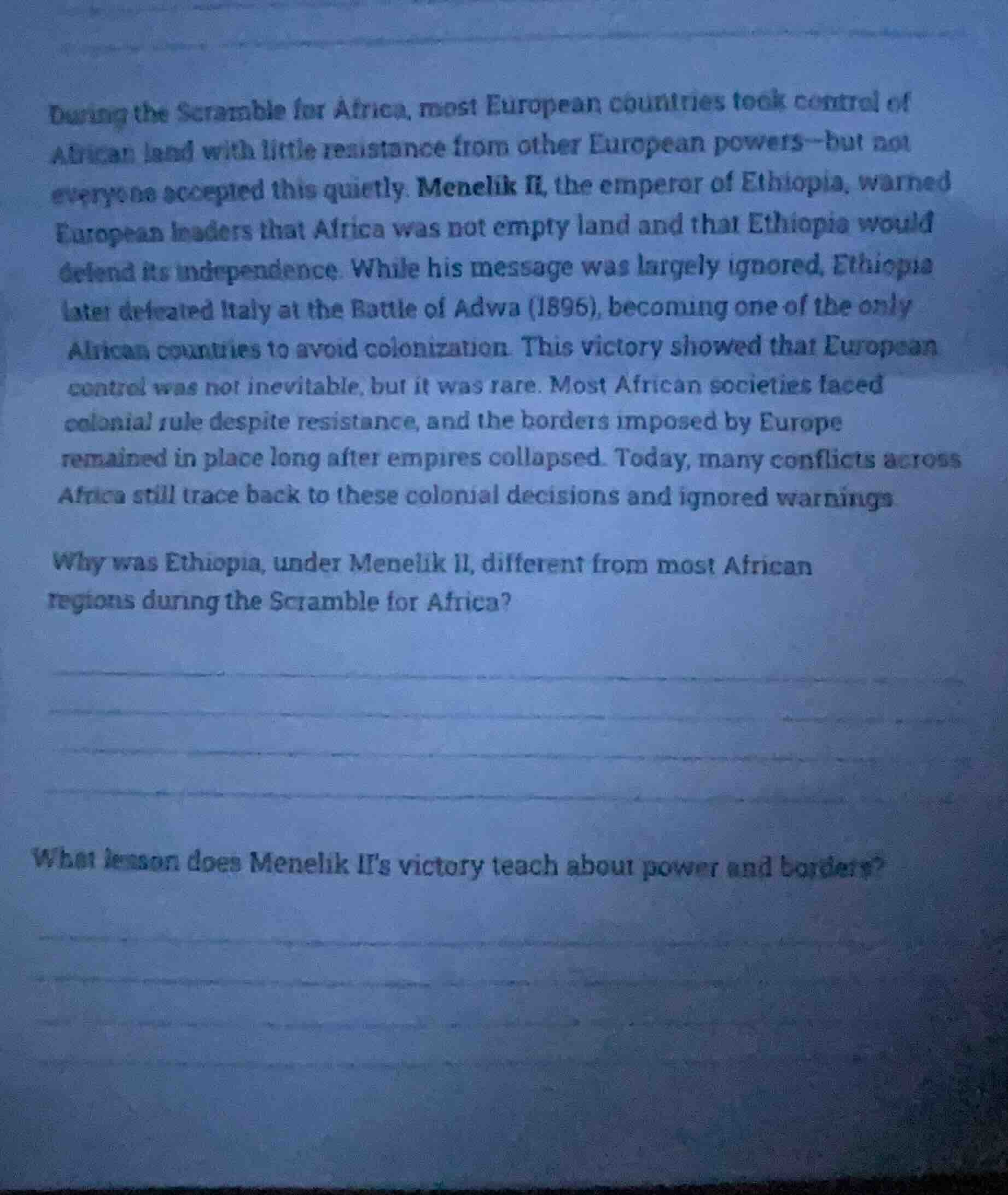
during the scramble for africa, most european countries took control of african land with little resistance from other european powers—but not everyone accepted this quietly. menelik ii, the emperor of ethiopia, warned european leaders that africa was not empty land and that ethiopia would defend its independence. while his message was largely ignored, ethiopia later defeated italy at the battle of adwa (1896), becoming one of the only african countries to avoid colonization. this victory showed that european control was not inevitable, but it was rare. most african societies faced colonial rule despite resistance, and the borders imposed by europe remained in place long after empires collapsed. today, many conflicts across africa still trace back to these colonial decisions and ignored warnings
why was ethiopia, under menelik ii, different from most african regions during the scramble for africa?
what lesson does menelik ii’s victory teach about power and borders?
For the first question: Ethiopia, under Menelik II, actively warned European powers of its intent to defend independence, then defeated Italy at the 1896 Battle of Adva, making it one of the few African nations to avoid full European colonization, unlike most African regions that fell under colonial rule despite resistance.
For the second question: Menelik II's victory shows that European colonial power was not inevitable; organized resistance can challenge dominant powers. It also illustrates that externally imposed borders (like those from European colonialism) are not permanent or inherently legitimate, and ignored warnings about self-determination can lead to long-term regional conflicts.

Snap & solve any problem in the app
Get step-by-step solutions on Sovi AI
Photo-based solutions with guided steps
Explore more problems and detailed explanations
- Ethiopia, under Menelik II, was different because it successfully resisted European colonization: Menelik II warned European leaders that Ethiopia would defend its independence, and Ethiopia defeated Italy at the Battle of Adva (1896), becoming one of the only African countries to avoid colonial rule, while most African societies were subjected to colonial control despite their resistance.
- Menelik II's victory teaches two key lessons: First, dominant power (like European colonial power) is not inevitable, as organized resistance can successfully challenge it. Second, externally imposed borders (such as those created by European colonial powers) lack inherent legitimacy, and ignoring calls for self-determination can lead to long-term regional conflicts that persist even after colonial empires collapse.