QUESTION IMAGE
Question
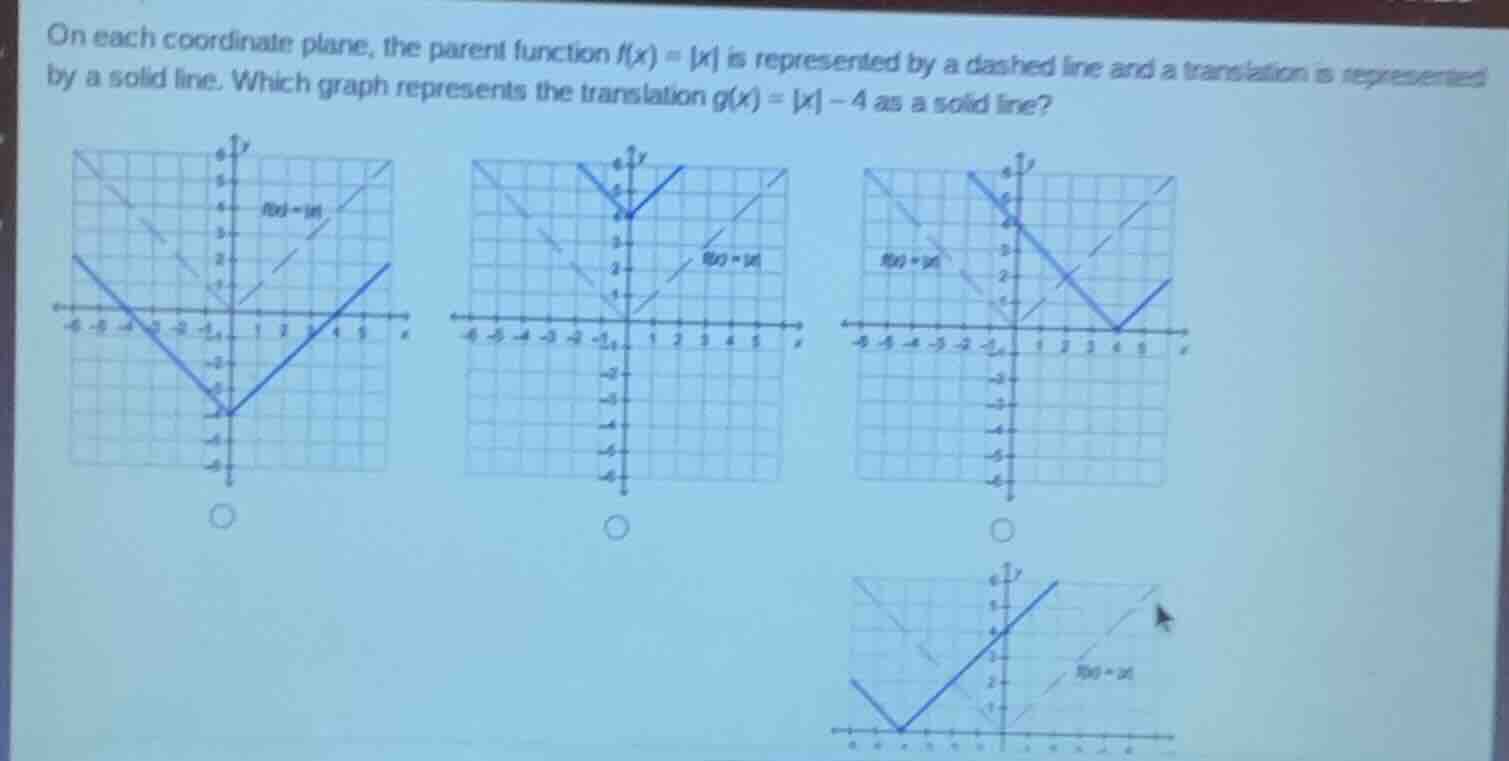
on each coordinate plane, the parent function f(x) = |x| is represented by a dashed line and a translation is represented by a solid line. which graph represents the translation g(x) = |x| - 4 as a solid line?
Step1: Recall transformation of absolute value function
The parent function is \( f(x) = |x| \), which has its vertex at \( (0, 0) \). The function \( g(x)=|x| - 4 \) is a vertical translation of the parent function. For a function \( y = f(x)+k \), if \( k<0 \), the graph shifts down by \( |k| \) units. Here, \( k=- 4 \), so the graph of \( g(x) \) is the graph of \( f(x)=|x| \) shifted down 4 units. So the vertex of \( g(x) \) should be at \( (0,-4) \).
Step2: Analyze each graph
- First graph: The solid line (translation) has its vertex at \( (0, - 4) \), which matches the vertical shift of 4 units down from the parent function \( f(x)=|x| \) (dashed line with vertex at \( (0,0) \)).
- Second graph: The solid line has its vertex at \( (0,4) \), which is a shift up, not down.
- Third graph: The solid line has its vertex at \( (4,0) \), which is a horizontal shift, not vertical.
- Fourth graph: The solid line has a different vertex position (not at \( (0,-4) \)) and slope behavior, so it does not match.

Snap & solve any problem in the app
Get step-by-step solutions on Sovi AI
Photo-based solutions with guided steps
Explore more problems and detailed explanations
The first graph (the one with the solid line vertex at (0, - 4))