QUESTION IMAGE
Question
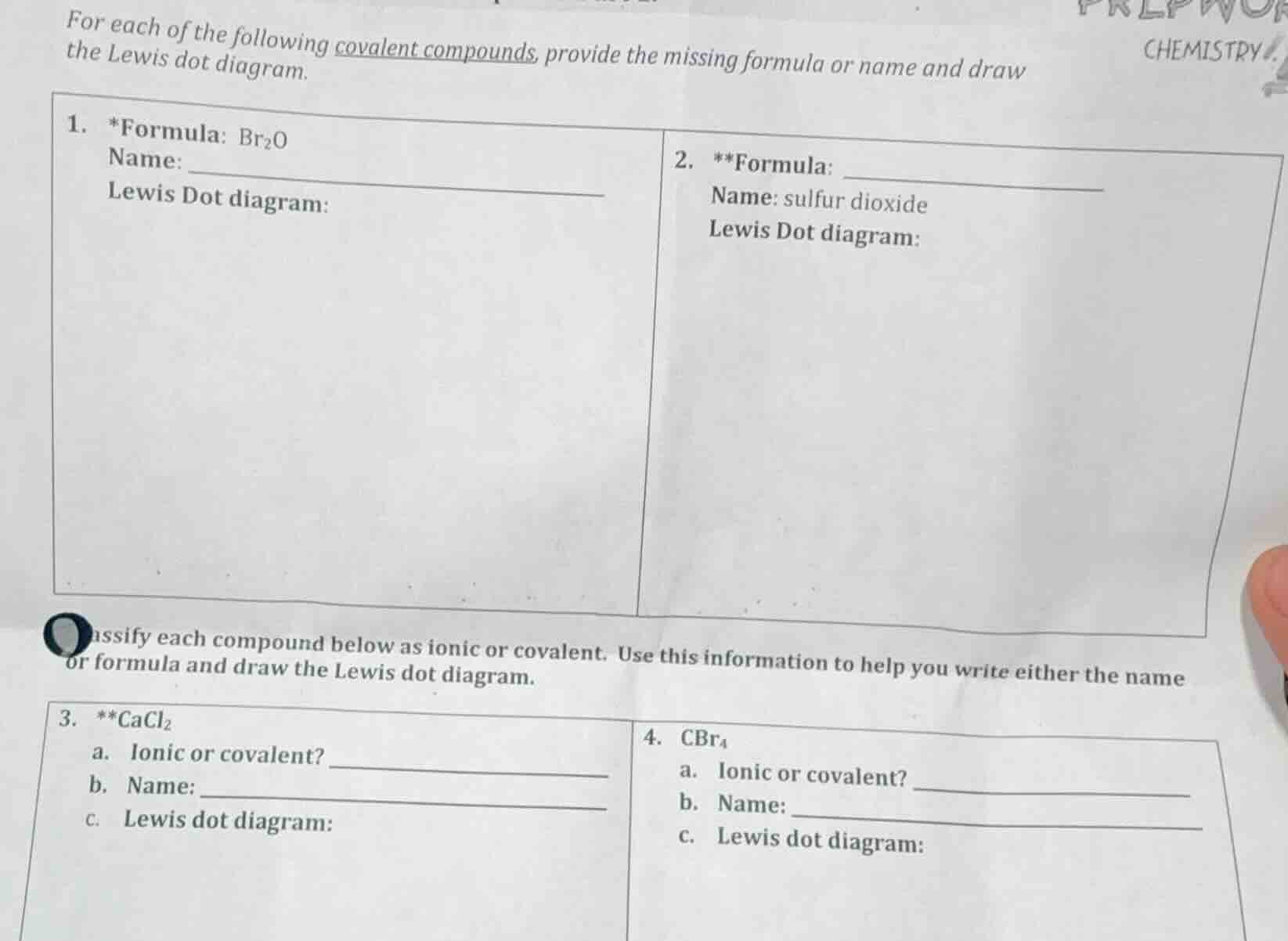
for each of the following covalent compounds, provide the missing formula or name and draw the lewis dot diagram.
- *formula: br₂o
name:
lewis dot diagram:
- **formula:
name: sulfur dioxide
lewis dot diagram:
classify each compound below as ionic or covalent. use this information to help you write either the name or formula and draw the lewis dot diagram.
- **cacl₂
a. ionic or covalent?
b. name:
c. lewis dot diagram:
- cbr₄
a. ionic or covalent?
b. name:
c. lewis dot diagram:
Problem 1:
Step1: Identify elements and prefixes
The formula is \( \text{Br}_2\text{O} \). The element \( \text{Br} \) is bromine, and there are 2 bromine atoms (so prefix "di-"), and \( \text{O} \) is oxygen (prefix "mono-" but often omitted for the second element in covalent naming).
Step2: Name the compound
Using covalent compound naming rules, the name is dibromine monoxide.
Step3: Draw Lewis Dot diagram
- Bromine (Br) has 7 valence electrons, oxygen (O) has 6.
- The structure: O is the central atom (less electronegative? Wait, O is more electronegative than Br? Wait, actually, in \( \text{Br}_2\text{O} \), the structure is Br - O - Br. Each Br has 3 lone pairs, O has 2 lone pairs. So the Lewis dot diagram: Br (with 3 lone pairs) - O (with 2 lone pairs) - Br (with 3 lone pairs). The bonding pairs: each Br - O is a single bond (2 electrons).
Step1: Identify elements and subscripts
Name is sulfur dioxide. Sulfur is S, dioxide means 2 oxygen atoms (O).
Step2: Write the formula
So the formula is \( \text{SO}_2 \).
Step3: Draw Lewis Dot diagram
- Sulfur (S) has 6 valence electrons, oxygen (O) has 6.
- S is central, bonded to two O atoms. S has a double bond with one O and a single bond with the other? Wait, formal charge: S has 6 valence, in \( \text{SO}_2 \), the structure is O=S=O (double bonds), with S having a lone pair? Wait, no: total valence electrons: 6 (S) + 2*6 (O) = 18.
- Arrange: S in center, two O atoms. Each O - S bond: let's calculate. If we do two double bonds: S=O=O? No, O=S=O. Each double bond is 4 electrons, so two double bonds (8 electrons) + lone pairs: S has 1 lone pair (2 electrons), each O has 2 lone pairs (4 electrons each). Wait, total: 2 (S lone) + 2*4 (O lone) + 8 (bonding) = 2 + 8 + 8 = 18, which matches. So Lewis dot diagram: O (::)=S( : )=O (::), where S has a lone pair (2 electrons), each O has 2 lone pairs (4 electrons), and double bonds (4 electrons each) between S and O.
Step1: Identify bond type
\( \text{CaCl}_2 \): Ca is a metal (calcium), Cl is a nonmetal (chlorine). Ionic compounds form between metals and nonmetals (transfer of electrons).
Step2: Classify
So it's ionic.
Part b:

Snap & solve any problem in the app
Get step-by-step solutions on Sovi AI
Photo-based solutions with guided steps
Explore more problems and detailed explanations
Name: dibromine monoxide
Lewis Dot diagram: Br (:::Br) - O (::) - Br (:::Br) (where : represent lone pairs, and - is a single bond; each Br has 3 lone pairs (6 electrons) and O has 2 lone pairs (4 electrons), and 2 bonding pairs (1 between each Br and O))