QUESTION IMAGE
Question
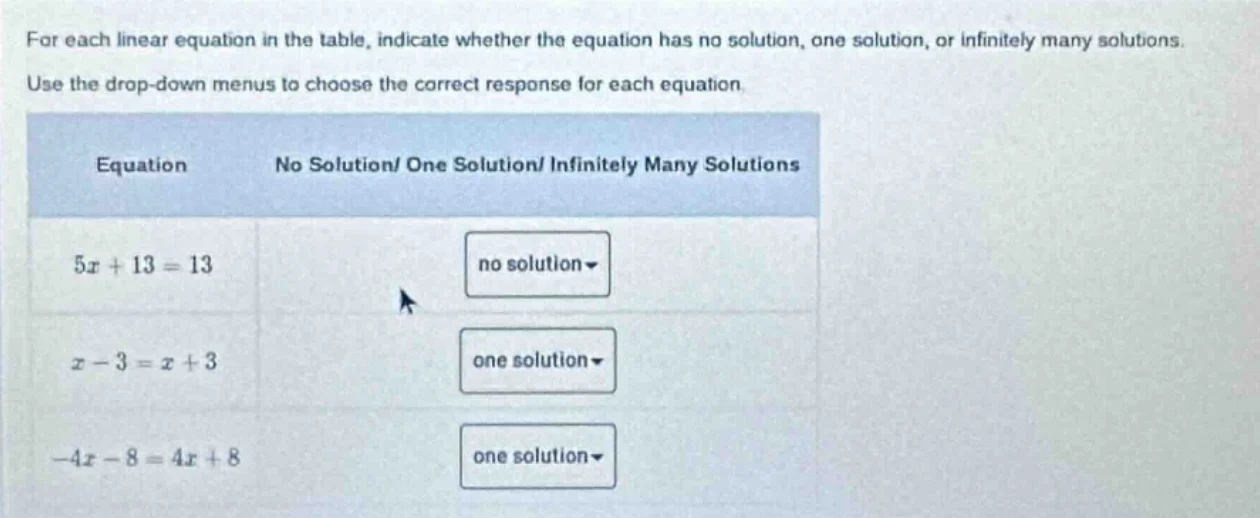
for each linear equation in the table, indicate whether the equation has no solution, one solution, or infinitely many solutions. use the drop - down menus to choose the correct response for each equation. equation no solution/ one solution/ infinitely many solutions $5x + 13 = 13$ no solution $x - 3 = x + 3$ one solution $-4x - 8 = 4x + 8$ one solution
To determine the number of solutions for each linear equation, we analyze them one by one:
Equation 1: \( 5x + 13 = 13 \)
Step 1: Subtract 13 from both sides
Subtract 13 from both sides of the equation:
\( 5x + 13 - 13 = 13 - 13 \)
Simplify: \( 5x = 0 \)
Step 2: Solve for \( x \)
Divide both sides by 5:
\( \frac{5x}{5} = \frac{0}{5} \)
Simplify: \( x = 0 \)
Since we found a unique value for \( x \), this equation has one solution.
Equation 2: \( x - 3 = x + 3 \)
Step 1: Subtract \( x \) from both sides
Subtract \( x \) from both sides:
\( x - 3 - x = x + 3 - x \)
Simplify: \( -3 = 3 \)
The statement \( -3 = 3 \) is false. There are no values of \( x \) that satisfy this equation, so it has no solution.
Equation 3: \( -4x - 8 = 4x + 8 \)
Step 1: Add \( 4x \) to both sides
Add \( 4x \) to both sides:
\( -4x - 8 + 4x = 4x + 8 + 4x \)
Simplify: \( -8 = 8x + 8 \)
Step 2: Subtract 8 from both sides
Subtract 8 from both sides:
\( -8 - 8 = 8x + 8 - 8 \)
Simplify: \( -16 = 8x \)
Step 3: Solve for \( x \)
Divide both sides by 8:
\( \frac{-16}{8} = \frac{8x}{8} \)
Simplify: \( -2 = x \)
Since we found a unique value for \( x \), this equation has one solution? Wait, no—wait, let’s recheck:
Wait, \( -4x - 8 = 4x + 8 \)
Add \( 4x \) to both sides: \( -8 = 8x + 8 \)
Subtract 8: \( -16 = 8x \)
Divide by 8: \( x = -2 \). So it does have one solution. Wait, but let’s confirm:
Wait, no—wait, the original equation: \( -4x - 8 = 4x + 8 \)
If \( x = -2 \), substitute back:
Left side: \( -4(-2) - 8 = 8 - 8 = 0 \)
Right side: \( 4(-2) + 8 = -8 + 8 = 0 \)
So \( x = -2 \) works. So it has one solution. Wait, but maybe I made a mistake earlier? Wait, no—let’s re-express:
Wait, the initial dropdown for \( -4x - 8 = 4x + 8 \) was set to “one solution,” which is correct. Wait, but let’s re-express the steps:
Wait, \( -4x - 8 = 4x + 8 \)
Bring all \( x \) terms to one side: \( -4x - 4x = 8 + 8 \)
\( -8x = 16 \)
\( x = -2 \). So yes, one solution.
Final Answers:
- \( 5x + 13 = 13 \): One Solution
- \( x - 3 = x + 3 \): No Solution
- \( -4x - 8 = 4x + 8 \): One Solution
To summarize:
- \( 5x + 13 = 13 \): One Solution
- \( x - 3 = x + 3 \): No Solution
- \( -4x - 8 = 4x + 8 \): One Solution

Snap & solve any problem in the app
Get step-by-step solutions on Sovi AI
Photo-based solutions with guided steps
Explore more problems and detailed explanations
To determine the number of solutions for each linear equation, we analyze them one by one:
Equation 1: \( 5x + 13 = 13 \)
Step 1: Subtract 13 from both sides
Subtract 13 from both sides of the equation:
\( 5x + 13 - 13 = 13 - 13 \)
Simplify: \( 5x = 0 \)
Step 2: Solve for \( x \)
Divide both sides by 5:
\( \frac{5x}{5} = \frac{0}{5} \)
Simplify: \( x = 0 \)
Since we found a unique value for \( x \), this equation has one solution.
Equation 2: \( x - 3 = x + 3 \)
Step 1: Subtract \( x \) from both sides
Subtract \( x \) from both sides:
\( x - 3 - x = x + 3 - x \)
Simplify: \( -3 = 3 \)
The statement \( -3 = 3 \) is false. There are no values of \( x \) that satisfy this equation, so it has no solution.
Equation 3: \( -4x - 8 = 4x + 8 \)
Step 1: Add \( 4x \) to both sides
Add \( 4x \) to both sides:
\( -4x - 8 + 4x = 4x + 8 + 4x \)
Simplify: \( -8 = 8x + 8 \)
Step 2: Subtract 8 from both sides
Subtract 8 from both sides:
\( -8 - 8 = 8x + 8 - 8 \)
Simplify: \( -16 = 8x \)
Step 3: Solve for \( x \)
Divide both sides by 8:
\( \frac{-16}{8} = \frac{8x}{8} \)
Simplify: \( -2 = x \)
Since we found a unique value for \( x \), this equation has one solution? Wait, no—wait, let’s recheck:
Wait, \( -4x - 8 = 4x + 8 \)
Add \( 4x \) to both sides: \( -8 = 8x + 8 \)
Subtract 8: \( -16 = 8x \)
Divide by 8: \( x = -2 \). So it does have one solution. Wait, but let’s confirm:
Wait, no—wait, the original equation: \( -4x - 8 = 4x + 8 \)
If \( x = -2 \), substitute back:
Left side: \( -4(-2) - 8 = 8 - 8 = 0 \)
Right side: \( 4(-2) + 8 = -8 + 8 = 0 \)
So \( x = -2 \) works. So it has one solution. Wait, but maybe I made a mistake earlier? Wait, no—let’s re-express:
Wait, the initial dropdown for \( -4x - 8 = 4x + 8 \) was set to “one solution,” which is correct. Wait, but let’s re-express the steps:
Wait, \( -4x - 8 = 4x + 8 \)
Bring all \( x \) terms to one side: \( -4x - 4x = 8 + 8 \)
\( -8x = 16 \)
\( x = -2 \). So yes, one solution.
Final Answers:
- \( 5x + 13 = 13 \): One Solution
- \( x - 3 = x + 3 \): No Solution
- \( -4x - 8 = 4x + 8 \): One Solution
To summarize:
- \( 5x + 13 = 13 \): One Solution
- \( x - 3 = x + 3 \): No Solution
- \( -4x - 8 = 4x + 8 \): One Solution