QUESTION IMAGE
Question
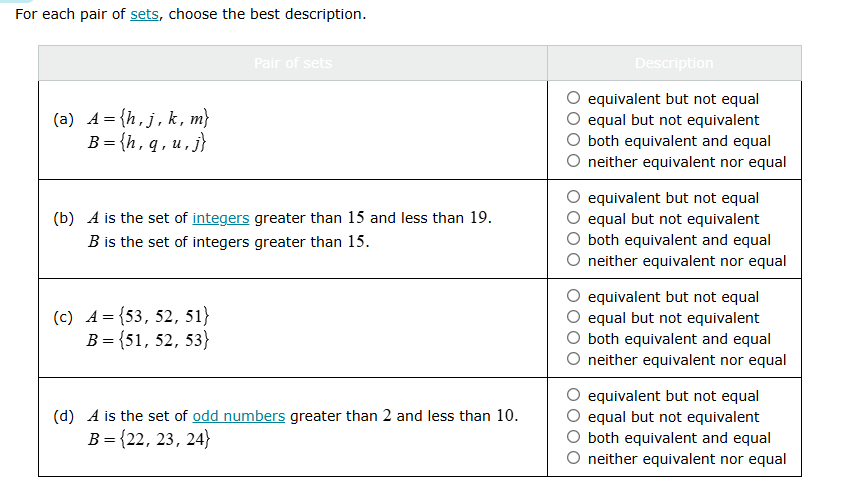
for each pair of sets, choose the best description.
pair of sets\tdescription
(a) $a = \\{h, j, k, m\\}$
$b = \\{h, q, u, j\\}$
\t$\bigcirc$ equivalent but not equal
\t$\bigcirc$ equal but not equivalent
\t$\bigcirc$ both equivalent and equal
\t$\bigcirc$ neither equivalent nor equal
(b) $a$ is the set of integers greater than 15 and less than 19.
$b$ is the set of integers greater than 15.
\t$\bigcirc$ equivalent but not equal
\t$\bigcirc$ equal but not equivalent
\t$\bigcirc$ both equivalent and equal
\t$\bigcirc$ neither equivalent nor equal
(c) $a = \\{53, 52, 51\\}$
$b = \\{51, 52, 53\\}$
\t$\bigcirc$ equivalent but not equal
\t$\bigcirc$ equal but not equivalent
\t$\bigcirc$ both equivalent and equal
\t$\bigcirc$ neither equivalent nor equal
(d) $a$ is the set of odd numbers greater than 2 and less than 10.
$b = \\{22, 23, 24\\}$
\t$\bigcirc$ equivalent but not equal
\t$\bigcirc$ equal but not equivalent
\t$\bigcirc$ both equivalent and equal
\t$\bigcirc$ neither equivalent nor equal
Step1: Define key terms
- Equal sets: Same elements (order doesn't matter).
- Equivalent sets: Same number of elements (cardinality).
Step2: Analyze pair (a)
Count elements: $n(A)=4$, $n(B)=4$ (equivalent).
Elements differ ($k,m
eq q,u$) (not equal).
Conclusion: equivalent but not equal.
Step3: Analyze pair (b)
Set $A=\{16,17,18\}$ ($n(A)=3$).
Set $B=\{16,17,18,...\}$ (infinite, $n(B)
eq3$).
Conclusion: neither equivalent nor equal.
Step4: Analyze pair (c)
Sets have identical elements (order doesn't matter, so equal).
Equal sets are always equivalent.
Conclusion: both equivalent and equal.
Step5: Analyze pair (d)
Set $A=\{3,5,7,9\}$ ($n(A)=4$).
Set $B=\{22,23,24\}$ ($n(B)=3$) (not equivalent).
Elements are entirely different (not equal).
Conclusion: neither equivalent nor equal.

Snap & solve any problem in the app
Get step-by-step solutions on Sovi AI
Photo-based solutions with guided steps
Explore more problems and detailed explanations
(a) equivalent but not equal
(b) neither equivalent nor equal
(c) both equivalent and equal
(d) neither equivalent nor equal