QUESTION IMAGE
Question
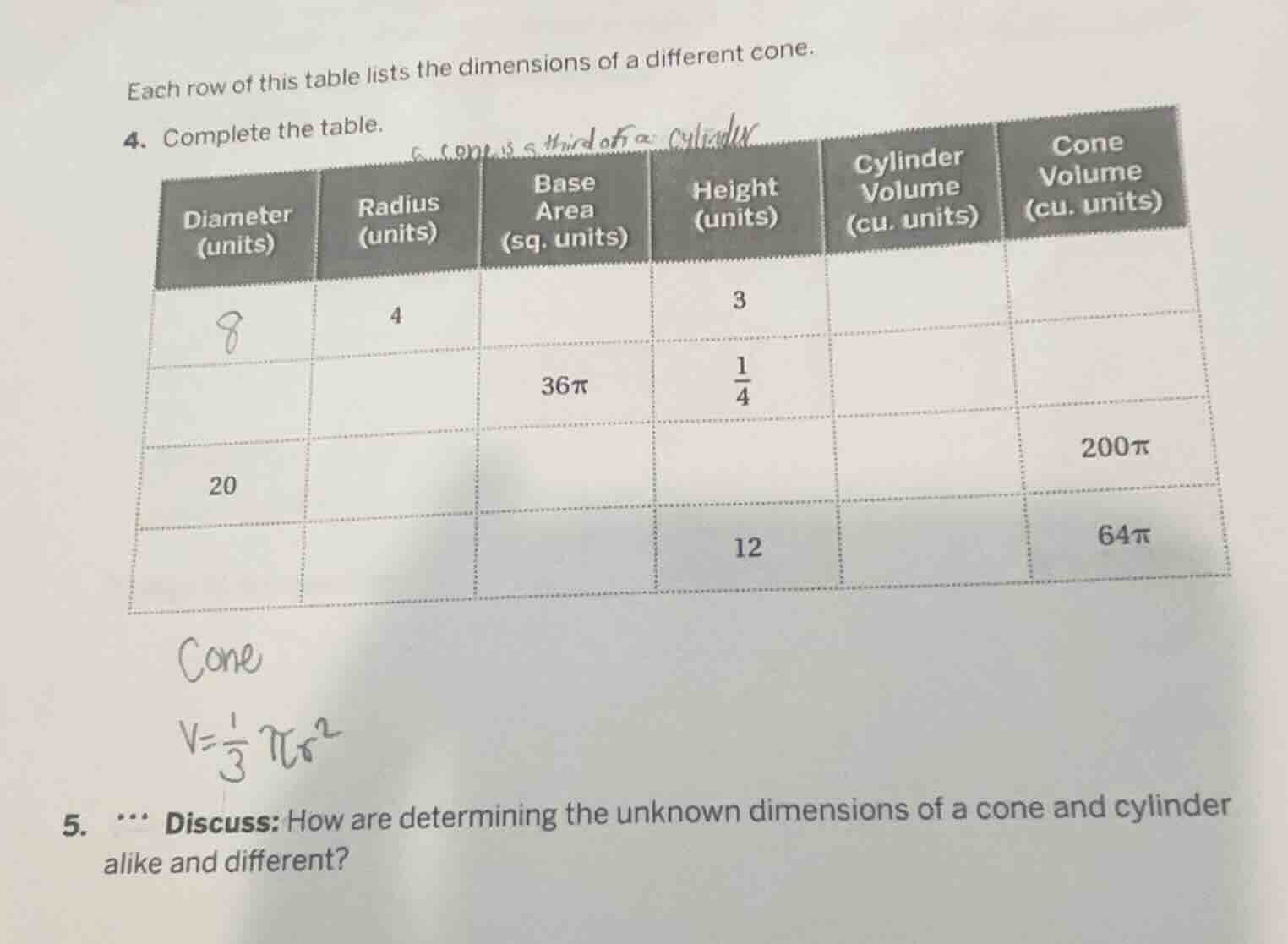
each row of this table lists the dimensions of a different cone.
- complete the table.
$v=\frac{1}{3}\pi r^{2}$
- discuss: how are determining the unknown dimensions of a cone and cylinder alike and different?
For Question 4 (Completing the Table)
Row 1
Step1: Calculate base area
Base area of a circle: $\pi r^2$
$\pi (4)^2 = 16\pi$
Step2: Calculate cylinder volume
Cylinder volume: $\pi r^2 h$
$16\pi \times 3 = 48\pi$
Step3: Calculate cone volume
Cone volume: $\frac{1}{3}\pi r^2 h$
$\frac{1}{3} \times 48\pi = 16\pi$
Row 2
Step1: Find radius from base area
Base area $\pi r^2 = 36\pi$, so $r^2=36$, $r=6$
Step2: Calculate diameter
Diameter = $2r$
$2\times6=12$
Step3: Calculate cylinder volume
Cylinder volume: $\pi r^2 h$
$36\pi \times \frac{1}{4} = 9\pi$
Step4: Calculate cone volume
Cone volume: $\frac{1}{3}\pi r^2 h$
$\frac{1}{3} \times 9\pi = 3\pi$
Row 3
Step1: Find radius from diameter
Radius $r=\frac{\text{Diameter}}{2}$
$\frac{20}{2}=10$
Step2: Calculate base area
Base area: $\pi r^2$
$\pi (10)^2=100\pi$
Step3: Find height from cone volume
Cone volume $V=\frac{1}{3}\pi r^2 h$, solve for $h$:
$h=\frac{3V}{\pi r^2} = \frac{3\times200\pi}{100\pi}=6$
Step4: Calculate cylinder volume
Cylinder volume: $\pi r^2 h$
$100\pi \times6=600\pi$
Row 4
Step1: Find base area from cone volume
Cone volume $V=\frac{1}{3}Bh$, solve for $B$ (base area):
$B=\frac{3V}{h}=\frac{3\times64\pi}{12}=16\pi$
Step2: Find radius from base area
$\pi r^2=16\pi$, so $r^2=16$, $r=4$
Step3: Calculate diameter
Diameter = $2r$
$2\times4=8$
Step4: Calculate cylinder volume
Cylinder volume: $Bh$
$16\pi \times12=192\pi$
- Alike: Both cones and cylinders use the same base area formula ($\pi r^2$) for circular bases, and you rearrange volume formulas to solve for unknown dimensions (radius, height, base area). Both rely on the relationship between linear dimensions (radius/diameter) and area/volume.
- Different: The volume formulas differ: cylinder volume is $V=\pi r^2 h$, while cone volume is $V=\frac{1}{3}\pi r^2 h$, so solving for unknowns requires accounting for the $\frac{1}{3}$ factor for cones. When given volume, cones will have a different height/radius relationship than a cylinder with the same base and volume.

Snap & solve any problem in the app
Get step-by-step solutions on Sovi AI
Photo-based solutions with guided steps
Explore more problems and detailed explanations
| Diameter (units) | Radius (units) | Base Area (sq. units) | Height (units) | Cylinder Volume (cu. units) | Cone Volume (cu. units) |
|---|---|---|---|---|---|
| 12 | 6 | $36\pi$ | $\frac{1}{4}$ | $9\pi$ | $3\pi$ |
| 20 | 10 | $100\pi$ | 6 | $600\pi$ | $200\pi$ |
| 8 | 4 | $16\pi$ | 12 | $192\pi$ | $64\pi$ |
---