QUESTION IMAGE
Question
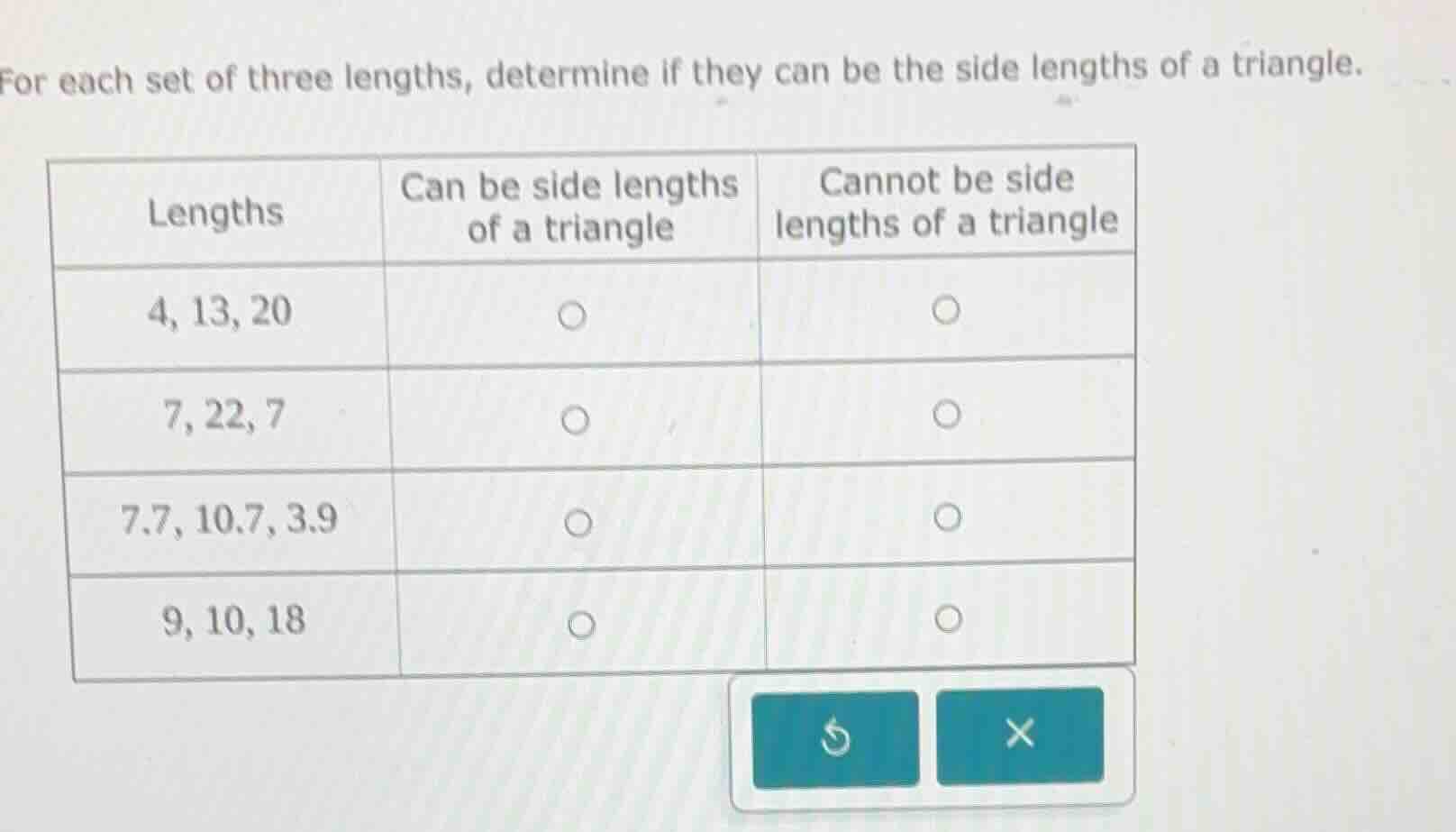
for each set of three lengths, determine if they can be the side lengths of a triangle.
lengths\tcan be side lengths of a triangle\tcannot be side lengths of a triangle
4, 13, 20\t○\t○
7, 22, 7\t○\t○
7.7, 10.7, 3.9\t○\t○
9, 10, 18\t○\t○
To determine if three lengths can form a triangle, we use the triangle inequality theorem, which states that the sum of the lengths of any two sides must be greater than the length of the remaining side.
Step 1: Analyze 4, 13, 20
Check the sums:
- \(4 + 13 = 17\), and \(17 < 20\). So, these lengths cannot form a triangle.
Step 2: Analyze 7, 22, 7
Check the sums:
- \(7 + 7 = 14\), and \(14 < 22\). So, these lengths cannot form a triangle.
Step 3: Analyze 7.7, 10.7, 3.9
Check the sums:
- \(7.7 + 3.9 = 11.6\), and \(11.6 > 10.7\)
- \(7.7 + 10.7 = 18.4\), and \(18.4 > 3.9\)
- \(10.7 + 3.9 = 14.6\), and \(14.6 > 7.7\)
So, these lengths can form a triangle.
Step 4: Analyze 9, 10, 18
Check the sums:
- \(9 + 10 = 19\), and \(19 > 18\)
- \(9 + 18 = 27\), and \(27 > 10\)
- \(10 + 18 = 28\), and \(28 > 9\)
So, these lengths can form a triangle.

Snap & solve any problem in the app
Get step-by-step solutions on Sovi AI
Photo-based solutions with guided steps
Explore more problems and detailed explanations
| Lengths | Can be side lengths of a triangle | Cannot be side lengths of a triangle |
|---|---|---|
| 7, 22, 7 | ○ (No) | ○ (Yes) |
| 7.7, 10.7, 3.9 | ○ (Yes) | ○ (No) |
| 9, 10, 18 | ○ (Yes) | ○ (No) |
(Note: For each row, mark the appropriate column with a filled circle (e.g., if it can be a triangle, fill the "Can be..." column, else fill the "Cannot be..." column))