QUESTION IMAGE
Question
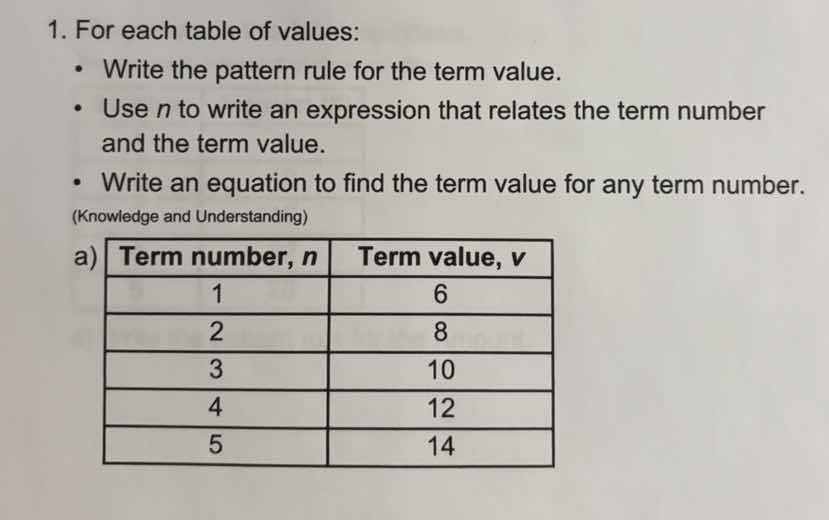
- for each table of values: • write the pattern rule for the term value. • use n to write an expression that relates the term number and the term value. • write an equation to find the term value for any term number. (knowledge and understanding) a) term number, n term value, v 1 6 2 8 3 10 4 12 5 14
Step1: Analyze the difference between term values
Looking at the term values: 6, 8, 10, 12, 14. The difference between consecutive term values is \(8 - 6=2\), \(10 - 8 = 2\), etc. So the common difference \(d = 2\).
Step2: Find the pattern rule
For a linear pattern (arithmetic sequence), the general form is \(v=v_1+(n - 1)d\), where \(v_1\) is the first term value, \(n\) is the term number, and \(d\) is the common difference. Here, \(v_1 = 6\) and \(d=2\). Substituting these values: \(v=6+(n - 1)\times2\). Simplify this expression: \(v=6 + 2n-2=2n + 4\).
Step3: Write the equation
The equation to find the term value for any term number \(n\) is \(v = 2n+4\). Also, the pattern rule is: The term value is obtained by taking the term number, multiplying it by 2, and then adding 4. Or, since it's an arithmetic sequence with first term 6 and common difference 2, each term value increases by 2 as the term number increases by 1.

Snap & solve any problem in the app
Get step-by-step solutions on Sovi AI
Photo-based solutions with guided steps
Explore more problems and detailed explanations
- Pattern rule: The term value \(v\) increases by 2 for each increase of 1 in the term number \(n\). The first term value (when \(n = 1\)) is 6, and each subsequent term is 2 more than the previous term.
- Expression: \(v=2n + 4\) (where \(n\) is the term number and \(v\) is the term value)
- Equation: \(v=2n + 4\) (to find the term value \(v\) for any term number \(n\))