QUESTION IMAGE
Question
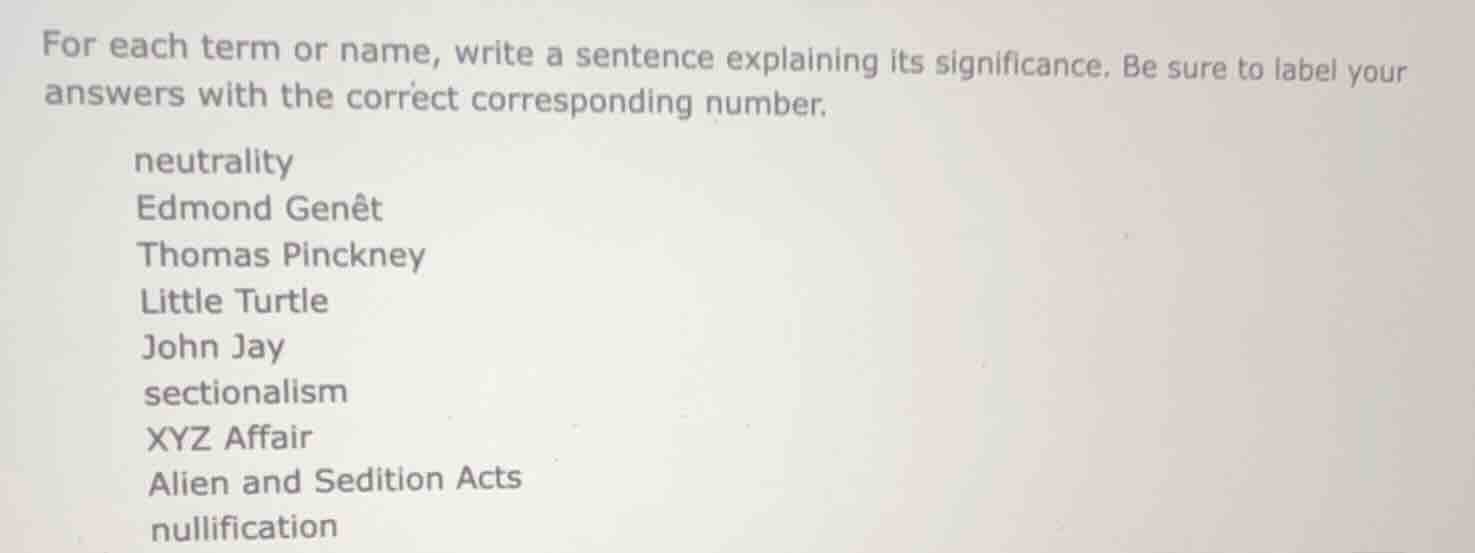
for each term or name, write a sentence explaining its significance. be sure to label your answers with the correct corresponding number. neutrality edmond genêt thomas pinckney little turtle john jay sectionalism xyz affair alien and sedition acts nullification
Brief Explanations
- neutrality: A foreign policy stance avoiding alignment with warring nations, foundational for early U.S. efforts to avoid European conflicts.
- Edmond Genêt: A French diplomat who violated U.S. neutrality by recruiting Americans for France's war against Britain, forcing the U.S. to assert its neutrality policy.
- Thomas Pinckney: Negotiated Pinckney's Treaty (1795) with Spain, securing U.S. access to the Mississippi River and resolving border disputes in the Southeast.
- Little Turtle: A Miami leader who defeated U.S. forces in early Northwest Indian Wars, highlighting U.S. military weaknesses against Indigenous nations.
- John Jay: Negotiated Jay's Treaty (1794) with Britain, resolving post-Revolutionary War trade and debt disputes while angering pro-French Americans.
- sectionalism: Loyalty to a U.S. region over the nation, a growing divide in the late 1700s that laid groundwork for future national conflict.
- XYZ Affair: A 1797 diplomatic scandal where French agents demanded bribes from U.S. envoys, sparking anti-French sentiment and a quasi-war with France.
- Alien and Sedition Acts: 1798 laws restricting immigrant rights and criticizing the government, seen as violating First Amendment freedoms by opponents.
- nullification: The idea that states can invalidate federal laws they deem unconstitutional, an early challenge to federal authority in U.S. history.

Snap & solve any problem in the app
Get step-by-step solutions on Sovi AI
Photo-based solutions with guided steps
Explore more problems and detailed explanations
- Neutrality was a key early U.S. foreign policy that kept the young nation out of European wars to protect its fragile stability.
- Edmond Genêt's unauthorized recruitment of Americans for France's war forced the U.S. to formally enforce its neutrality stance, asserting federal authority over foreign relations.
- Thomas Pinckney's 1795 treaty with Spain secured critical U.S. access to the Mississippi River and normalized trade and border relations in the American South.
- Little Turtle's military victories against U.S. troops in the Northwest Territory exposed early U.S. military shortcomings and delayed westward expansion.
- John Jay's 1794 treaty with Britain resolved lingering Revolutionary War debts and trade issues, though it fueled political division over U.S. ties to Britain.
- Sectionalism emerged in the late 1700s as regional economic and political differences deepened, creating tensions that would shape U.S. history for decades.
- The XYZ Affair sparked widespread anti-French sentiment in the U.S., leading to a period of undeclared naval war (the Quasi-War) with France.
- The Alien and Sedition Acts targeted immigrants and government critics, prompting protests that argued the laws violated the First Amendment's free speech protections.
- Nullification introduced the controversial idea that states could reject federal laws, establishing an early precedent for states' rights debates in the U.S.