QUESTION IMAGE
Question
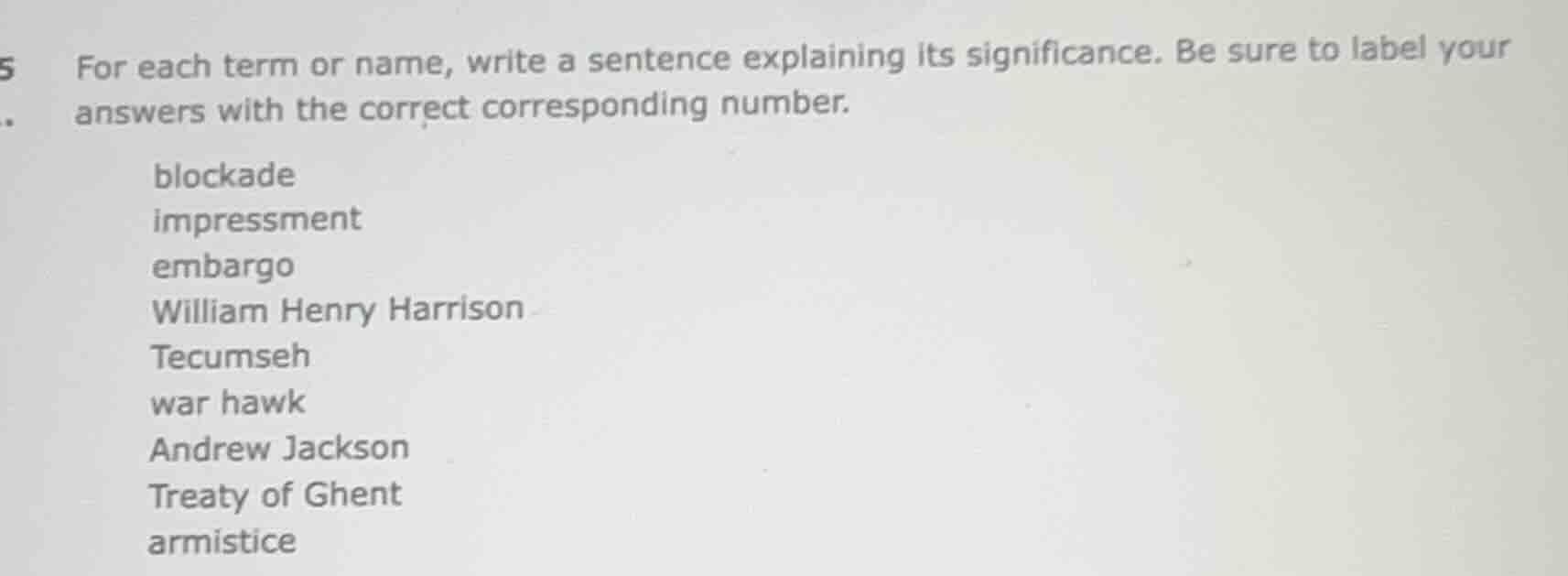
for each term or name, write a sentence explaining its significance. be sure to label your answers with the correct corresponding number. blockade impressment embargo william henry harrison tecumseh war hawk andrew jackson treaty of ghent armistice
Brief Explanations
- blockade: A military tactic to cut off supplies/trade for control.
- impressment: Forced enlistment of sailors, a War of 1812 cause.
- embargo: A trade ban to pressure foreign nations (e.g., U.S. 1807).
- William Henry Harrison: Beat Tecumseh; later U.S. president.
- Tecumseh: Unified Indigenous tribes against U.S. expansion.
- war hawk: Politician pushing for war (War of 1812 advocates).
- Andrew Jackson: Won Battle of New Orleans (War of 1812).
- Treaty of Ghent: Ended the War of 1812, restored pre-war borders.
- armistice: A temporary halt to fighting, a ceasefire.

Snap & solve any problem in the app
Get step-by-step solutions on Sovi AI
Photo-based solutions with guided steps
Explore more problems and detailed explanations
- blockade: A military strategy that seals off a region to stop trade, supplies, or movement, often used to force surrender or compliance, notably in the War of 1812 against U.S. ports.
- impressment: The forced enlistment of people into military service, most infamously British seizure of American sailors that was a key cause of the War of 1812.
- embargo: An official government ban on trade with a foreign country, such as the U.S. Embargo Act of 1807, intended to pressure Britain and France but which harmed the American economy.
- William Henry Harrison: An American military leader who defeated Tecumseh's confederacy at the Battle of Tippecanoe (1811) and later became the 9th U.S. President, dying shortly after taking office.
- Tecumseh: A Shawnee leader who tried to unify Indigenous nations in the Midwest to resist American expansion, fighting against U.S. forces in the War of 1812 until his death in battle.
- war hawk: A political figure who aggressively advocates for going to war, specifically referring to U.S. Congress members who pushed for the War of 1812 against Britain.
- Andrew Jackson: A U.S. general who won the decisive Battle of New Orleans (1815) after the War of 1812 had officially ended, later serving as the 7th U.S. President.
- Treaty of Ghent: The 1814 agreement that ended the War of 1812, restoring all conquered territory to pre-war owners and resolving no major pre-war disputes.
- armistice: A formal agreement between warring parties to temporarily stop fighting, a ceasefire that can precede a permanent peace treaty.