QUESTION IMAGE
Question
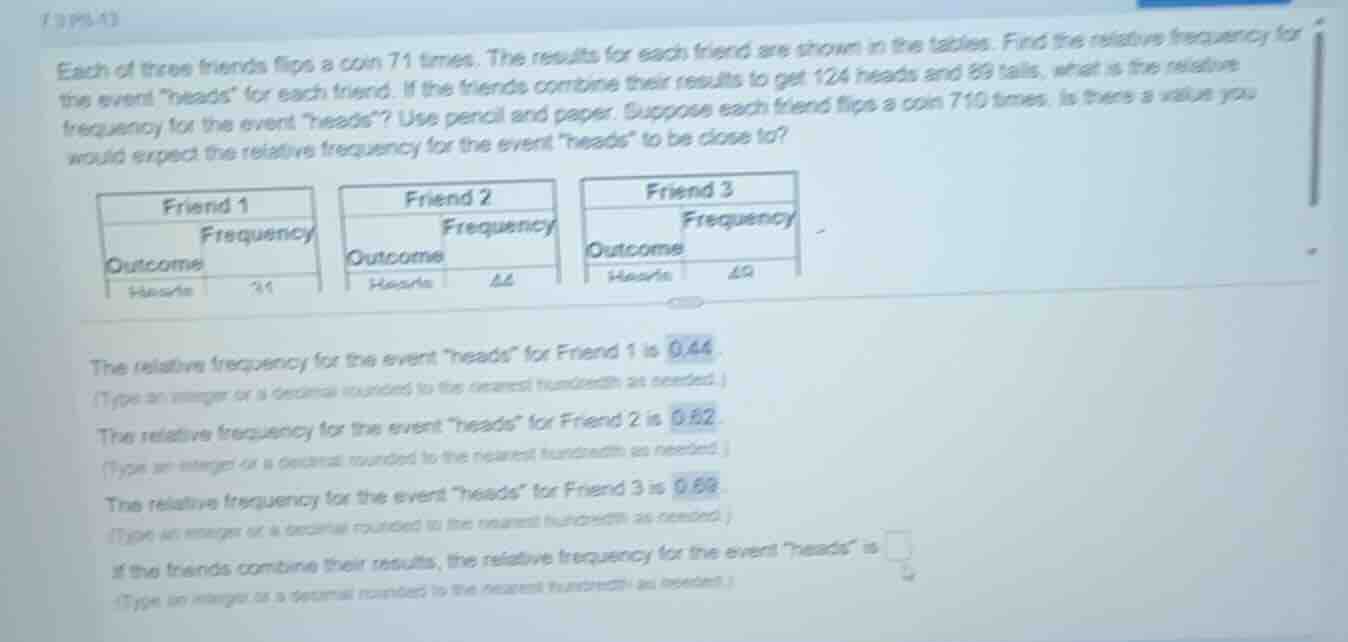
each of three friends flips a coin 71 times. the results for each friend are shown in the tables. find the relative frequency for the event \heads\ for each friend. if the friends combine their results to get 124 heads and 89 tails, what is the relative frequency for the event \heads\? use pencil and paper. suppose each friend flips a coin 710 times. is there a value you would expect the relative frequency for the event \heads\ to be close to?
friend 1
outcome frequency
heads 31
friend 2
outcome frequency
heads 44
friend 3
outcome frequency
heads 49
the relative frequency for the event \heads\ for friend 1 is 0.44
(type an integer or a decimal rounded to the nearest hundredth as needed.)
the relative frequency for the event \heads\ for friend 2 is 0.62
(type an integer or a decimal rounded to the nearest hundredth as needed.)
the relative frequency for the event \heads\ for friend 3 is 0.69
(type an integer or a decimal rounded to the nearest hundredth as needed.)
if the friends combine their results, the relative frequency for the event \heads\ is
(type an integer or a decimal rounded to the nearest hundredth as needed.)
Step1: Define relative frequency
Relative frequency = $\frac{\text{Number of heads}}{\text{Total number of flips}}$
Step2: Calculate total flips combined
Total flips = $71 + 71 + 71 = 213$
Step3: Compute combined relative frequency
$\text{Relative frequency} = \frac{124}{213} \approx 0.58$
Step4: Identify expected long-run value
For a fair coin, the theoretical probability of heads is $\frac{1}{2} = 0.5$

Snap & solve any problem in the app
Get step-by-step solutions on Sovi AI
Photo-based solutions with guided steps
Explore more problems and detailed explanations
The relative frequency for the event "heads" when combining results is $\boldsymbol{0.58}$.
When each friend flips 710 times, we would expect the relative frequency for "heads" to be close to $\boldsymbol{0.5}$.