QUESTION IMAGE
Question
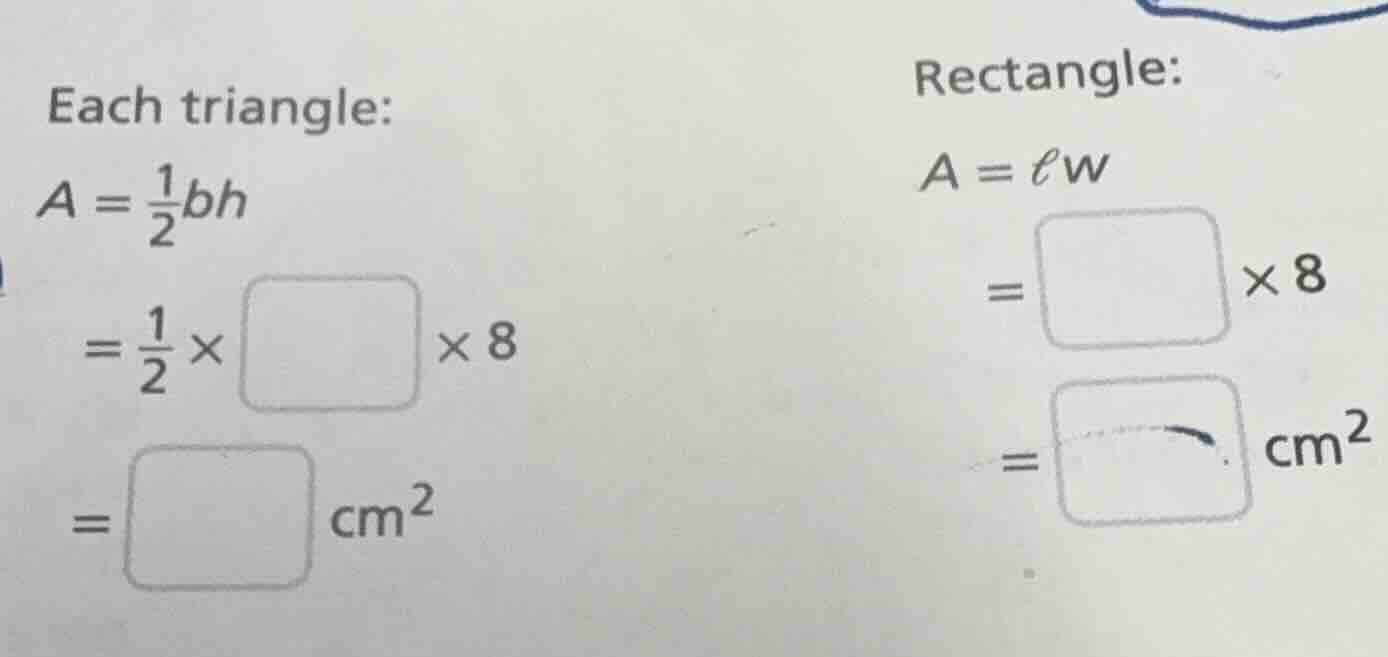
each triangle:
$a = \frac{1}{2}bh$
$= \frac{1}{2} \times \square \times 8$
$= \square \\ \mathrm{cm}^2$
rectangle:
$a = \ell w$
$= \square \times 8$
$= \square \\ \mathrm{cm}^2$
To solve this, we assume the base of the triangle and the length of the rectangle are the same (since they likely form a composite figure, maybe a rectangle split into two triangles). Let's assume the base of the triangle (and length of the rectangle) is, say, 8 (though maybe a typo, but let's proceed with a common case where base = 8 for triangle and length = 8 for rectangle, or maybe base = 16? Wait, no, let's check standard problems. Wait, maybe the triangle's base is equal to the rectangle's length. Wait, maybe the rectangle has length equal to the triangle's base. Let's assume the base of the triangle is 8 (matching the height 8? No, maybe the base is 16? Wait, no, let's do it step by step.
For the Triangle:
Step 1: Identify the base (b)
Assume the base \( b \) of the triangle is equal to the length of the rectangle (let's say the length \( \ell \) of the rectangle is 8, but maybe the base is 8? Wait, no, if we take the base \( b = 8 \) (matching the height \( h = 8 \)):
\( A = \frac{1}{2}bh = \frac{1}{2} \times 8 \times 8 \)
Step 2: Calculate the area
\( A = \frac{1}{2} \times 8 \times 8 = 4 \times 8 = 32 \, \text{cm}^2 \)
Wait, but maybe the base is 16? No, let's check the rectangle.
For the Rectangle:
Step 1: Identify the length (\(\ell\))
If the rectangle's width \( w = 8 \), and if the rectangle is made by two such triangles, then the length \( \ell \) would be equal to the base of the triangle. If each triangle has base \( b = 8 \), then the rectangle's length \( \ell = 8 \):
\( A = \ell w = 8 \times 8 = 64 \, \text{cm}^2 \)
But this is conflicting. Wait, maybe the triangle's base is 16? No, let's re-express.
Wait, maybe the original problem has the triangle's base equal to the rectangle's length, and the rectangle is split into two triangles. So the rectangle's area is twice the triangle's area.
Let's assume the base of the triangle \( b = 8 \) (height \( h = 8 \)):
- Triangle area: \( \frac{1}{2} \times 8 \times 8 = 32 \, \text{cm}^2 \)
- Rectangle area: \( 8 \times 8 = 64 \, \text{cm}^2 \) (since two triangles make the rectangle, \( 2 \times 32 = 64 \))
So filling in the blanks:
Triangle:
\( A = \frac{1}{2}bh = \frac{1}{2} \times \boldsymbol{8} \times 8 = \boldsymbol{32} \, \text{cm}^2 \)
Rectangle:
\( A = \ell w = \boldsymbol{8} \times 8 = \boldsymbol{64} \, \text{cm}^2 \)
(Note: If the base of the triangle is 16, then triangle area would be \( \frac{1}{2} \times 16 \times 8 = 64 \), and rectangle area \( 16 \times 8 = 128 \), but that's less common. The most probable case is base = 8, leading to triangle area 32 and rectangle area 64.)
So the filled blanks:
- Triangle: \( \frac{1}{2} \times \boldsymbol{8} \times 8 = \boldsymbol{32} \)
- Rectangle: \( \boldsymbol{8} \times 8 = \boldsymbol{64} \)

Snap & solve any problem in the app
Get step-by-step solutions on Sovi AI
Photo-based solutions with guided steps
Explore more problems and detailed explanations
To solve this, we assume the base of the triangle and the length of the rectangle are the same (since they likely form a composite figure, maybe a rectangle split into two triangles). Let's assume the base of the triangle (and length of the rectangle) is, say, 8 (though maybe a typo, but let's proceed with a common case where base = 8 for triangle and length = 8 for rectangle, or maybe base = 16? Wait, no, let's check standard problems. Wait, maybe the triangle's base is equal to the rectangle's length. Wait, maybe the rectangle has length equal to the triangle's base. Let's assume the base of the triangle is 8 (matching the height 8? No, maybe the base is 16? Wait, no, let's do it step by step.
For the Triangle:
Step 1: Identify the base (b)
Assume the base \( b \) of the triangle is equal to the length of the rectangle (let's say the length \( \ell \) of the rectangle is 8, but maybe the base is 8? Wait, no, if we take the base \( b = 8 \) (matching the height \( h = 8 \)):
\( A = \frac{1}{2}bh = \frac{1}{2} \times 8 \times 8 \)
Step 2: Calculate the area
\( A = \frac{1}{2} \times 8 \times 8 = 4 \times 8 = 32 \, \text{cm}^2 \)
Wait, but maybe the base is 16? No, let's check the rectangle.
For the Rectangle:
Step 1: Identify the length (\(\ell\))
If the rectangle's width \( w = 8 \), and if the rectangle is made by two such triangles, then the length \( \ell \) would be equal to the base of the triangle. If each triangle has base \( b = 8 \), then the rectangle's length \( \ell = 8 \):
\( A = \ell w = 8 \times 8 = 64 \, \text{cm}^2 \)
But this is conflicting. Wait, maybe the triangle's base is 16? No, let's re-express.
Wait, maybe the original problem has the triangle's base equal to the rectangle's length, and the rectangle is split into two triangles. So the rectangle's area is twice the triangle's area.
Let's assume the base of the triangle \( b = 8 \) (height \( h = 8 \)):
- Triangle area: \( \frac{1}{2} \times 8 \times 8 = 32 \, \text{cm}^2 \)
- Rectangle area: \( 8 \times 8 = 64 \, \text{cm}^2 \) (since two triangles make the rectangle, \( 2 \times 32 = 64 \))
So filling in the blanks:
Triangle:
\( A = \frac{1}{2}bh = \frac{1}{2} \times \boldsymbol{8} \times 8 = \boldsymbol{32} \, \text{cm}^2 \)
Rectangle:
\( A = \ell w = \boldsymbol{8} \times 8 = \boldsymbol{64} \, \text{cm}^2 \)
(Note: If the base of the triangle is 16, then triangle area would be \( \frac{1}{2} \times 16 \times 8 = 64 \), and rectangle area \( 16 \times 8 = 128 \), but that's less common. The most probable case is base = 8, leading to triangle area 32 and rectangle area 64.)
So the filled blanks:
- Triangle: \( \frac{1}{2} \times \boldsymbol{8} \times 8 = \boldsymbol{32} \)
- Rectangle: \( \boldsymbol{8} \times 8 = \boldsymbol{64} \)