QUESTION IMAGE
Question
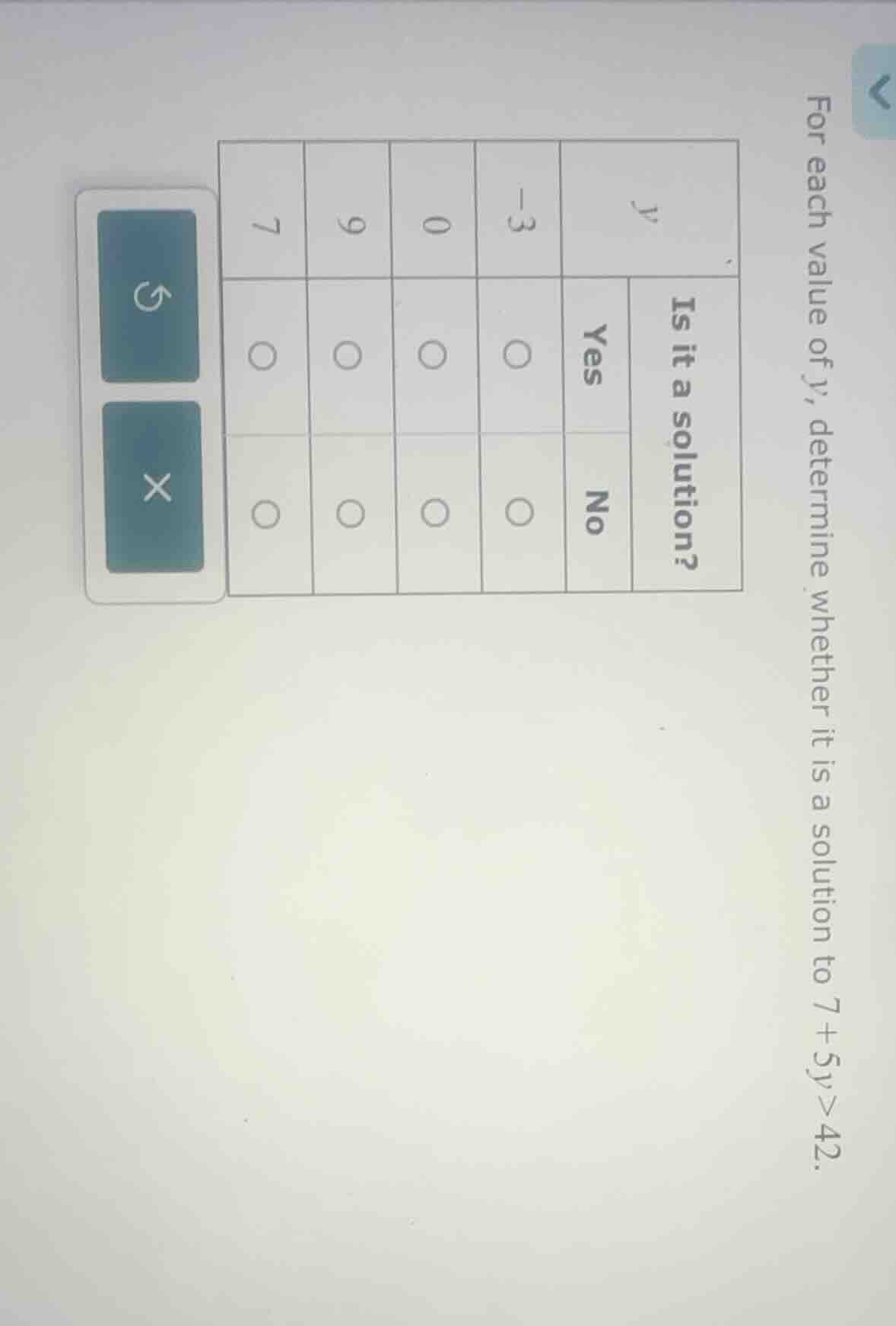
for each value of y, determine whether it is a solution to 7 + 5y > 42.
| is it a solution? | yes | no | ||
|---|---|---|---|---|
| ○ | ○ | ○ | ○ | |
| ○ | ○ | ○ | ○ |
First, we solve the inequality \(7 + 5y>42\) for \(y\).
Step 1: Subtract 7 from both sides
Subtract 7 from each side of the inequality to isolate the term with \(y\).
\(7 + 5y-7>42 - 7\)
Simplifying both sides, we get \(5y>35\).
Step 2: Divide by 5
Divide both sides of the inequality by 5 to solve for \(y\).
\(\frac{5y}{5}>\frac{35}{5}\)
Simplifying, we find \(y > 7\).
Now we check each value of \(y\):
For \(y=- 3\):
We check if \(-3>7\). Since \(-3\) is less than 7, \(-3\) is not a solution.
For \(y = 0\):
We check if \(0>7\). Since \(0\) is less than 7, \(0\) is not a solution.
For \(y=9\):
We check if \(9>7\). Since \(9\) is greater than 7, \(9\) is a solution.
For \(y = 7\):
We check if \(7>7\). Since \(7\) is not greater than 7 (it is equal), \(7\) is not a solution.

Snap & solve any problem in the app
Get step-by-step solutions on Sovi AI
Photo-based solutions with guided steps
Explore more problems and detailed explanations
- For \(y=-3\): No
- For \(y = 0\): No
- For \(y=9\): Yes
- For \(y = 7\): No
So in the table:
- For \(y=-3\), mark "No"
- For \(y = 0\), mark "No"
- For \(y=9\), mark "Yes"
- For \(y = 7\), mark "No"