QUESTION IMAGE
Question
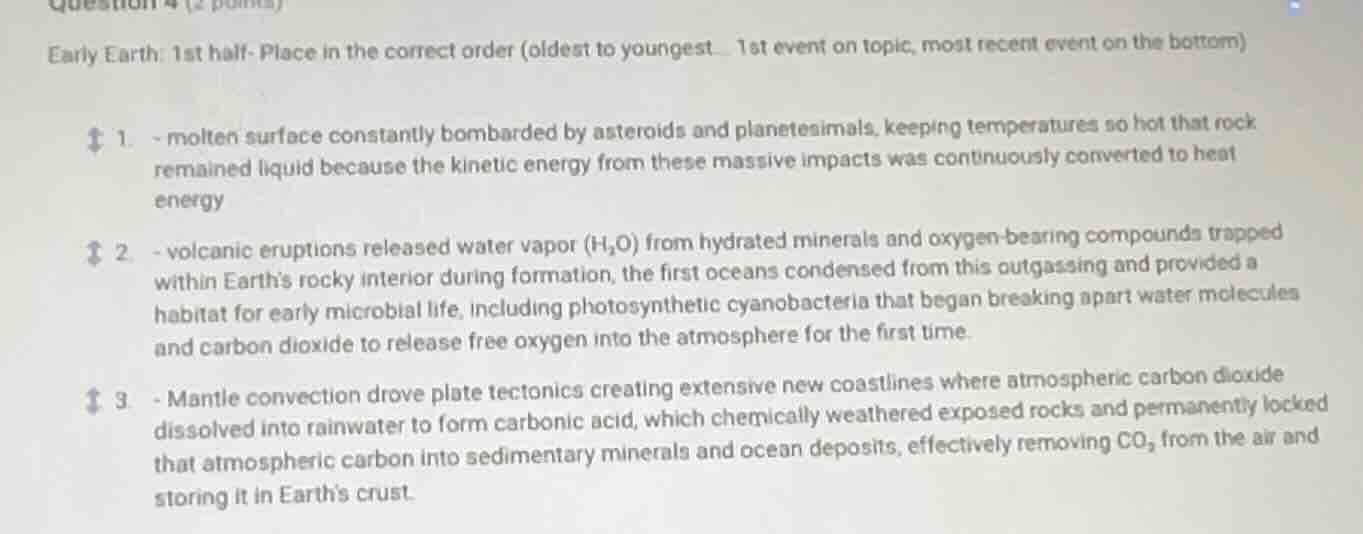
early earth: 1st half - place in the correct order (oldest to youngest. 1st event on top, most recent event on the bottom)
- - molten surface constantly bombarded by asteroids and planetesimals, keeping temperatures so hot that rock remained liquid because the kinetic energy from these massive impacts was continuously converted to heat energy
- - volcanic eruptions released water vapor (h₂o) from hydrated minerals and oxygen - bearing compounds trapped within earths rocky interior during formation, the first oceans condensed from this outgassing and provided a habitat for early microbial life, including photosynthetic cyanobacteria that began breaking apart water molecules and carbon dioxide to release free oxygen into the atmosphere for the first time.
- - mantle convection drove plate tectonics creating extensive new coastlines where atmospheric carbon dioxide dissolved into rainwater to form carbonic acid, which chemically weathered exposed rocks and permanently locked that atmospheric carbon into sedimentary minerals and ocean deposits, effectively removing co₂ from the air and storing it in earths crust.
Brief Explanations
- The molten, constantly bombarded surface is the earliest stage of Earth's formation, when the planet had not yet cooled or developed stable surface features.
- Once impacts slowed, volcanic outgassing released water vapor that formed oceans, and early microbial life (including oxygen-producing cyanobacteria) emerged, which is the next stage after the initial molten phase.
- Mantle convection driving plate tectonics, chemical weathering, and carbon sequestration is a later, more geologically advanced process that occurred after oceans and early life were established.

Snap & solve any problem in the app
Get step-by-step solutions on Sovi AI
Photo-based solutions with guided steps
Explore more problems and detailed explanations
Oldest (top) to Youngest (bottom):
- - molten surface constantly bombarded by asteroids and planetesimals, keeping temperatures so hot that rock remained liquid because the kinetic energy from these massive impacts was continuously converted to heat energy
- - volcanic eruptions released water vapor (H₂O) from hydrated minerals and oxygen-bearing compounds trapped within Earth's rocky interior during formation, the first oceans condensed from this outgassing and provided a habitat for early microbial life, including photosynthetic cyanobacteria that began breaking apart water molecules and carbon dioxide to release free oxygen into the atmosphere for the first time
- - Mantle convection drove plate tectonics creating extensive new coastlines where atmospheric carbon dioxide dissolved into rainwater to form carbonic acid, which chemically weathered exposed rocks and permanently locked that atmospheric carbon into sedimentary minerals and ocean deposits, effectively removing CO₂ from the air and storing it in Earth's crust