QUESTION IMAGE
Question
the earth is dying. between climate change, pollution, and resource depletion, the future of life on this planet is uncertain. could the solution be to make our home on a new planet? while such a course might be tempting, the many complexities of developing a new planetary home make migrating off - planet an unrealistic option.
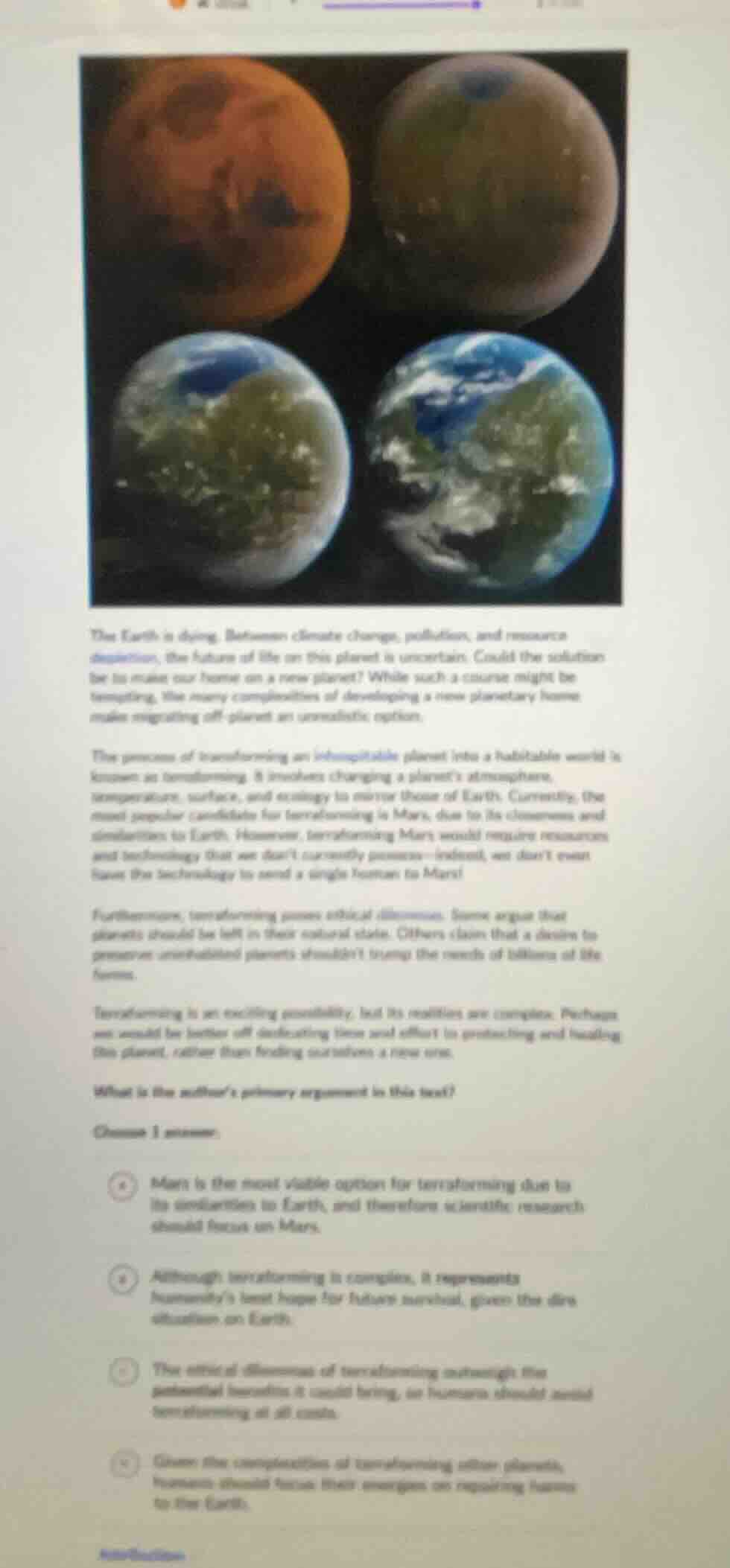
the process of transforming an inhospitable planet into a habitable world is known as terraforming. it involves changing a planet’s atmosphere, temperature, surface, and ecology to mirror those of earth. currently, the most popular candidate for terraforming is mars, due to its closeness and similarities to earth. however, terraforming mars would require resources and technology that we don’t currently possess - indeed, we don’t even have the technology to send a single human to mars!
furthermore, terraforming poses ethical dilemmas. some argue that planets should be left in their natural states. others claim that a desire to preserve uninhabited planets shouldn’t trump the needs of billions of life forms.
terraforming is an exciting possibility, but its realities are complex. perhaps we would be better off dedicating time and effort to protecting and healing this planet, rather than looking outward to a new one.
what is the author’s primary argument in this text?
choose 1 answer:
- mars is the most viable option for terraforming due to its similarities to earth, and therefore scientific research should focus on mars.
- although terraforming is complex, it represents humanity’s best hope for future survival, given the dire situation on earth.
- the ethical dilemmas of terraforming outweigh the potential benefits it could bring, so humans should avoid terraforming at all costs.
- given the complications of terraforming other planets, humans should focus their energies on repairing harm to the earth.
- Analyze Option 1: The text says terraforming Mars is not feasible now (lack tech) and focuses on why staying on Earth is better, not advocating research on Mars. Eliminate.
- Analyze Option 2: The author concludes we should focus on Earth, not that terraforming is humanity's best hope. Eliminate.
- Analyze Option 3: The ethical dimension is a secondary point, and the author doesn't say to avoid terraforming at all costs, but that focusing on Earth is better. Eliminate.
- Analyze Option 4: The text explains terraforming is complex (tech, resources, ethical) and ends by saying we should spend time on protecting/healing Earth. This matches.

Snap & solve any problem in the app
Get step-by-step solutions on Sovi AI
Photo-based solutions with guided steps
Explore more problems and detailed explanations
D. Given the complications of terraforming other planets, humans should focus their energies on repairing harm to the Earth.