QUESTION IMAGE
Question
east and west germany are now united.
the soviet union has become 15 different countries.
czechoslovakias borders have changed.
yugoslavias borders have changed.
both a and b
both c and d
Brief Explanations
- Analyze Option A: East and West Germany united in 1990, which is a true historical change.
- Analyze Option B: The Soviet Union dissolved into 15 independent countries, which is also a true historical change.
- Analyze Option C: Czechoslovakia split into the Czech Republic and Slovakia, so its borders changed, but this is part of the group in Option E (C and D) is incorrect as A and B are also true. Wait, no—wait, the map shows Southern Europe/North Africa, but the options are about post - Cold War European/Soviet changes. Wait, the correct combination: A (Germany unification) and B (Soviet Union dissolution) are both true. Wait, no, wait the options: "Both A and B" is an option. Wait, let's re - check:
- Option A: East and West Germany are now united. True (1990 unification).
- Option B: The Soviet Union has become 15 different countries. True (dissolution of USSR into 15 republics).
- Option C: Czechoslovakia's borders changed (split into two countries), true.
- Option D: Yugoslavia's borders changed (broke into multiple countries), true.
- But the map is of Southern Europe, but the question is about which of the options is correct. Wait, the key is that A and B are about the Soviet bloc and Germany, while C and D are about Eastern European countries. But the correct answer here: Wait, no, the option "Both A and B" is E? Wait, the options are:
- A. East and West Germany are now united.
- B. The Soviet Union has become 15 different countries.
- C. Czechoslovakia's borders have changed.
- D. Yugoslavia's borders have changed.
- E. Both A and B
- F. Both C and D
Wait, the historical facts:
- A is true (1990 unification).
- B is true (USSR dissolved into 15 countries).
- C is true (Czechoslovakia split in 1993).
- D is true (Yugoslavia broke up in the 1990s).
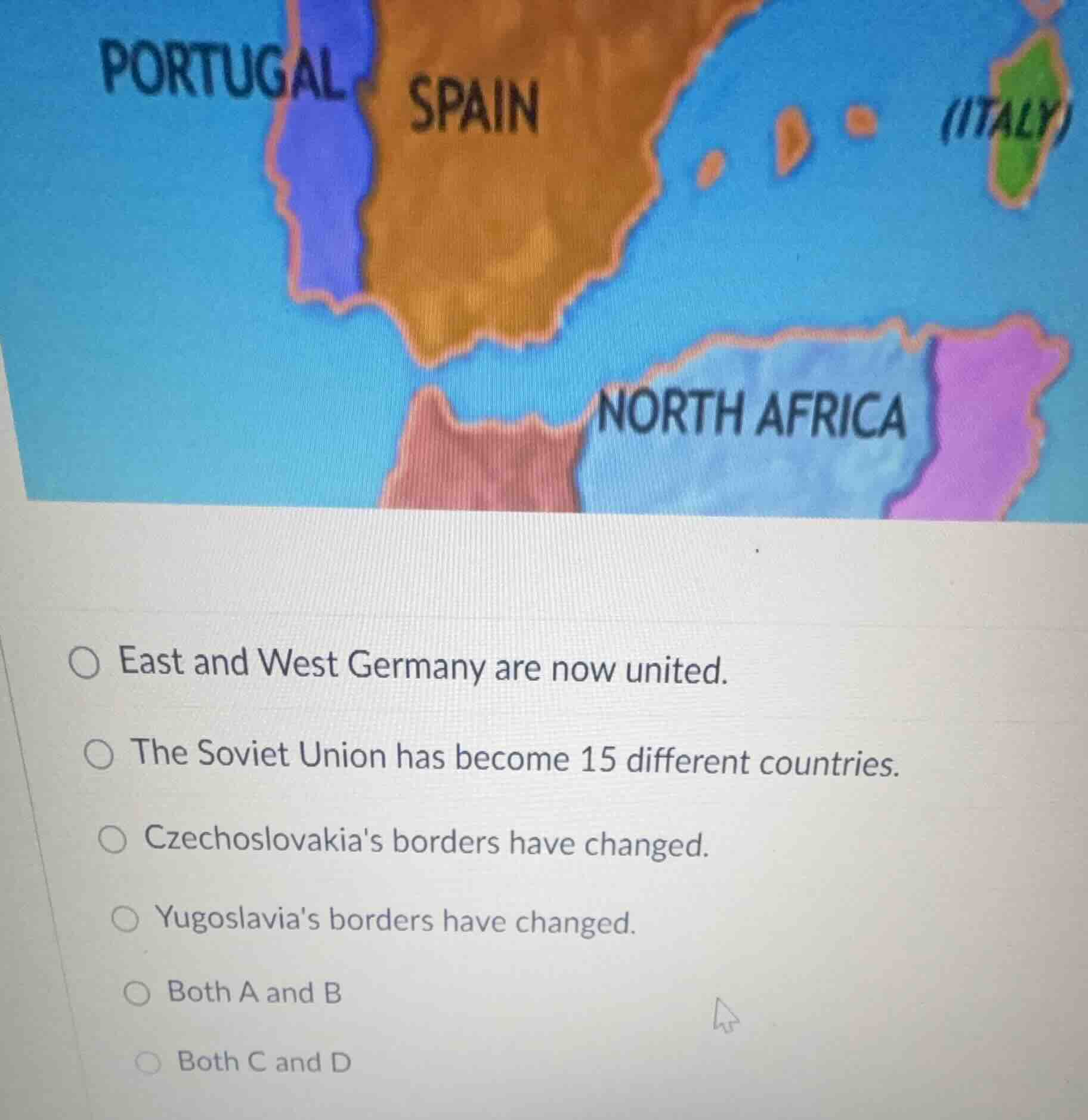
But the map shows Portugal, Spain, Italy, North Africa, which are not related to the countries in A - D directly. But the question is about which of the options is correct. Wait, the option "Both A and B" (E) is correct? Wait, no, wait the user's options: the last two options are "Both A and B" and "Both C and D". Wait, let's check the historical context:
- The changes in A (Germany) and B (USSR) are both major post - Cold War changes. C (Czechoslovakia) and D (Yugoslavia) are also post - Cold War changes, but the option "Both A and B" is a valid combination as both A and B are true. Wait, no, I think I made a mistake earlier. Let's confirm:
- East and West Germany united (A: true).
- Soviet Union became 15 countries (B: true).
- Czechoslovakia split (C: true).
- Yugoslavia broke up (D: true).
- But the option "Both A and B" is an option, and "Both C and D" is another. But the correct answer here is "Both A and B" (E) because A and B are both true, while C and D are also true but the option "Both C and D" is also there. Wait, no, the map is of Western Europe and North Africa, but the question is about the options. Wait, maybe the question is about which of the options is correct in terms of the changes shown? No, the map is just a background. The key is the historical facts: A and B are both true, so "Both A and B" is correct.

Snap & solve any problem in the app
Get step-by-step solutions on Sovi AI
Photo-based solutions with guided steps
Explore more problems and detailed explanations
E. Both A and B