QUESTION IMAGE
Question
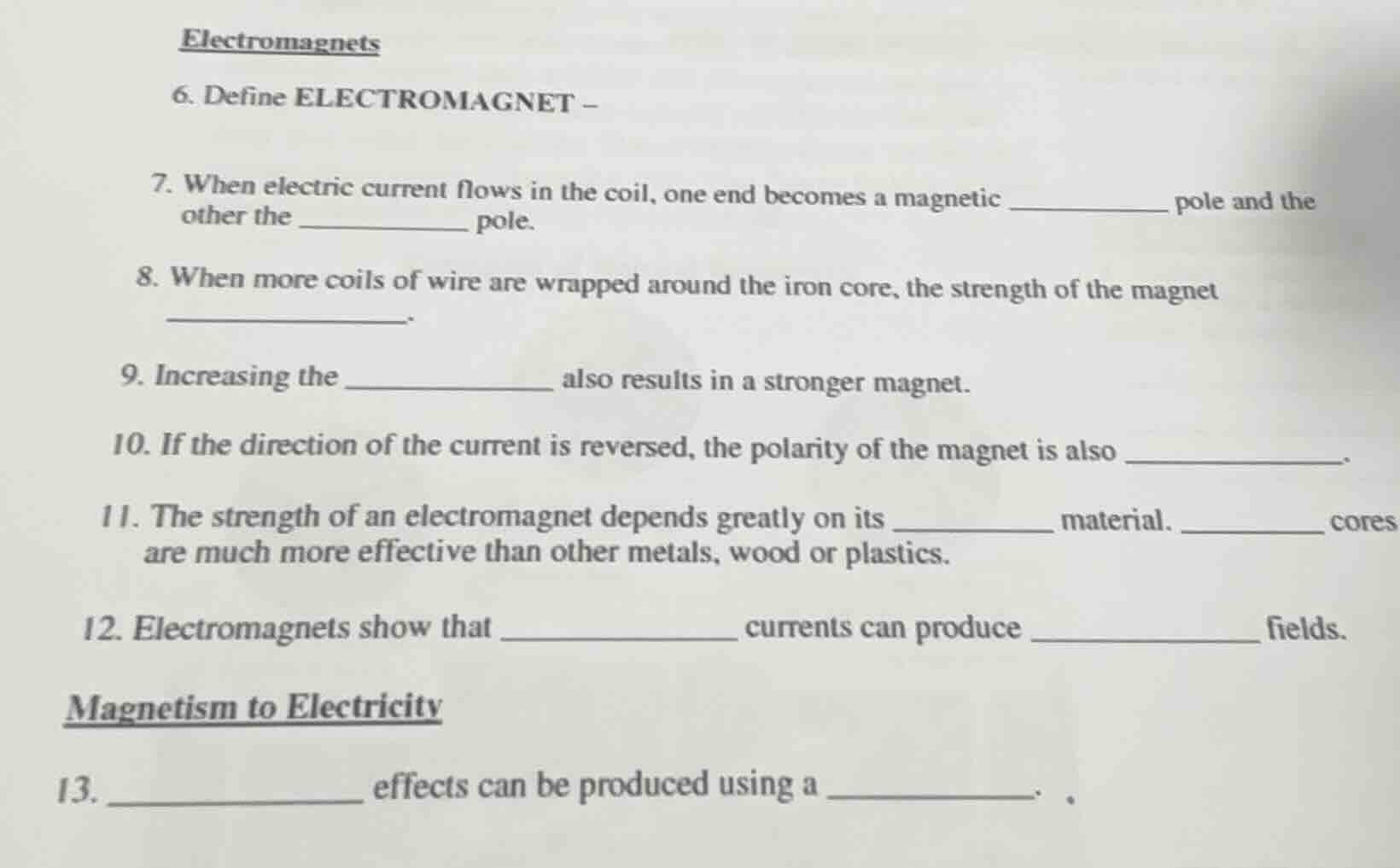
electromagnets
- define electromagnet –
- when electric current flows in the coil, one end becomes a magnetic ____ pole and the other the ____ pole.
- when more coils of wire are wrapped around the iron core, the strength of the magnet ______.
- increasing the ______ also results in a stronger magnet.
- if the direction of the current is reversed, the polarity of the magnet is also ______.
- the strength of an electromagnet depends greatly on its ____ material. ____ cores are much more effective than other metals, wood or plastics.
- electromagnets show that ____ currents can produce ____ fields.
magnetism to electricity
- ____ effects can be produced using a ____.
Question 6
An electromagnet is a type of magnet in which the magnetic field is produced by an electric current. It typically consists of a coil of wire wrapped around a magnetic core (usually made of a ferromagnetic material like iron), and the magnetism exists only as long as the electric current is flowing through the coil.
When an electric current flows through a coil (like in an electromagnet), the coil behaves like a bar magnet and develops two magnetic poles: a North (N) pole and a South (S) pole. The direction of the current determines which end is North and which is South, but by default, we identify the two poles as North and South.
The strength of an electromagnet is directly related to the number of turns (coils) of wire around the core, the amount of current, and the core material. Increasing the number of coils (turns) of wire wrapped around the iron core increases the magnetic field strength because each turn of the wire contributes to the magnetic field, and more turns mean a stronger cumulative magnetic effect.

Snap & solve any problem in the app
Get step-by-step solutions on Sovi AI
Photo-based solutions with guided steps
Explore more problems and detailed explanations
An electromagnet is a magnet where the magnetic field is generated by an electric current (usually a coil of wire around a magnetic core, with magnetism present only while current flows).