QUESTION IMAGE
Question
electrons and their arrangement in atoms
chemistry
name_________
period 1 2 3 4 5 6 date____
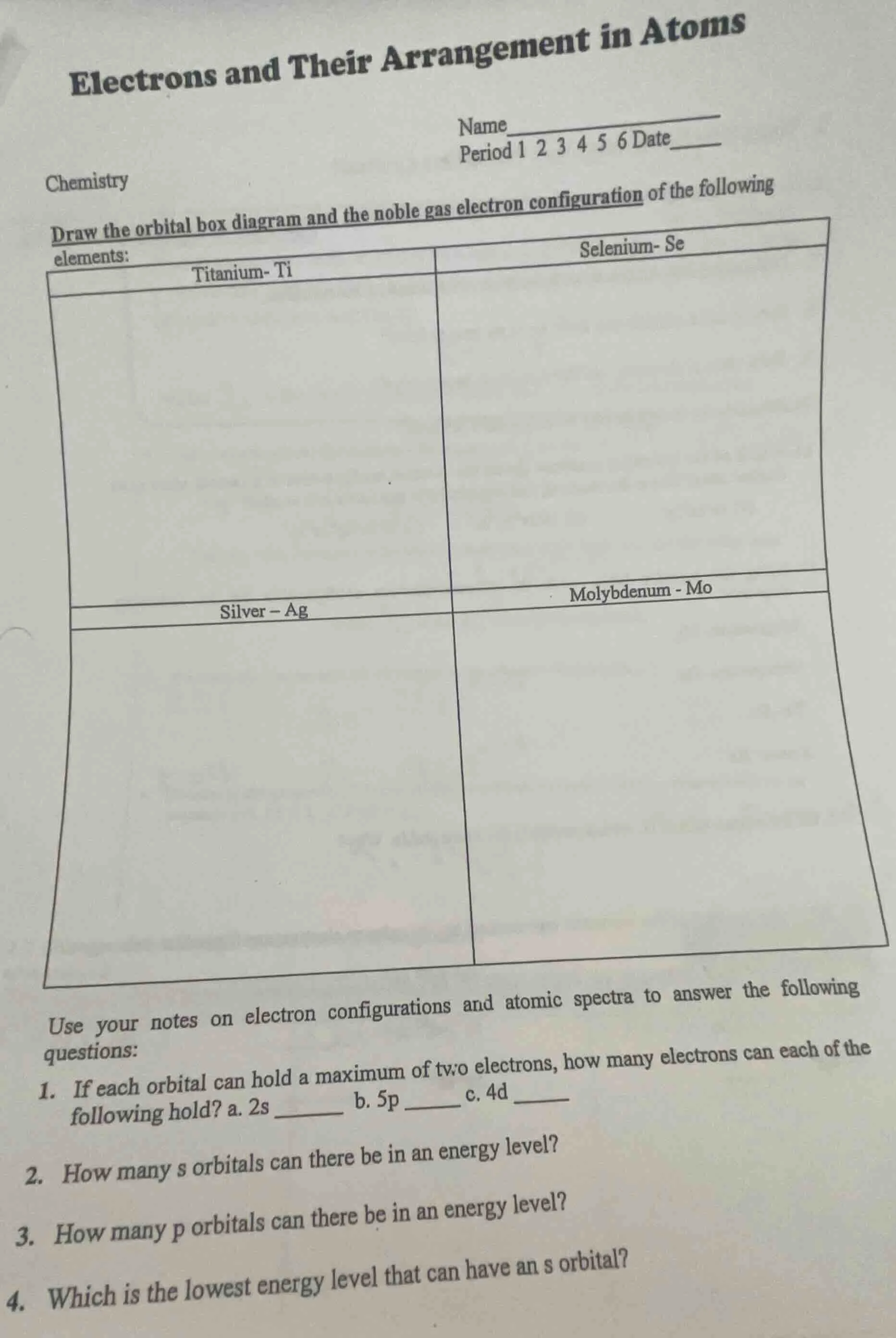
draw the orbital box diagram and the noble gas electron configuration of the following elements:
titanium- ti selenium- se
silver – ag molybdenum - mo
use your notes on electron configurations and atomic spectra to answer the following questions:
- if each orbital can hold a maximum of two electrons, how many electrons can each of the following hold? a. 2s ____ b. 5p __ c. 4d ____
- how many s orbitals can there be in an energy level?
- how many p orbitals can there be in an energy level?
- which is the lowest energy level that can have an s orbital?
---
Part 1: Orbital Box Diagrams & Noble Gas Configurations
Titanium (Ti, Atomic #22)
Step1: Find noble gas core
Noble gas before Ti is Ar ($Z=18$)
Step2: Add valence electrons
Remaining electrons: $22-18=4$. Fill $4s^2$, then $3d^2$
Orbital box diagram:
[Ar] 4s: ↑↓ 3d: ↑ ↑ □ □ □Noble gas config: $[Ar] 4s^2 3d^2$
---
Selenium (Se, Atomic #34)
Step1: Find noble gas core
Noble gas before Se is Ar ($Z=18$)
Step2: Add valence electrons
Remaining electrons: $34-18=16$. Fill $4s^2$, $3d^{10}$, then $4p^4$
Orbital box diagram:
[Ar] 4s: ↑↓ 3d: ↑↓ ↑↓ ↑↓ ↑↓ ↑↓ 4p: ↑↓ ↑ ↑ □Noble gas config: $[Ar] 4s^2 3d^{10} 4p^4$
---
Silver (Ag, Atomic #47)
Step1: Find noble gas core
Noble gas before Ag is Kr ($Z=36$)
Step2: Add valence electrons (exception)
Remaining electrons: $47-36=11$. Filled $5s^1$ (stable full d), then $4d^{10}$
Orbital box diagram:
[Kr] 5s: ↑ 4d: ↑↓ ↑↓ ↑↓ ↑↓ ↑↓Noble gas config: $[Kr] 5s^1 4d^{10}$
---
Molybdenum (Mo, Atomic #42)
Step1: Find noble gas core
Noble gas before Mo is Kr ($Z=36$)
Step2: Add valence electrons (exception)
Remaining electrons: $42-36=6$. Filled $5s^1$ (stable half d), then $4d^5$
Orbital box diagram:
[Kr] 5s: ↑ 4d: ↑ ↑ ↑ ↑ ↑Noble gas config: $[Kr] 5s^1 4d^5$
---
Part 2: Orbital Capacity & Count Questions
Question 1
Step1: 2s orbital capacity
s-subshell has 1 orbital; $1 \times 2 = 2$
Step2: 5p orbital capacity
p-subshell has 3 orbitals; $3 \times 2 = 6$
Step3: 4d orbital capacity
d-subshell has 5 orbitals; $5 \times 2 = 10$
Question 2
Step1: s orbital count per energy level
s-subshell only has 1 orbital per $n$
Question 3
Step1: p orbital count per energy level
p-subshell has 3 orbitals per $n \geq 2$
Question 4
Step1: Lowest energy level for s orbital
s-orbitals exist starting at $n=1$
---

Snap & solve any problem in the app
Get step-by-step solutions on Sovi AI
Photo-based solutions with guided steps
Explore more problems and detailed explanations
Orbital Box Diagrams & Noble Gas Configurations
- Titanium (Ti)
- Orbital Box Diagram:
[Ar] 4s: ↑↓ 3d: ↑ ↑ □ □ □- Noble Gas Configuration: $[Ar] 4s^2 3d^2$
- Selenium (Se)
- Orbital Box Diagram:
[Ar] 4s: ↑↓ 3d: ↑↓ ↑↓ ↑↓ ↑↓ ↑↓ 4p: ↑↓ ↑ ↑ □- Noble Gas Configuration: $[Ar] 4s^2 3d^{10} 4p^4$
- Silver (Ag)
- Orbital Box Diagram:
[Kr] 5s: ↑ 4d: ↑↓ ↑↓ ↑↓ ↑↓ ↑↓- Noble Gas Configuration: $[Kr] 5s^1 4d^{10}$
- Molybdenum (Mo)
- Orbital Box Diagram:
[Kr] 5s: ↑ 4d: ↑ ↑ ↑ ↑ ↑- Noble Gas Configuration: $[Kr] 5s^1 4d^5$
Orbital Capacity & Count Answers
- a. 2; b. 6; c. 10
- 1
- 3
- Energy level 1 ($n=1$)