QUESTION IMAGE
Question
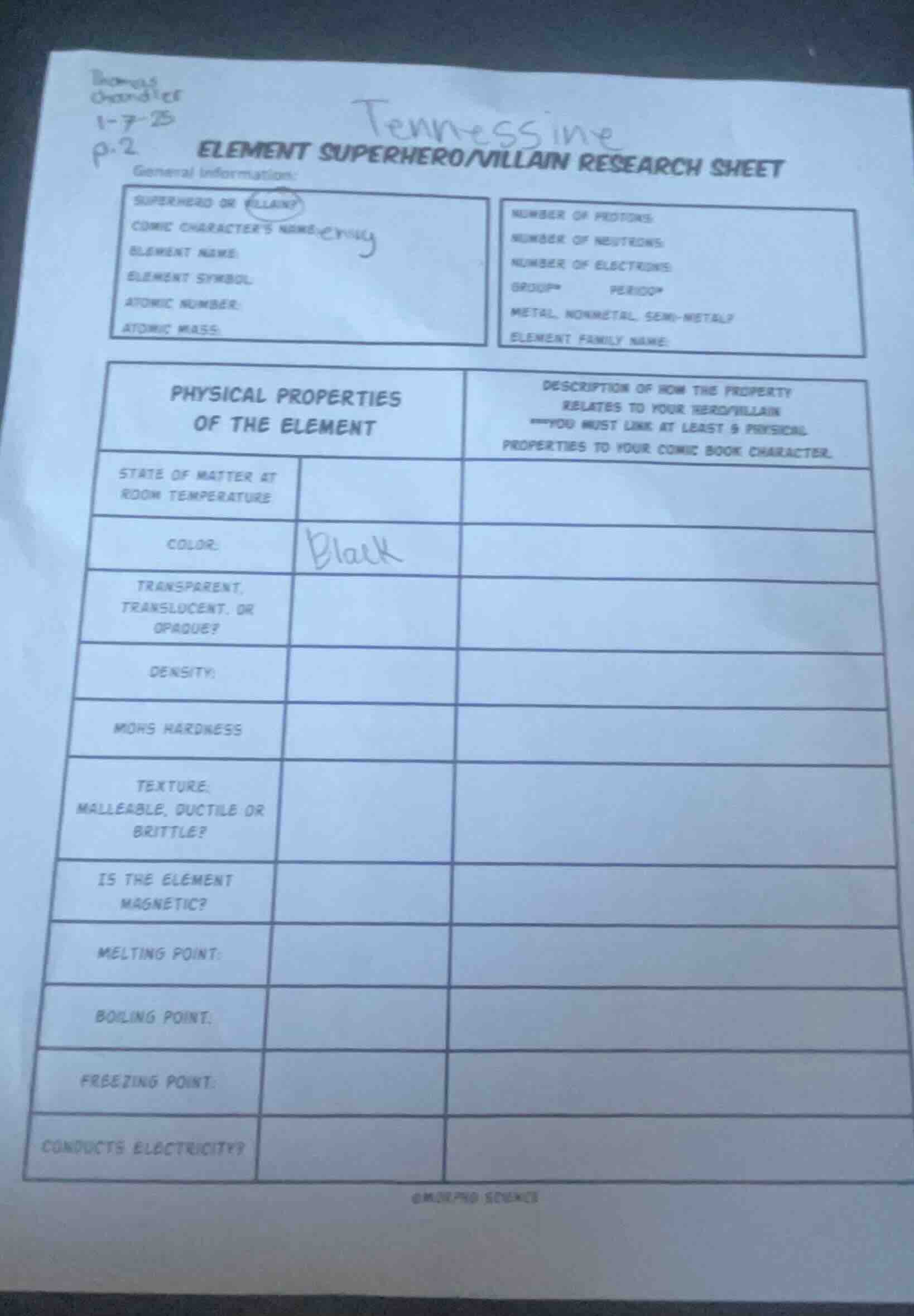
element superhero/villain research sheet general information: superhero or villain? comic characters name: element name: element symbol: atomic number: atomic mass: number of protons: number of neutrons: number of electrons: group# period# metal, nonmetal, semi-metal? element family name: physical properties of the element description of how the property relates to your hero/villain ***you must link at least 5 physical properties to your comic book character. state of matter at room temperature color: black transparent, translucent, or opaque? density: mohs hardness texture: malleable, ductile or brittle? is the element magnetic? melting point: boiling point: freezing point: conducts electricity? ©murphy science
To fill out the "Element Superhero/Villain Research Sheet" for the element Tennessine (Ts), we can follow these steps:
General Information
- Superhero or Villain?: Villain (as marked on the sheet)
- Comic Character’s Name: (e.g., “Evil Ts” or a creative name)
- Element Name: Tennessine
- Element Symbol: Ts
- Atomic Number: 117
- Atomic Mass: ~294 (most stable isotope)
- Number of Protons: 117 (protons = atomic number)
- Number of Neutrons: \( 294 - 117 = 177 \) (neutrons = atomic mass – atomic number, approximate)
- Number of Electrons: 117 (electrons = protons in a neutral atom)
- Group: 17 (halogens)
- Period: 7
- Metal, Nonmetal, Semi - metal?: Metalloid (or predicted to be a metalloid; experimental data is limited)
- Element Family Name: Halogens
Physical Properties of the Element (and How They Relate to the Villain)
| Physical Property | Value/Description | How It Relates to the Villain |
|---|---|---|
| Color | Unknown (no experimental data), but we can infer (e.g., dark/black as a villain) | The villain’s costume/skin is black, matching the “dark” nature of a rare, unstable element. |
| Transparent, Translucent, or Opaque? | Opaque (like most solids) | The villain is “opaque” to detection (hard to study, like Tennessine), making them elusive. |
| Density | Predicted to be ~7 g/cm³ (theoretical) | The villain is “dense” (hard to defeat) or their weapons have high density. |
| Mohs Hardness | Unknown (no experimental data) | The villain’s armor has “unknown hardness” (unpredictable, like Tennessine’s properties). |
| Texture: Malleable, Ductile, or Brittle? | Predicted to be brittle (like many metalloids/heavy elements) | The villain’s plans are “brittle” (easily disrupted, like Tennessine’s short - lived isotopes). |
| Is the Element Magnetic? | Unknown (no experimental data) | The villain has “unpredictable magnetism” (hard to control, like Tennessine’s behavior). |
| Melting Point | Predicted to be ~620 K (≈347 °C, theoretical) | The villain can “melt” under extreme pressure (like Tennessine’s melting point) or use heat - based attacks. |
| Boiling Point | Predicted to be ~883 K (≈610 °C, theoretical) | The villain’s lair has a “boiling” atmosphere, or they can vaporize into a gas (like Tennessine’s boiling point). |
| Freezing Point | Same as melting point (solid → liquid transition) | The villain can “freeze” enemies (reverse of melting) or their powers involve temperature shifts. |
| Conducts Electricity? | Predicted to be a poor co…

Snap & solve any problem in the app
Get step-by-step solutions on Sovi AI
Photo-based solutions with guided steps
Explore more problems and detailed explanations
To fill out the "Element Superhero/Villain Research Sheet" for the element Tennessine (Ts), we can follow these steps:
General Information
- Superhero or Villain?: Villain (as marked on the sheet)
- Comic Character’s Name: (e.g., “Evil Ts” or a creative name)
- Element Name: Tennessine
- Element Symbol: Ts
- Atomic Number: 117
- Atomic Mass: ~294 (most stable isotope)
- Number of Protons: 117 (protons = atomic number)
- Number of Neutrons: \( 294 - 117 = 177 \) (neutrons = atomic mass – atomic number, approximate)
- Number of Electrons: 117 (electrons = protons in a neutral atom)
- Group: 17 (halogens)
- Period: 7
- Metal, Nonmetal, Semi - metal?: Metalloid (or predicted to be a metalloid; experimental data is limited)
- Element Family Name: Halogens
Physical Properties of the Element (and How They Relate to the Villain)
| Physical Property | Value/Description | How It Relates to the Villain |
|---|---|---|
| Color | Unknown (no experimental data), but we can infer (e.g., dark/black as a villain) | The villain’s costume/skin is black, matching the “dark” nature of a rare, unstable element. |
| Transparent, Translucent, or Opaque? | Opaque (like most solids) | The villain is “opaque” to detection (hard to study, like Tennessine), making them elusive. |
| Density | Predicted to be ~7 g/cm³ (theoretical) | The villain is “dense” (hard to defeat) or their weapons have high density. |
| Mohs Hardness | Unknown (no experimental data) | The villain’s armor has “unknown hardness” (unpredictable, like Tennessine’s properties). |
| Texture: Malleable, Ductile, or Brittle? | Predicted to be brittle (like many metalloids/heavy elements) | The villain’s plans are “brittle” (easily disrupted, like Tennessine’s short - lived isotopes). |
| Is the Element Magnetic? | Unknown (no experimental data) | The villain has “unpredictable magnetism” (hard to control, like Tennessine’s behavior). |
| Melting Point | Predicted to be ~620 K (≈347 °C, theoretical) | The villain can “melt” under extreme pressure (like Tennessine’s melting point) or use heat - based attacks. |
| Boiling Point | Predicted to be ~883 K (≈610 °C, theoretical) | The villain’s lair has a “boiling” atmosphere, or they can vaporize into a gas (like Tennessine’s boiling point). |
| Freezing Point | Same as melting point (solid → liquid transition) | The villain can “freeze” enemies (reverse of melting) or their powers involve temperature shifts. |
| Conducts Electricity? | Predicted to be a poor conductor (metalloid/near - metal) | The villain’s technology “conducts electricity poorly,” making their traps hard to short - circuit. |
Example Narrative (Optional)
The villain “Evil Ts” uses Tennessine’s unstable nature to their advantage: their powers involve short - lived, destructive “bursts” (like Tennessine’s radioactive decay). Their black, opaque appearance mirrors the element’s mysterious, unstudied nature, and their “dense” personality makes them a formidable foe!
This fills out the sheet with theoretical and inferred data (since Tennessine is highly unstable and has limited experimental data). Adjust the creative elements (comic name, villain traits) to fit your story!