QUESTION IMAGE
Question
elements of argument
an argument is a text that tries to convince an audience. the following characteristics and
techniques distinguish arguments from other forms of writing:
- a claim is the idea or position a writer presents, defends, and wants readers to accept.
for example: wealthy americans should pay a much higher tax rate than poor and
middle-class americans.
- a counterclaim is an opposing view the writer discusses.
for example: taxing wealthy people at a higher rate penalizes them for being financially successful.
- a concession acknowledges that part of a counterargument is valid.
for example: it is true that hardworking entrepreneurs and businesspeople should not be penalized for
their success.
- a rebuttal presents reasons and evidence that disprove a counterargument.
for example: however, the very wealthy often pay a lower tax rate than middle-class americans. their
rates should be raised so that they pay their fair share.
a writers understanding of their audience, or the intended reader, is important in an argument.
the claim makes the writers position clear. the counterclaim, concession, and rebuttal
demonstrate the writers awareness of what the audience feels, thinks, or knows, and attempts to
address those concerns in a logical, persuasive way.
directions: read the passage below. then, answer the questions that follow. for items
1-4, write the number of the correct sentence.
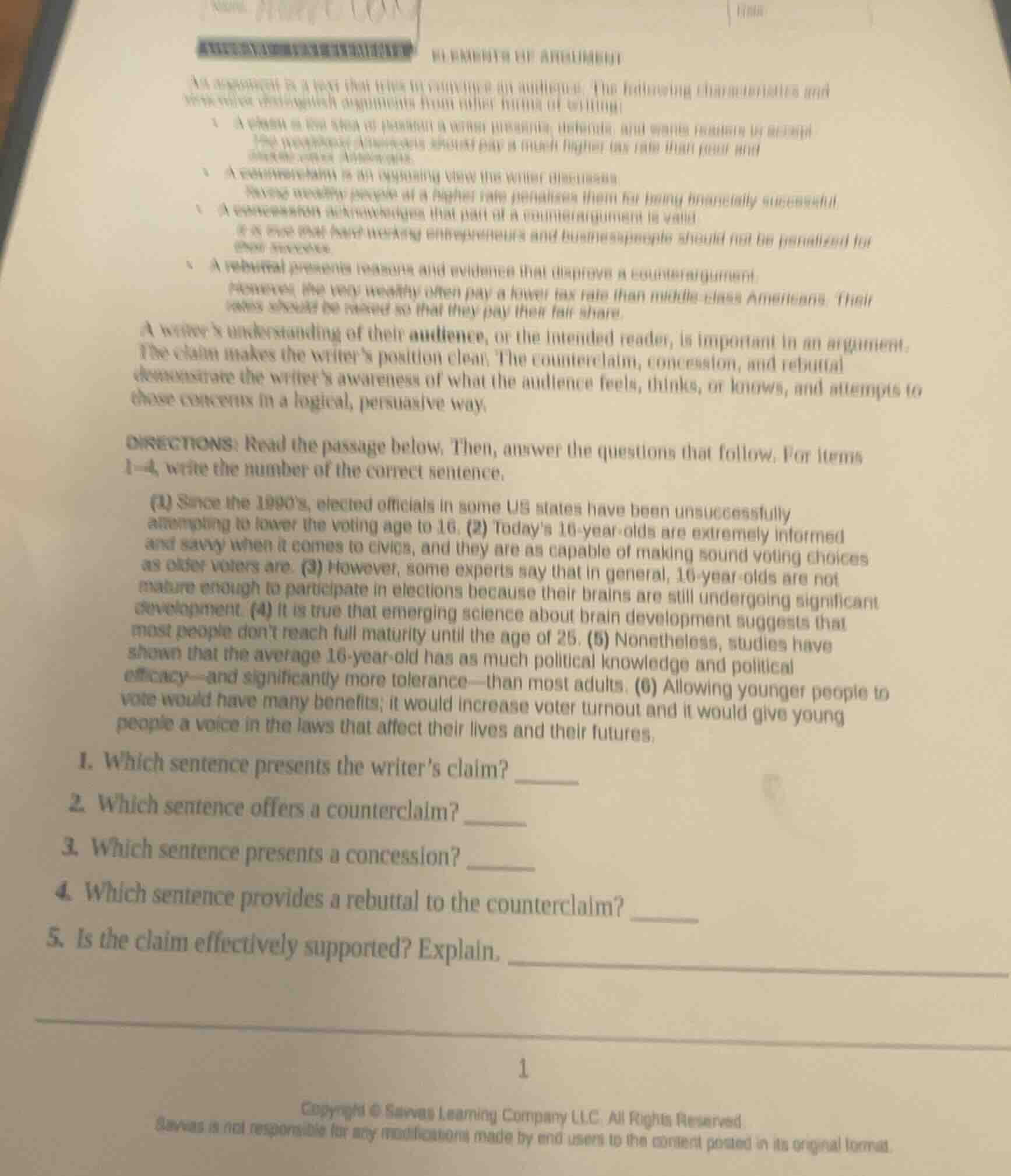
(1) since the 1990s, elected officials in some us states have been unsuccessfully
attempting to lower the voting age to 16. (2) todays 16-year-olds are extremely informed
and savvy when it comes to civics, and they are as capable of making sound voting choices
as older voters are. (3) however, some experts say that in general, 16-year-olds are not
mature enough to participate in elections because their brains are still undergoing significant
development. (4) it is true that emerging science about brain development suggests that
most people dont reach full maturity until the age of 25. (5) nonetheless, studies have
shown that the average 16-year-old has as much political knowledge and political
efficacy—and significantly more tolerance—than most adults. (6) allowing younger people to
vote would have many benefits; it would increase voter turnout and it would give young
people a voice in the laws that affect their lives and their futures.
- which sentence presents the writers claim? ______
- which sentence offers a counterclaim? ______
- which sentence presents a concession? ______
- which sentence provides a rebuttal to the counterclaim? ______
- is the claim effectively supported? explain. ______
1
copyright © savvas learning company llc. all rights reserved.
savvas is not responsible for any modifications made by end users to the content posted in its original format.
- The claim is the writer's core position that 16-year-olds are capable voters, stated in sentence 2.
- The counterclaim is the opposing view that 16-year-olds lack maturity, in sentence 3.
- The concession acknowledges a valid part of the counterclaim about brain development, in sentence 4.
- The rebuttal disproves the counterclaim with evidence of teens' political competence, in sentence 5.
- The claim is supported: it uses evidence of teens' civic knowledge, addresses counterarguments via concession and rebuttal, and lists tangible benefits of lowering the voting age.

Snap & solve any problem in the app
Get step-by-step solutions on Sovi AI
Photo-based solutions with guided steps
Explore more problems and detailed explanations
- 2
- 3
- 4
- 5
- Yes, the claim is effectively supported. It provides evidence that 16-year-olds have strong political knowledge and tolerance, addresses counterarguments about brain maturity with a concession and evidence-based rebuttal, and outlines clear benefits like increased voter turnout and youth representation in laws affecting their futures.