QUESTION IMAGE
Question
elements of carbohydrates
many chemical reactions take place inside cells. organisms are constantly breaking apart molecules and using the atoms to create other molecules. one of the classes of molecules found in living organisms is carbohydrates.
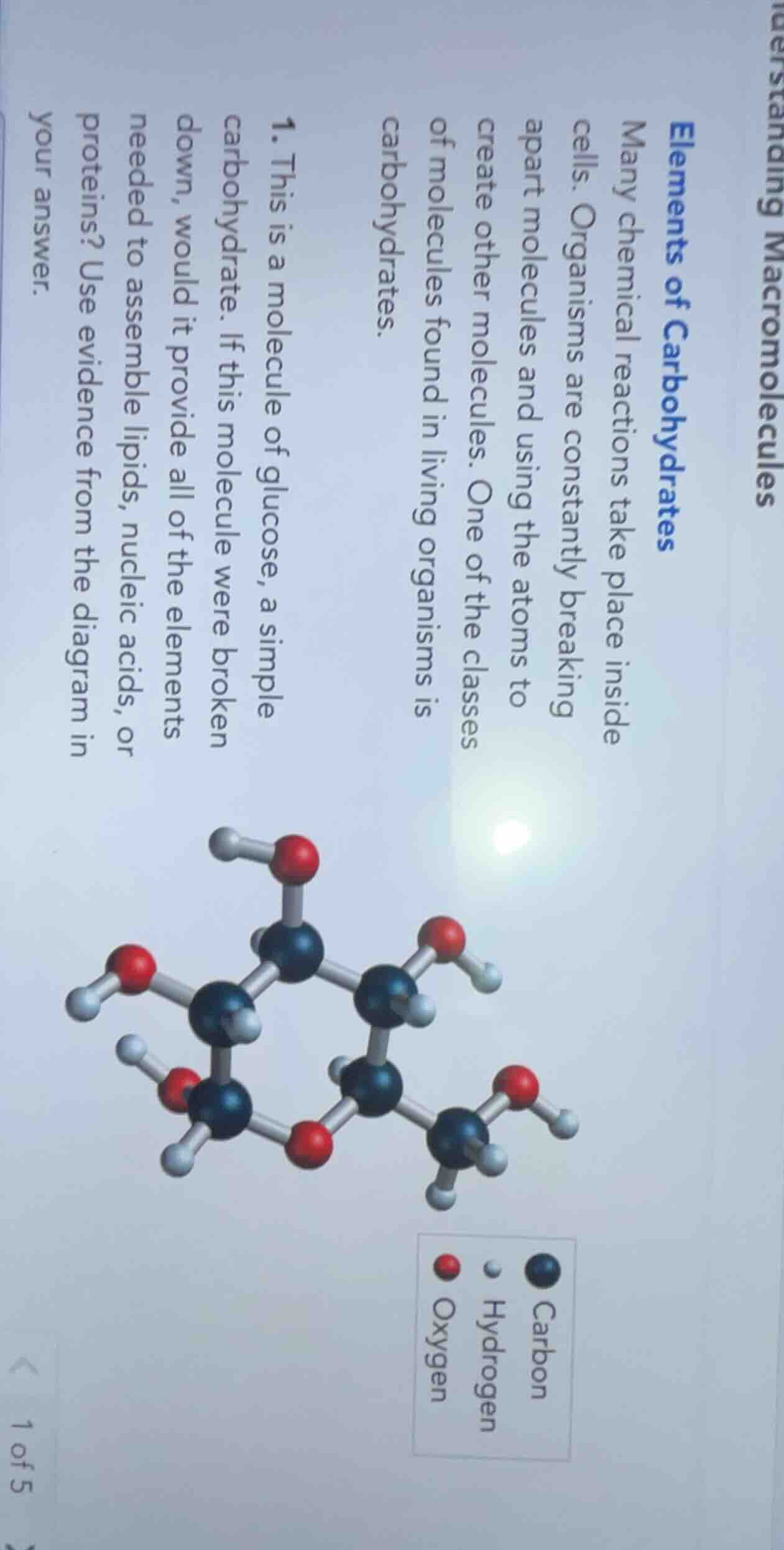
- this is a molecule of glucose, a simple carbohydrate. if this molecule were broken down, would it provide all of the elements needed to assemble lipids, nucleic acids, or proteins? use evidence from the diagram in your answer.
Glucose (a carbohydrate) is made of carbon, hydrogen, and oxygen (from the diagram: black = C, gray = H, red = O).
- Lipids: Also consist of C, H, O (some have P, but basic lipids like fats use C, H, O). So glucose’s elements (C, H, O) can help assemble lipids.
- Proteins: Require nitrogen (N) in addition to C, H, O. Glucose has no N, so can’t fully assemble proteins.
- Nucleic Acids: Need phosphorus (P) and nitrogen (N) too. Glucose lacks these, so can’t assemble nucleic acids.
Thus, glucose’s elements (C, H, O) can provide all elements needed for lipids (since lipids’ basic structure uses C, H, O), but not for proteins or nucleic acids (which need extra elements like N, P).

Snap & solve any problem in the app
Get step-by-step solutions on Sovi AI
Photo-based solutions with guided steps
Explore more problems and detailed explanations
The molecule of glucose (a carbohydrate) would provide all the elements needed to assemble lipids. Glucose is composed of carbon (C), hydrogen (H), and oxygen (O) (evidenced by the diagram: black = C, gray = H, red = O). Lipids also primarily consist of C, H, and O (e.g., fats, oils), so the elements from glucose (C, H, O) are sufficient. In contrast, proteins require nitrogen (N) (and sometimes sulfur) in addition to C, H, O, and nucleic acids require nitrogen (N) and phosphorus (P) as well—elements not present in glucose. Thus, glucose’s elements can fully supply what is needed for lipids, but not for proteins or nucleic acids.