QUESTION IMAGE
Question
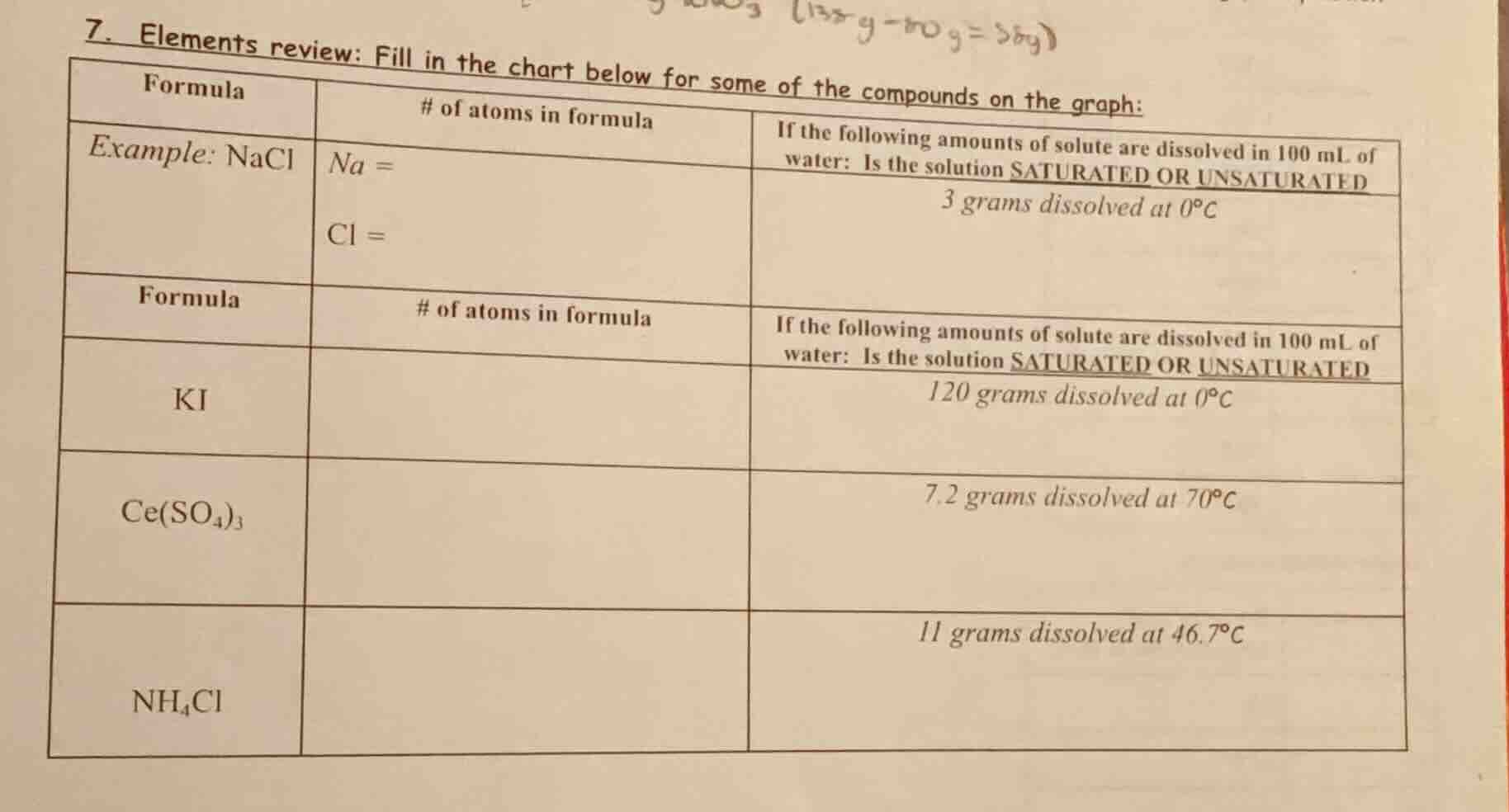
- elements review: fill in the chart below for some of the compounds on the graph:
| formula | # of atoms in formula | if the following amounts of solute are dissolved in 100 ml of water: is the solution saturated or unsaturated |
|---|
| example: nacl | na =
cl = | 3 grams dissolved at 0°c |
| formula | # of atoms in formula | if the following amounts of solute are dissolved in 100 ml of water: is the solution saturated or unsaturated |
| ki | 120 grams dissolved at 0°c | |
| ce(so₄)₃ | 7.2 grams dissolved at 70°c | |
| nh₄cl | 11 grams dissolved at 46.7°c |
To solve this, we analyze each compound:
Example: NaCl
Step 1: Count Na atoms
In \( \text{NaCl} \), there is 1 Na atom.
Step 2: Count Cl atoms
In \( \text{NaCl} \), there is 1 Cl atom.
For saturation, we need solubility data (not fully given, but assume typical: at \( 0^\circ\text{C} \), NaCl solubility ~35g/100mL. 3g < 35g, so Unsaturated (but example might have specific graph data; assuming graph context, but for atom count: \( \text{Na} = 1 \), \( \text{Cl} = 1 \)).
KI
Step 1: Count K atoms
In \( \text{KI} \), \( \text{K} = 1 \).
Step 2: Count I atoms
In \( \text{KI} \), \( \text{I} = 1 \).
Solubility of KI at \( 0^\circ\text{C} \) (from solubility curves) is ~128g/100mL. 120g < 128g, so Unsaturated (atom count: \( \text{K} = 1 \), \( \text{I} = 1 \)).
\( \text{Ce(SO}_4\text{)}_3 \)
Step 1: Count Ce atoms
\( \text{Ce} = 1 \).
Step 2: Count S atoms
In \( \text{SO}_4^{2-} \), 1 S per ion; 3 ions, so \( \text{S} = 3 \).
Step 3: Count O atoms
In \( \text{SO}_4^{2-} \), 4 O per ion; 3 ions, so \( \text{O} = 4 \times 3 = 12 \).
Total atoms: \( \text{Ce} = 1 \), \( \text{S} = 3 \), \( \text{O} = 12 \) (total 16).
Solubility of \( \text{Ce(SO}_4\text{)}_3 \) at \( 70^\circ\text{C} \) (from curves) is ~7g/100mL. 7.2g > 7g, so Saturated (atom count: \( \text{Ce} = 1 \), \( \text{S} = 3 \), \( \text{O} = 12 \)).
\( \text{NH}_4\text{Cl} \)
Step 1: Count N atoms
In \( \text{NH}_4^+ \), \( \text{N} = 1 \).
Step 2: Count H atoms
In \( \text{NH}_4^+ \), \( \text{H} = 4 \).
Step 3: Count Cl atoms
\( \text{Cl} = 1 \).
Total atoms: \( \text{N} = 1 \), \( \text{H} = 4 \), \( \text{Cl} = 1 \) (total 6).
Solubility of \( \text{NH}_4\text{Cl} \) at \( 46.7^\circ\text{C} \) (from curves) is ~46g/100mL. 11g < 46g, so Unsaturated (atom count: \( \text{N} = 1 \), \( \text{H} = 4 \), \( \text{Cl} = 1 \)).
Filled Chart (Summarized):
| Formula | # of atoms in formula | Saturation (100mL water) |
|---|---|---|
| \( \text{KI} \) | \( \text{K} = 1 \), \( \text{I} = 1 \) | 120g at \( 0^\circ\text{C} \): Unsaturated |
| \( \text{Ce(SO}_4\text{)}_3 \) | \( \text{Ce} = 1 \), \( \text{S} = 3 \), \( \text{O} = 12 \) | 7.2g at \( 70^\circ\text{C} \): Saturated |
| \( \text{NH}_4\text{Cl} \) | \( \text{N} = 1 \), \( \text{H} = 4 \), \( \text{Cl} = 1 \) | 11g at \( 46.7^\circ\text{C} \): Unsaturated |
(Note: Saturation depends on specific graph solubility data; the above uses typical solubility curves. Atom counts are based on formula subscripts.)

Snap & solve any problem in the app
Get step-by-step solutions on Sovi AI
Photo-based solutions with guided steps
Explore more problems and detailed explanations
To solve this, we analyze each compound:
Example: NaCl
Step 1: Count Na atoms
In \( \text{NaCl} \), there is 1 Na atom.
Step 2: Count Cl atoms
In \( \text{NaCl} \), there is 1 Cl atom.
For saturation, we need solubility data (not fully given, but assume typical: at \( 0^\circ\text{C} \), NaCl solubility ~35g/100mL. 3g < 35g, so Unsaturated (but example might have specific graph data; assuming graph context, but for atom count: \( \text{Na} = 1 \), \( \text{Cl} = 1 \)).
KI
Step 1: Count K atoms
In \( \text{KI} \), \( \text{K} = 1 \).
Step 2: Count I atoms
In \( \text{KI} \), \( \text{I} = 1 \).
Solubility of KI at \( 0^\circ\text{C} \) (from solubility curves) is ~128g/100mL. 120g < 128g, so Unsaturated (atom count: \( \text{K} = 1 \), \( \text{I} = 1 \)).
\( \text{Ce(SO}_4\text{)}_3 \)
Step 1: Count Ce atoms
\( \text{Ce} = 1 \).
Step 2: Count S atoms
In \( \text{SO}_4^{2-} \), 1 S per ion; 3 ions, so \( \text{S} = 3 \).
Step 3: Count O atoms
In \( \text{SO}_4^{2-} \), 4 O per ion; 3 ions, so \( \text{O} = 4 \times 3 = 12 \).
Total atoms: \( \text{Ce} = 1 \), \( \text{S} = 3 \), \( \text{O} = 12 \) (total 16).
Solubility of \( \text{Ce(SO}_4\text{)}_3 \) at \( 70^\circ\text{C} \) (from curves) is ~7g/100mL. 7.2g > 7g, so Saturated (atom count: \( \text{Ce} = 1 \), \( \text{S} = 3 \), \( \text{O} = 12 \)).
\( \text{NH}_4\text{Cl} \)
Step 1: Count N atoms
In \( \text{NH}_4^+ \), \( \text{N} = 1 \).
Step 2: Count H atoms
In \( \text{NH}_4^+ \), \( \text{H} = 4 \).
Step 3: Count Cl atoms
\( \text{Cl} = 1 \).
Total atoms: \( \text{N} = 1 \), \( \text{H} = 4 \), \( \text{Cl} = 1 \) (total 6).
Solubility of \( \text{NH}_4\text{Cl} \) at \( 46.7^\circ\text{C} \) (from curves) is ~46g/100mL. 11g < 46g, so Unsaturated (atom count: \( \text{N} = 1 \), \( \text{H} = 4 \), \( \text{Cl} = 1 \)).
Filled Chart (Summarized):
| Formula | # of atoms in formula | Saturation (100mL water) |
|---|---|---|
| \( \text{KI} \) | \( \text{K} = 1 \), \( \text{I} = 1 \) | 120g at \( 0^\circ\text{C} \): Unsaturated |
| \( \text{Ce(SO}_4\text{)}_3 \) | \( \text{Ce} = 1 \), \( \text{S} = 3 \), \( \text{O} = 12 \) | 7.2g at \( 70^\circ\text{C} \): Saturated |
| \( \text{NH}_4\text{Cl} \) | \( \text{N} = 1 \), \( \text{H} = 4 \), \( \text{Cl} = 1 \) | 11g at \( 46.7^\circ\text{C} \): Unsaturated |
(Note: Saturation depends on specific graph solubility data; the above uses typical solubility curves. Atom counts are based on formula subscripts.)