QUESTION IMAGE
Question
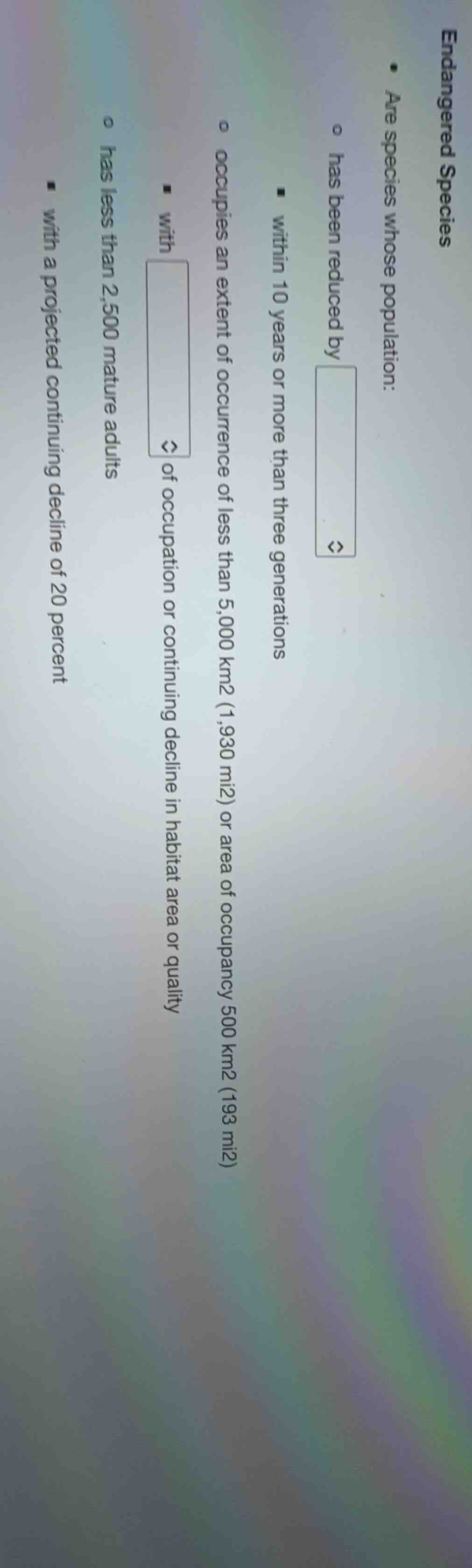
endangered species - are species whose population:
- has been reduced by
- within 10 years or more than three generations
- occupies an extent of occurrence of less than 5,000 km2 (1,930 mi2) or area of occupancy 500 km2 (193 mi2)
- with of occupation or continuing decline in habitat area or quality
- has less than 2,500 mature adults
- with a projected continuing decline of 20 percent
To answer questions related to endangered species' population criteria, we refer to the IUCN Red List criteria (a key framework in conservation biology, part of the Natural Science - Biology subfield).
For the first dropdown ("has been reduced by"):
The IUCN criteria for population reduction state that a species is endangered if its population has been reduced by 50% or more within 10 years or three generations (whichever is longer). This is a core criterion for assessing population decline in endangered species.
For the second dropdown ("with [ ] of occupation or continuing decline..."):
The IUCN criteria for habitat decline (area of occupancy or quality) specify that a species is endangered if it has a continuing decline (e.g., due to habitat loss, degradation) in its area of occupancy or quality. The phrase here fits the criterion of a "continuing decline" in habitat - related metrics (area or quality) alongside the other population - based criteria (e.g., <2,500 mature adults, population reduction).
Final Answers (Filling the Blanks):
- First blank (population reduction): $\boldsymbol{50\%}$ (or "50 percent" depending on formatting; the key is the 50% reduction within 10 years/3 generations).
- Second blank (habitat decline): $\boldsymbol{continuing\ decline}$ (matches the IUCN criterion for ongoing habitat loss/quality reduction).
(Note: If the dropdowns have specific options, the most accurate IUCN - based answers for these blanks are "50%" (for population reduction) and "continuing decline" (for habitat - related decline), as these align with the standard endangered species assessment criteria.)

Snap & solve any problem in the app
Get step-by-step solutions on Sovi AI
Photo-based solutions with guided steps
Explore more problems and detailed explanations
To answer questions related to endangered species' population criteria, we refer to the IUCN Red List criteria (a key framework in conservation biology, part of the Natural Science - Biology subfield).
For the first dropdown ("has been reduced by"):
The IUCN criteria for population reduction state that a species is endangered if its population has been reduced by 50% or more within 10 years or three generations (whichever is longer). This is a core criterion for assessing population decline in endangered species.
For the second dropdown ("with [ ] of occupation or continuing decline..."):
The IUCN criteria for habitat decline (area of occupancy or quality) specify that a species is endangered if it has a continuing decline (e.g., due to habitat loss, degradation) in its area of occupancy or quality. The phrase here fits the criterion of a "continuing decline" in habitat - related metrics (area or quality) alongside the other population - based criteria (e.g., <2,500 mature adults, population reduction).
Final Answers (Filling the Blanks):
- First blank (population reduction): $\boldsymbol{50\%}$ (or "50 percent" depending on formatting; the key is the 50% reduction within 10 years/3 generations).
- Second blank (habitat decline): $\boldsymbol{continuing\ decline}$ (matches the IUCN criterion for ongoing habitat loss/quality reduction).
(Note: If the dropdowns have specific options, the most accurate IUCN - based answers for these blanks are "50%" (for population reduction) and "continuing decline" (for habitat - related decline), as these align with the standard endangered species assessment criteria.)