QUESTION IMAGE
Question
energy
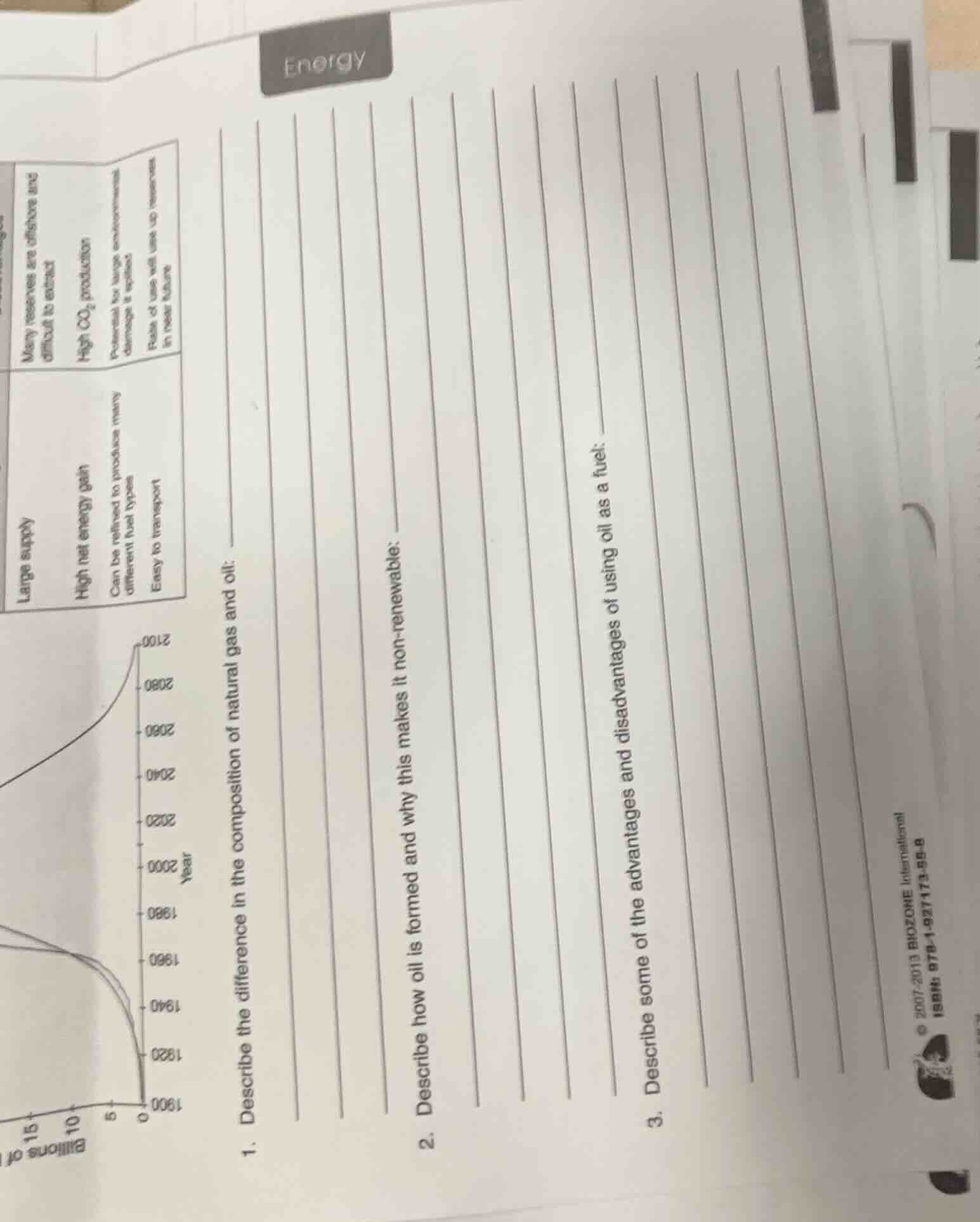
- describe the difference in the composition of natural gas and oil:
- describe how oil is formed and why this makes it non - renewable:
- describe some of the advantages and disadvantages of using oil as a fuel:
Question 1: Describe the difference in the composition of natural gas and oil.
Natural gas is mainly composed of methane ($CH_4$) along with small amounts of other hydrocarbons like ethane, propane, and butane. Oil (petroleum) is a complex mixture of hydrocarbons, including alkanes, cycloalkanes, and aromatic hydrocarbons, with varying carbon chain lengths. The main difference is in their molecular structure and hydrocarbon composition: natural gas has simpler, shorter - chain hydrocarbons (dominantly methane), while oil has a wider range of more complex, longer - chain hydrocarbons.
Oil is formed from the remains of marine organisms (plankton, algae) that died millions of years ago. These organisms were buried under sediment, and over time, due to high pressure and temperature in the Earth's crust, their organic matter was transformed into oil. It is non - renewable because the formation process takes millions of years, and the rate of consumption (extraction and use) is much faster than the rate at which it is formed naturally.
Advantages:
- Energy Density: Oil has a high energy density, meaning it can provide a large amount of energy per unit volume or mass. This makes it efficient for use in transportation (e.g., powering cars, ships, planes) as it can provide long - range travel without frequent refueling.
- Versatility: It can be refined into a wide variety of products such as gasoline, diesel, jet fuel, and lubricants, which are used in different sectors of the economy.
- Infrastructure: There is a well - developed global infrastructure for extracting, refining, transporting, and distributing oil, which makes it easy to access and use.
Disadvantages:
- Environmental Impact: Burning oil releases large amounts of carbon dioxide ($CO_2$) and other pollutants (e.g., sulfur oxides, nitrogen oxides) which contribute to climate change and air pollution. Also, oil spills during extraction, transportation, or refining can cause severe damage to ecosystems (e.g., marine life in case of ocean spills).
- Finite Resource: As a non - renewable resource, oil reserves are limited. Once they are depleted, there will be no new oil formed in a human - relevant timescale.
- Political and Economic Instability: Oil - producing regions often face political unrest, and the global oil market is subject to price fluctuations, which can have a significant impact on the economies of oil - importing and oil - producing countries.

Snap & solve any problem in the app
Get step-by-step solutions on Sovi AI
Photo-based solutions with guided steps
Explore more problems and detailed explanations
Natural gas is mainly methane ($CH_4$) with small other hydrocarbons. Oil is a complex mix of various hydrocarbons (alkanes, cycloalkanes, aromatics) with longer, more complex chains.