QUESTION IMAGE
Question
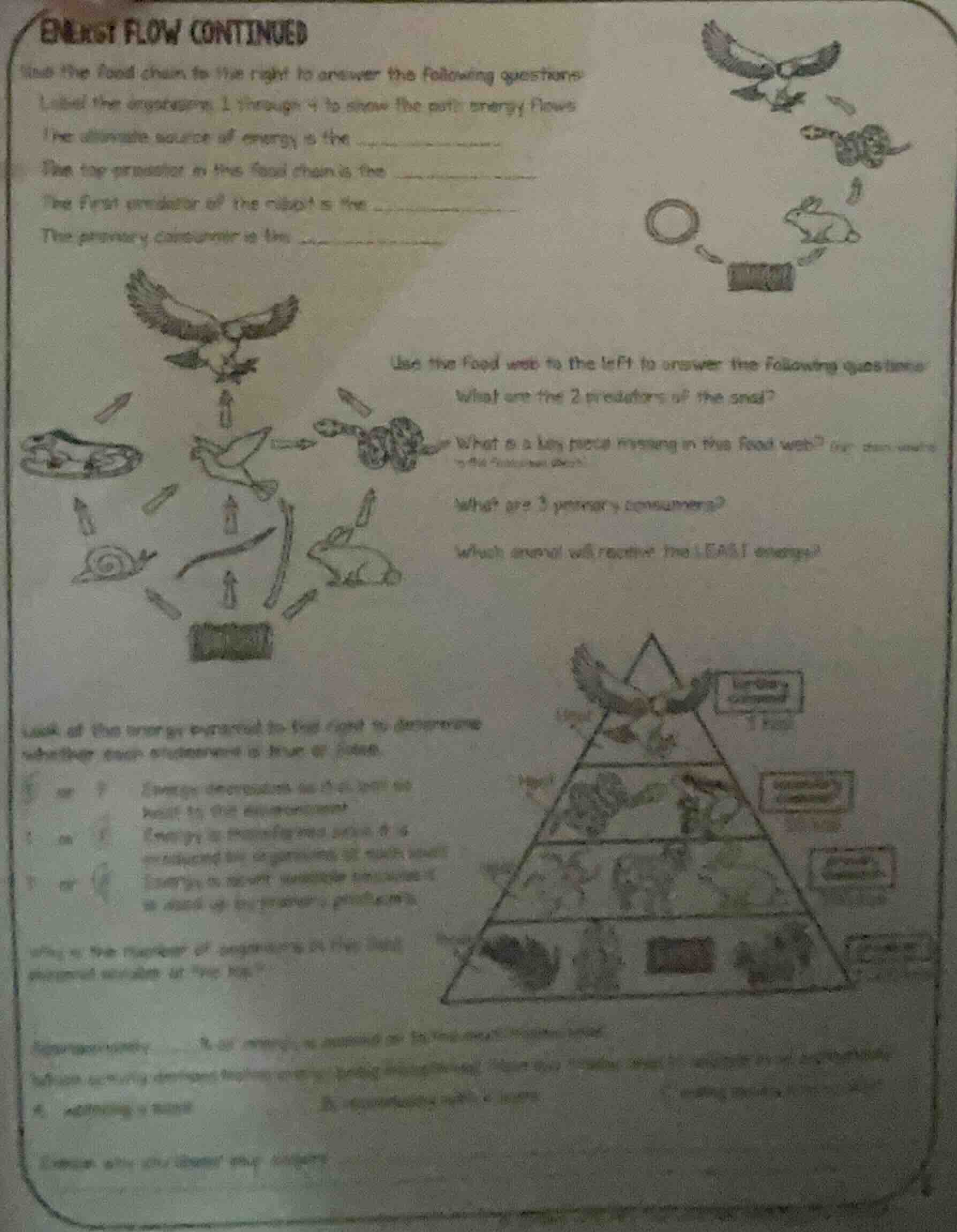
energy flow continued
use the food chain to the right to answer the following questions:
list the organisms 1 through 4 to show the path energy flows
the ultimate source of energy is the _____________
the top predator in this food chain is the _____________
the first predator of the rabbit is the _____________
the primary consumer is the _____________
use the food web to the left to answer the following questions:
what are the 2 predators of the snail?
what is a key piece missing in this food web? (or decomposers?)
what are 3 primary consumers?
which animal will receive the least energy?
look at the energy pyramid to the right to determine whether each statement is true or false.
(questions about energy pyramid: energy decreases as it moves up? energy is transferred when one organism eats another? energy to support organisms is about 10% of producer’s energy?)
why is the number of organisms on the top pyramid level so few?
approximately ____% of energy is passed on to the next level.
(question about energy flow in ecosystem: before activity, students list ways energy is used. options: a. obtaining a mate, b. reproductive needs, c. building tissues, d. all of these)
explain why you chose your answer.
To solve the questions related to the food chain, food web, and energy pyramid, we analyze each part:
1. Energy Flow Path (Food Chain)
The food chain likely involves: Grass (Producer) → Rabbit (Primary Consumer) → Snake (Secondary Consumer) → Hawk (Tertiary Consumer). So label 1–4 as: 1. Grass, 2. Rabbit, 3. Snake, 4. Hawk.
2. Ultimate Energy Source
The ultimate source of energy in ecosystems is the Sun (solar energy).
3. Top Producer in the Food Chain
The producer (autotroph) is the Grass (or plant) that makes its own food via photosynthesis.
4. First Predator of the Rabbit
In the food chain, the rabbit is eaten by the Snake (so the snake is the first predator of the rabbit).
5. Primary Consumer
The primary consumer (eats producers) is the Rabbit (eats grass).
6. Predators of the Snail (Food Web)
From the food web, the snail’s predators are likely the Bird (e.g., Dove) and the Hawk (or another carnivore/omnivore that eats snails).
7. Missing Part in the Food Web
A key part missing is Decomposers (e.g., bacteria/fungi) to break down dead organisms and recycle nutrients.
8. Three Primary Consumers
Primary consumers eat producers (plants). Examples: Rabbit, Snail, Insect (or other herbivores in the web).
9. Animal with Least Energy
In an energy pyramid, energy decreases with each trophic level. The Hawk (top predator) receives the least energy (as energy is lost at each level).
10. Energy Pyramid Statements (True/False)
- “Energy decomposes as it is lost to the environment?” → Energy is transferred (not decomposed); lost as heat. So False.
- “Energy is transferred when it is consumed by organisms of each level?” → True (energy moves from prey to predator).
- “Energy to support consumers is about 10% of producer’s production?” → True (10% energy transfer rule).
11. Number of Organisms in the Energy Pyramid
Energy pyramids have fewer organisms at higher levels (due to energy loss). So the number of organisms is Smaller at the top (e.g., hawk level) than at the bottom (grass level).
12. Energy Movement in the Pyramid
Energy moves Upward through trophic levels (from producers to top predators), but most is lost as heat.
13. Energy Transfer Before Activity
Before an animal (e.g., rabbit) is active, energy is stored as Chemical Energy in its food (e.g., grass) or body.
14. Why Food Chains Have Few Steps
Food chains have 3–5 steps because Energy loss (≈90% per level) makes it inefficient to support more than 4–5 trophic levels (not enough energy for higher levels).
These answers align with ecological principles (energy flow, trophic levels, producers/consumers, decomposers).

Snap & solve any problem in the app
Get step-by-step solutions on Sovi AI
Photo-based solutions with guided steps
Explore more problems and detailed explanations
To solve the questions related to the food chain, food web, and energy pyramid, we analyze each part:
1. Energy Flow Path (Food Chain)
The food chain likely involves: Grass (Producer) → Rabbit (Primary Consumer) → Snake (Secondary Consumer) → Hawk (Tertiary Consumer). So label 1–4 as: 1. Grass, 2. Rabbit, 3. Snake, 4. Hawk.
2. Ultimate Energy Source
The ultimate source of energy in ecosystems is the Sun (solar energy).
3. Top Producer in the Food Chain
The producer (autotroph) is the Grass (or plant) that makes its own food via photosynthesis.
4. First Predator of the Rabbit
In the food chain, the rabbit is eaten by the Snake (so the snake is the first predator of the rabbit).
5. Primary Consumer
The primary consumer (eats producers) is the Rabbit (eats grass).
6. Predators of the Snail (Food Web)
From the food web, the snail’s predators are likely the Bird (e.g., Dove) and the Hawk (or another carnivore/omnivore that eats snails).
7. Missing Part in the Food Web
A key part missing is Decomposers (e.g., bacteria/fungi) to break down dead organisms and recycle nutrients.
8. Three Primary Consumers
Primary consumers eat producers (plants). Examples: Rabbit, Snail, Insect (or other herbivores in the web).
9. Animal with Least Energy
In an energy pyramid, energy decreases with each trophic level. The Hawk (top predator) receives the least energy (as energy is lost at each level).
10. Energy Pyramid Statements (True/False)
- “Energy decomposes as it is lost to the environment?” → Energy is transferred (not decomposed); lost as heat. So False.
- “Energy is transferred when it is consumed by organisms of each level?” → True (energy moves from prey to predator).
- “Energy to support consumers is about 10% of producer’s production?” → True (10% energy transfer rule).
11. Number of Organisms in the Energy Pyramid
Energy pyramids have fewer organisms at higher levels (due to energy loss). So the number of organisms is Smaller at the top (e.g., hawk level) than at the bottom (grass level).
12. Energy Movement in the Pyramid
Energy moves Upward through trophic levels (from producers to top predators), but most is lost as heat.
13. Energy Transfer Before Activity
Before an animal (e.g., rabbit) is active, energy is stored as Chemical Energy in its food (e.g., grass) or body.
14. Why Food Chains Have Few Steps
Food chains have 3–5 steps because Energy loss (≈90% per level) makes it inefficient to support more than 4–5 trophic levels (not enough energy for higher levels).
These answers align with ecological principles (energy flow, trophic levels, producers/consumers, decomposers).