QUESTION IMAGE
Question
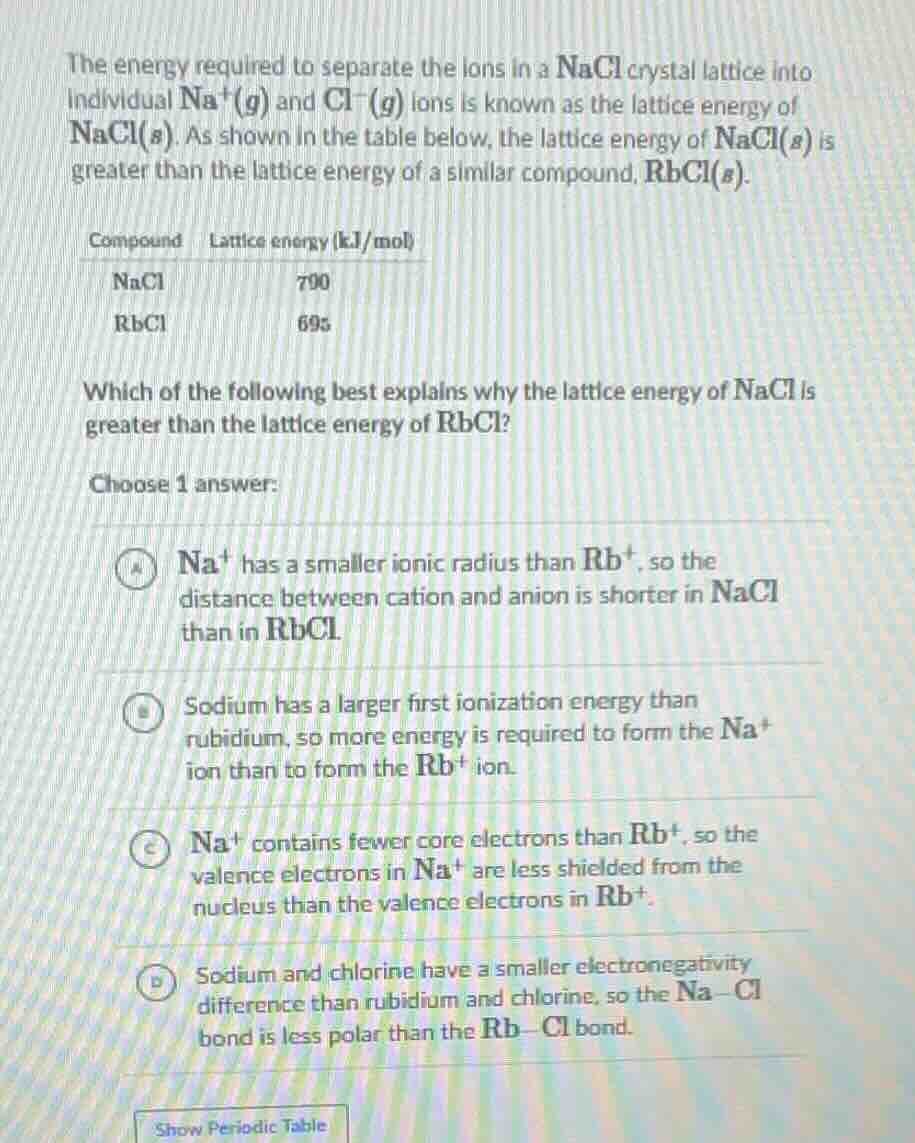
the energy required to separate the ions in a nacl crystal lattice into individual na⁺(g) and cl⁻(g) ions is known as the lattice energy of nacl(s). as shown in the table below, the lattice energy of nacl(g) is greater than the lattice energy of a similar compound, rbcl(g).
compound lattice energy (kj/mol)
nacl 700
rbcl 695
which of the following best explains why the lattice energy of nacl is greater than the lattice energy of rbcl?
choose 1 answer:
a na⁺ has a smaller ionic radius than rb⁺, so the distance between cation and anion is shorter in nacl than in rbcl.
b sodium has a larger first ionization energy than rubidium, so more energy is required to form the na⁺ ion than to form the rb⁺ ion.
c na⁺ contains fewer core electrons than rb⁺, so the valence electrons in na⁺ are less shielded from the nucleus than the valence electrons in rb⁺.
d sodium and chlorine have a smaller electronegativity difference than rubidium and chlorine, so the na–cl bond is less polar than the rb–cl bond.
To determine why NaCl has a greater lattice energy than RbCl, we analyze the factors affecting lattice energy (which depends on ion charge and ion - ion distance, with smaller distance and higher charge leading to greater lattice energy).
- Option A: $Na^+$ has a smaller ionic radius than $Rb^+$. In the crystal lattice, the distance between $Na^+$ and $Cl^-$ is shorter than the distance between $Rb^+$ and $Cl^-$. A shorter ion - ion distance means a stronger electrostatic attraction between ions, which leads to a greater lattice energy. This option is consistent with the concept of lattice energy.
- Option B: Lattice energy is about the energy to separate ions in a lattice, not about the energy to form the ions (ionization energy). So this option is incorrect as it confuses lattice energy with ionization energy.
- Option C: The shielding of valence electrons in the cation is not the main factor determining lattice energy. Lattice energy is more related to the distance between ions and ion charges, so this option is not relevant.
- Option D: The electronegativity difference affects bond polarity, but lattice energy depends on ion - ion interactions (distance and charge), not bond polarity. Also, Na has a higher electronegativity than Rb, so the Na - Cl electronegativity difference is larger than Rb - Cl, making this option's statement wrong.

Snap & solve any problem in the app
Get step-by-step solutions on Sovi AI
Photo-based solutions with guided steps
Explore more problems and detailed explanations
A. $\ce{Na^{+}}$ has a smaller ionic radius than $\ce{Rb^{+}}$, so the distance between cation and anion is shorter in $\ce{NaCl}$ than in $\ce{RbCl}$.