QUESTION IMAGE
Question
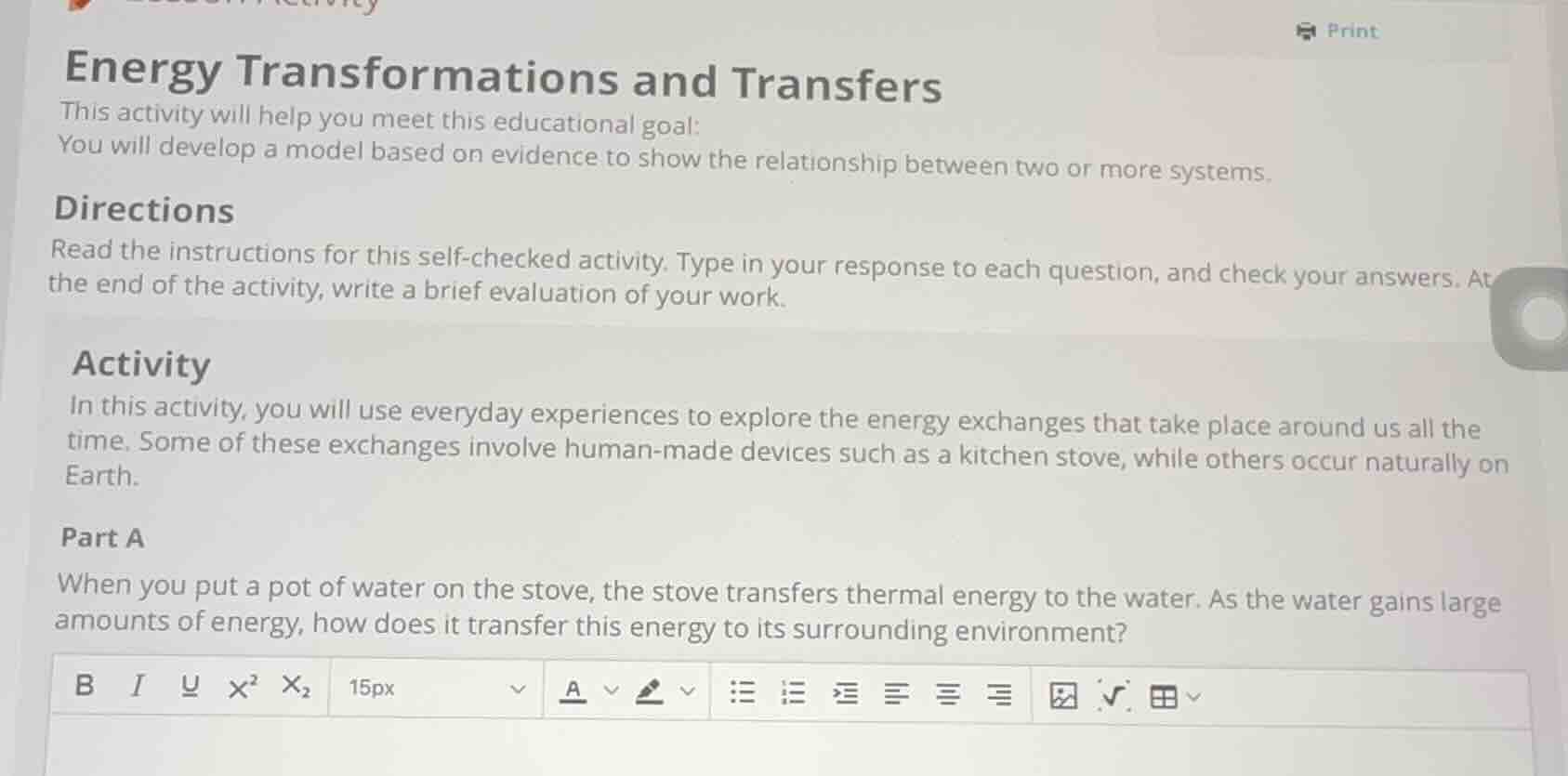
energy transformations and transfers
this activity will help you meet this educational goal:
you will develop a model based on evidence to show the relationship between two or more systems.
directions
read the instructions for this self - checked activity. type in your response to each question, and check your answers. at the end of the activity, write a brief evaluation of your work.
activity
in this activity, you will use everyday experiences to explore the energy exchanges that take place around us all the time. some of these exchanges involve human - made devices such as a kitchen stove, while others occur naturally on earth.
part a
when you put a pot of water on the stove, the stove transfers thermal energy to the water. as the water gains large amounts of energy, how does it transfer this energy to its surrounding environment?
When water on the stove gains thermal energy and gets hot, it transfers energy to the surrounding environment mainly through two processes: conduction (transfer of heat through direct contact, e.g., the hot pot transferring heat to the air or objects touching it) and convection (in the air, hot air rises and is replaced by cooler air, creating a current that carries heat away) as well as radiation (emission of infrared radiation which carries heat energy). Also, if the water boils, the steam (water vapor) carries heat energy and when it condenses in the surrounding air, it releases that heat.

Snap & solve any problem in the app
Get step-by-step solutions on Sovi AI
Photo-based solutions with guided steps
Explore more problems and detailed explanations
When the water gains thermal energy from the stove and becomes hot, it transfers energy to the surrounding environment primarily through conduction (transferring heat to nearby objects or air via direct contact), convection (creating air currents as hot air near the water rises and is replaced by cooler air, which then gets heated and rises, transferring heat away), and radiation (emitting infrared radiation that carries heat energy). Additionally, if the water boils, the water vapor (steam) produced carries thermal energy; when this steam condenses in the cooler surrounding air, it releases the heat it had absorbed during vaporization, further transferring energy to the environment.