QUESTION IMAGE
Question
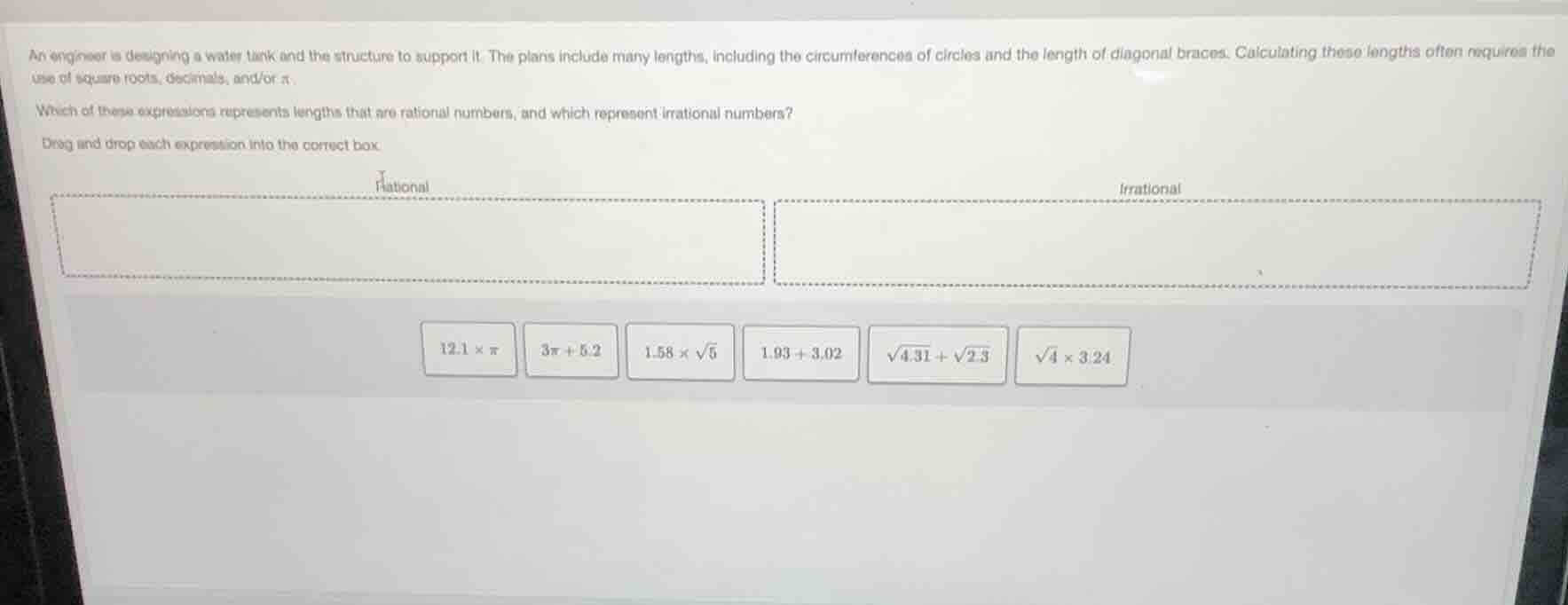
an engineer is designing a water tank and the structure to support it. the plans include many lengths, including the circumferences of circles and the length of diagonal braces. calculating these lengths often requires the use of square roots, decimals, and/or π. which of these expressions represents lengths that are rational numbers, and which represent irrational numbers? drag and drop each expression into the correct box. rational irrational 12.1 × π 3π + 5.2 1.58 × √5 1.93 + 3.02 √4.31 + √2.5 √4 × 3.24
To determine if an expression represents a rational or irrational number, we use the definitions:
- Rational numbers: Can be expressed as a fraction of two integers (\(\frac{p}{q}\), \(q
eq0\)), or are terminating/repeating decimals. They can also be results of operations on rational numbers (like addition, multiplication) or square roots of perfect squares (since \(\sqrt{4} = 2\), a rational number).
- Irrational numbers: Cannot be expressed as a fraction of two integers, have non - terminating and non - repeating decimal expansions. They include numbers like \(\pi\) (and expressions involving \(\pi\) that can't be simplified to a rational form), square roots of non - perfect squares, and sums/products involving such irrational numbers.
Step 1: Analyze \(1.93 + 3.02\)
Adding two decimals: \(1.93+3.02 = 4.95\), which is a terminating decimal. So, \(1.93 + 3.02\) is a rational number.
Step 2: Analyze \(\sqrt{4}\times3.24\)
First, calculate \(\sqrt{4}\). Since \(2\times2 = 4\), \(\sqrt{4}=2\). Then, \(2\times3.24=6.48\), which is a terminating decimal. So, \(\sqrt{4}\times3.24\) is a rational number.
Step 3: Analyze \(12.1\times\pi\)
\(\pi\) is an irrational number. When we multiply a non - zero rational number (\(12.1\)) by an irrational number (\(\pi\)), the result is irrational. So, \(12.1\times\pi\) is an irrational number.
Step 4: Analyze \(3\pi + 5.2\)
\(\pi\) is irrational, and \(3\pi\) is also irrational (multiplying an irrational number by a non - zero rational number \(3\) gives an irrational number). Adding a rational number (\(5.2\)) to an irrational number (\(3\pi\)) results in an irrational number. So, \(3\pi + 5.2\) is an irrational number.
Step 5: Analyze \(1.58\times\sqrt{5}\)
\(\sqrt{5}\) is an irrational number (since \(5\) is not a perfect square). Multiplying a rational number (\(1.58\)) by an irrational number (\(\sqrt{5}\)) gives an irrational number. So, \(1.58\times\sqrt{5}\) is an irrational number.
Step 6: Analyze \(\sqrt{4.31}+\sqrt{2.5}\)
\(4.31\) and \(2.5\) are not perfect squares. So, \(\sqrt{4.31}\) and \(\sqrt{2.5}\) are irrational numbers. The sum of two irrational numbers is also an irrational number. So, \(\sqrt{4.31}+\sqrt{2.5}\) is an irrational number.

Snap & solve any problem in the app
Get step-by-step solutions on Sovi AI
Photo-based solutions with guided steps
Explore more problems and detailed explanations
- Rational: \(1.93 + 3.02\), \(\sqrt{4}\times3.24\)
- Irrational: \(12.1\times\pi\), \(3\pi + 5.2\), \(1.58\times\sqrt{5}\), \(\sqrt{4.31}+\sqrt{2.5}\)