QUESTION IMAGE
Question
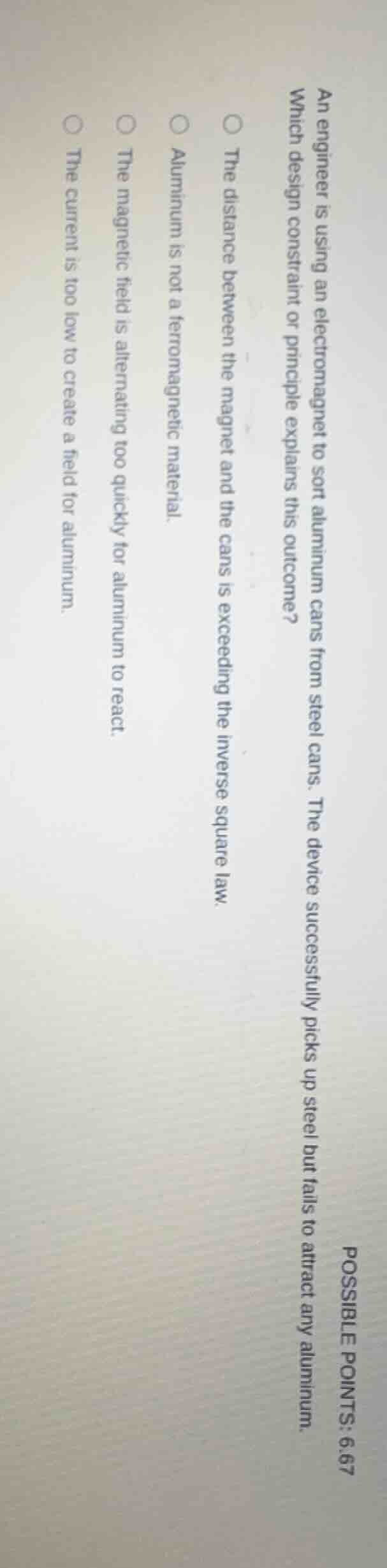
an engineer is using an electromagnet to sort aluminum cans from steel cans. the device successfully picks up steel but fails to attract any aluminum. which design constraint or principle explains this outcome? the distance between the magnet and the cans is exceeding the inverse square law. aluminum is not a ferromagnetic material. the magnetic field is alternating too quickly for aluminum to react. the current is too low to create a field for aluminum.
Steel is a ferromagnetic material, meaning it is strongly attracted to magnets. Aluminum is a paramagnetic material, which only has an extremely weak magnetic response that is not strong enough to be picked up by a standard electromagnet used for sorting. The other options do not explain the core reason: the inverse square law affects magnetic strength with distance but doesn't explain why aluminum isn't attracted at all; alternating field speed and current level don't address the fundamental magnetic property difference.

Snap & solve any problem in the app
Get step-by-step solutions on Sovi AI
Photo-based solutions with guided steps
Explore more problems and detailed explanations
Aluminum is not a ferromagnetic material.