QUESTION IMAGE
Question
english test
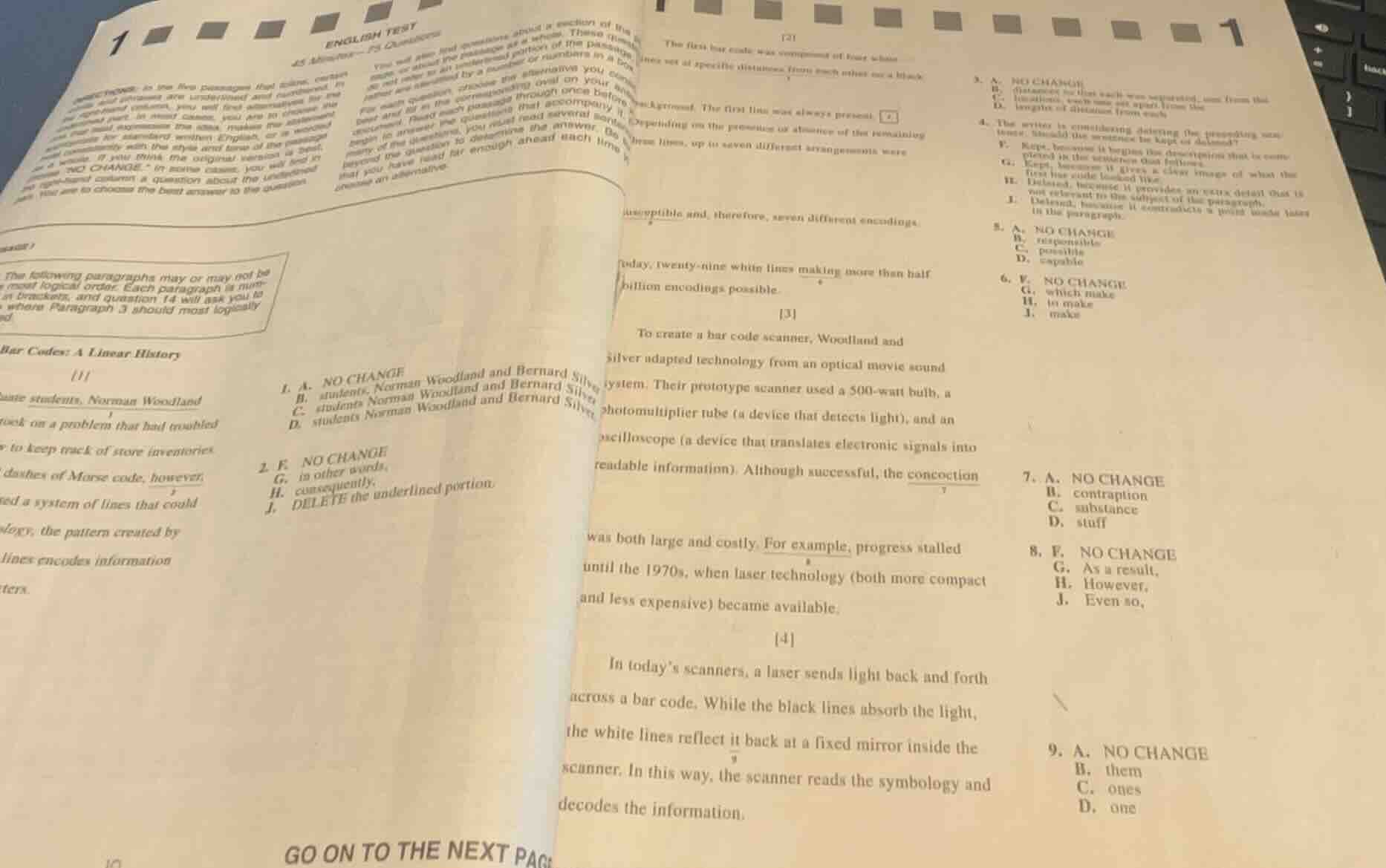
the following paragraphs may or may not be in most logical order. each paragraph is num- bered in brackets, and question 14 will ask you to where paragraph 3 should most logically go.
bar codes: a linear history
1
students, norman woodland and bernard silver, took on a problem that had troubled to keep track of store inventories
dashes of morse code, however,
ed a system of lines that could
ology, the pattern created by
lines encodes information
ters.
- a. no change
b. students, norman woodland and bernard silver
c. students norman woodland and bernard silver,
d. students norman woodland and bernard silver
- f. no change
g. in other words,
h. consequently,
j. delete the underlined portion.
(2)
the first bar code was composed of four white lines set at specific distances from each other on a black ground. the first line was always present. depending on the presence or absence of the remaining three lines, up to seven different arrangements were susceptible and, therefore, seven different encodings.
today, twenty - nine white lines making more than half billion encodings possible.
3
to create a bar code scanner, woodland and silver adapted technology from an optical movie sound system. their prototype scanner used a 500 - watt bulb, a photomultiplier tube (a device that detects light), and an oscilloscope (a device that translates electronic signals into readable information). although successful, the concoction was both large and costly. for example, progress stalled until the 1970s, when laser technology (both more compact and less expensive) became available.
4
in todays scanners, a laser sends light back and forth across a bar code. while the black lines absorb the light, the white lines reflect it back at a fixed mirror inside the scanner. in this way, the scanner reads the symbology and decodes the information.
- a. no change
b.
c. situations, the first such was separated, one from the
d. length of distance from each
- the writer is considering deleting the preceding sen- tence. should the sentence be kept or deleted?
f. kept, because it begins the description that is to come
g. kept, because it gives a clear image of what the
h. deleted, because it provides an extra detail that is not relevant to the subject of the paragraph.
j. deleted, because it contradicts a point made later in the paragraph.
- a. no change
b. possible
c. capable
d.
- f. no change
g. which make
h. in make
j. make
- a. no change
b. contraption
c. substance
d. stuff
- f. no change
g. as a result,
h. however,
j. even so,
- a. no change
b. them
c. ones
d. one
- Question 1: The phrase "graduate students" is an appositive describing the two men, so it needs a comma after it to set it off from the proper nouns.
- Question 2: The sentence shifts from talking about Morse code to the new line-based system; "however" correctly shows this contrast, so no change is needed.
- Question 3: The context refers to the distances between lines being different from one another, so "distances of distance from each other" is incorrect. "Distances from each other" is the clear, correct phrasing.
- Question 4: The preceding sentence introduces the first bar code's structure, and the sentence in question elaborates on how it worked (creating 7 encodings). This is relevant context for the history of bar codes, so it should be kept.
- Question 5: The correct collocation is "make...possible", so "possible" is the right adjective here.
- Question 6: The subject "twenty-nine white lines" is plural, so the verb must be plural "make" to agree.
- Question 7: "Contraption" is the best term to describe a bulky, experimental prototype device, which fits the context of the early scanner.
- Question 8: The sentence explains the result of the prototype being large and costly (progress stalling), so "As a result" correctly shows this causal relationship.
- Question 9: The pronoun refers to the singular noun "light", so the singular pronoun "it" is correct, no change needed.

Snap & solve any problem in the app
Get step-by-step solutions on Sovi AI
Photo-based solutions with guided steps
Explore more problems and detailed explanations
- A. NO CHANGE
- F. NO CHANGE
- D. lengths of distance from each
- F. Keep, because it begins the description that is completed in the sentence that follows
- C. possible
- J. make
- B. contraption
- G. As a result,
- A. NO CHANGE