QUESTION IMAGE
Question
equality
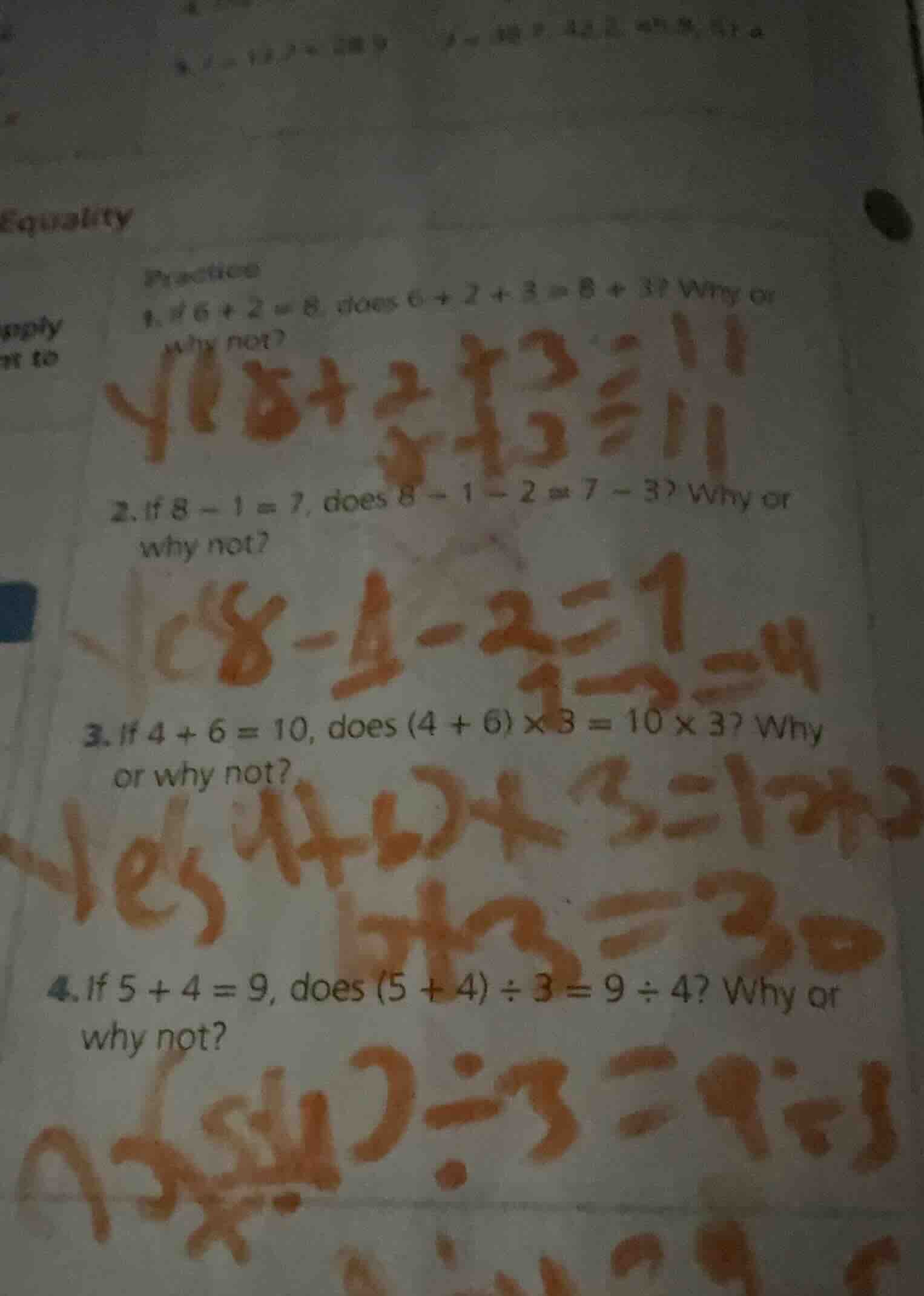
practice
- if 6 + 2 = 8, does 6 + 2 + 3 = 8 + 3? why or why not?
- if 8 - 1 = 7, does 8 - 1 - 2 = 7 - 3? why or why not?
- if 4 + 6 = 10, does (4 + 6) × 3 = 10 × 3? why or why not?
- if 5 + 4 = 9, does (5 + 4) ÷ 3 = 9 ÷ 4? why or why not?
Step1: Evaluate left-hand side (LHS)
$6+2+3 = 11$
Step2: Evaluate right-hand side (RHS)
$8+3 = 11$
Step3: Compare LHS and RHS
$11=11$, so equality holds due to the Addition Property of Equality (adding the same value to both sides of a true equality keeps it true).
Step4: Evaluate LHS of question 2
$8-1-2 = 5$
Step5: Evaluate RHS of question 2
$7-3 = 4$
Step6: Compare LHS and RHS
$5
eq4$, so equality fails because different values were subtracted from each side.
Step7: Evaluate LHS of question 3
$(4+6)\times3 = 10\times3 = 30$
Step8: Evaluate RHS of question 3
$10\times3 = 30$
Step9: Compare LHS and RHS
$30=30$, so equality holds due to the Multiplication Property of Equality (multiplying both sides of a true equality by the same non-zero value keeps it true).
Step10: Evaluate LHS of question 4
$(5+4)\div3 = 9\div3 = 3$
Step11: Evaluate RHS of question 4
$9\div4 = 2.25$
Step12: Compare LHS and RHS
$3
eq2.25$, so equality fails because different values were used to divide each side.

Snap & solve any problem in the app
Get step-by-step solutions on Sovi AI
Photo-based solutions with guided steps
Explore more problems and detailed explanations
- Yes, because $6+2+3=11$ and $8+3=11$. Adding the same number to both sides of a true equality preserves the equality.
- No, because $8-1-2=5$ and $7-3=4$. Different numbers were subtracted from each side, so the equality does not hold.
- Yes, because $(4+6)\times3=30$ and $10\times3=30$. Multiplying both sides of a true equality by the same number preserves the equality.
- No, because $(5+4)\div3=3$ and $9\div4=2.25$. Different numbers were used to divide each side, so the equality does not hold.