QUESTION IMAGE
Question
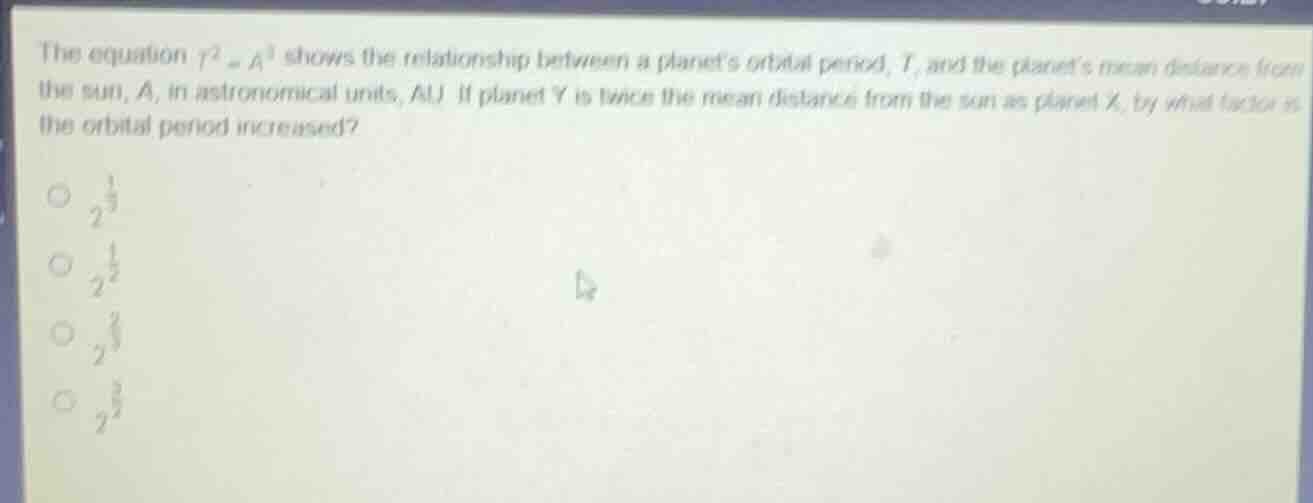
the equation ( t^2 = a^3 ) shows the relationship between a planets orbital period, ( t ), and the planets mean distance from the sun, ( a ), in astronomical units, au. if planet y is twice the mean distance from the sun as planet x, by what factor is the orbital period increased?
( 2^{\frac{1}{3}} )
( 2^{\frac{1}{2}} )
( 2^{\frac{2}{3}} )
( 2^{\frac{3}{2}} )
Step1: Define variables for planets X and Y
Let the mean distance of planet X from the sun be \( A_X \), so its orbital period \( T_X \) satisfies \( T_X^2 = A_X^3 \). For planet Y, its mean distance \( A_Y = 2A_X \), and its orbital period \( T_Y \) satisfies \( T_Y^2 = A_Y^3 \).
Step2: Substitute \( A_Y \) in terms of \( A_X \)
Substitute \( A_Y = 2A_X \) into the equation for \( T_Y \): \( T_Y^2=(2A_X)^3 = 8A_X^3 \).
Step3: Relate \( T_Y^2 \) to \( T_X^2 \)
We know \( T_X^2 = A_X^3 \), so substitute \( A_X^3=T_X^2 \) into the equation for \( T_Y^2 \): \( T_Y^2 = 8T_X^2 \).
Step4: Solve for \( T_Y \) in terms of \( T_X \)
Take the square root of both sides: \( T_Y=\sqrt{8}T_X = 2^{\frac{3}{2}}T_X \)? Wait, no, wait. Wait, \( T^2 = A^3 \), so \( T = A^{\frac{3}{2}} \). So for planet X, \( T_X = A_X^{\frac{3}{2}} \), for planet Y, \( T_Y=(2A_X)^{\frac{3}{2}}=2^{\frac{3}{2}}A_X^{\frac{3}{2}} = 2^{\frac{3}{2}}T_X \)? Wait, no, wait the options have \( 2^{\frac{3}{2}} \)? Wait the options are \( 2^{\frac{1}{3}} \), \( 2^{\frac{1}{2}} \), \( 2^{\frac{2}{3}} \), \( 2^{\frac{3}{2}} \). Wait, let's do it again.
Wait, the formula is \( T^2 = A^3 \), so \( T = A^{\frac{3}{2}} \). So if \( A_Y = 2A_X \), then \( T_Y=(2A_X)^{\frac{3}{2}}=2^{\frac{3}{2}}A_X^{\frac{3}{2}} \). But \( T_X = A_X^{\frac{3}{2}} \), so \( T_Y = 2^{\frac{3}{2}}T_X \)? Wait no, wait \( T^2 = A^3 \), so \( T = A^{3/2} \). So when \( A \) is doubled, \( T \) becomes \( (2A)^{3/2}=2^{3/2}A^{3/2}=2^{3/2}T \). Wait, but let's check the options. The last option is \( 2^{\frac{3}{2}} \), which is \( \sqrt{8} \), but wait, maybe I made a mistake. Wait, no, let's re-express \( T^2 = A^3 \), so \( T = A^{3/2} \), so the factor by which \( T \) increases when \( A \) is multiplied by 2 is \( (2A)^{3/2}/A^{3/2}=2^{3/2} \). So the factor is \( 2^{\frac{3}{2}} \), which is option D (the last option). Wait, but let's check the steps again.
Wait, let's let \( A_X = a \), so \( T_X^2 = a^3 \), so \( T_X = a^{3/2} \). For planet Y, \( A_Y = 2a \), so \( T_Y^2=(2a)^3 = 8a^3 \), so \( T_Y = \sqrt{8a^3}= (8)^{1/2}a^{3/2}= (2^3)^{1/2}a^{3/2}=2^{3/2}a^{3/2}=2^{3/2}T_X \). So the factor is \( 2^{3/2} \), which is \( 2^{\frac{3}{2}} \), so the answer is \( 2^{\frac{3}{2}} \), which is the last option.
Wait, but let's check the options again. The options are:
- \( 2^{\frac{1}{3}} \)
- \( 2^{\frac{1}{2}} \)
- \( 2^{\frac{2}{3}} \)
- \( 2^{\frac{3}{2}} \)
Yes, so the correct factor is \( 2^{\frac{3}{2}} \), which is the last option.

Snap & solve any problem in the app
Get step-by-step solutions on Sovi AI
Photo-based solutions with guided steps
Explore more problems and detailed explanations
\( 2^{\frac{3}{2}} \) (the last option, e.g., if the last option is D. \( 2^{\frac{3}{2}} \), then D. \( 2^{\frac{3}{2}} \))