QUESTION IMAGE
Question
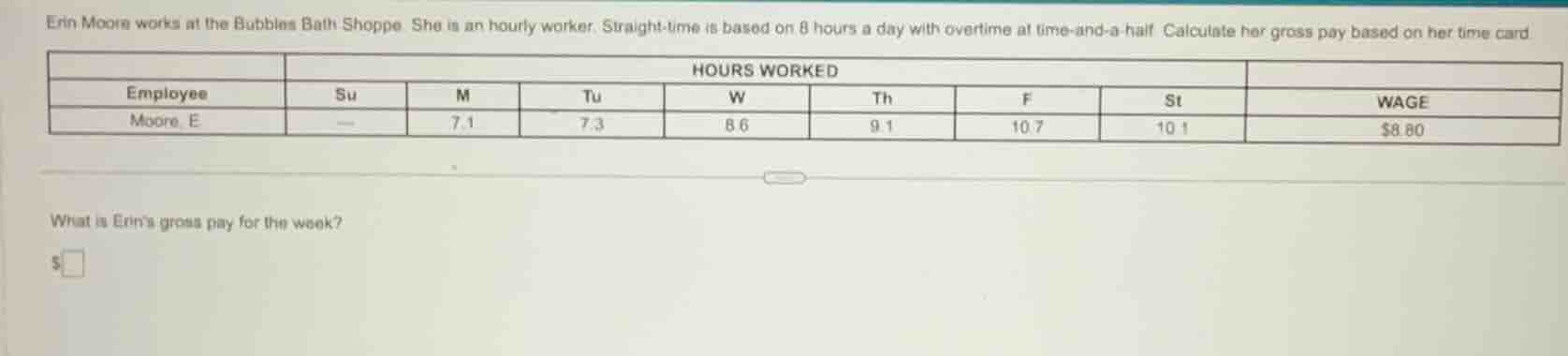
erin moore works at the bubbles bath shoppe. she is an hourly worker. straight - time is based on 8 hours a day with overtime at time - and - a - half. calculate her gross pay based on her time card.
employee
moore, e
hours worked
su
—
m
7.1
tu
7.3
w
8.6
th
9.1
f
10.7
st
10.1
wage
$8.80
what is erins gross pay for the week?
$\square
Step1: Calculate total hours worked
First, sum up all the hours worked each day: \(7.1 + 7.3 + 8.6 + 9.1 + 10.7 + 10.1\)
\(7.1+7.3 = 14.4\); \(14.4 + 8.6 = 23\); \(23 + 9.1 = 32.1\); \(32.1 + 10.7 = 42.8\); \(42.8 + 10.1 = 52.9\) hours total.
Step2: Determine regular and overtime hours
Straight - time is 8 hours per day. For a week, regular hours (if we consider daily 8 - hour basis, but here we can also calculate total regular hours as \(8\times6 = 48\) hours (since there are 6 working days: M, Tu, W, Th, F, St). Wait, actually, let's check the hours:
Wait, the days are M (7.1), Tu (7.3), W (8.6), Th (9.1), F (10.7), St (10.1). So 6 days.
First, for each day, regular hours are 8, overtime is hours over 8.
Let's calculate overtime for each day:
- M: \(7.1\leq8\), overtime = 0
- Tu: \(7.3\leq8\), overtime = 0
- W: \(8.6 - 8=0.6\)
- Th: \(9.1 - 8 = 1.1\)
- F: \(10.7 - 8=2.7\)
- St: \(10.1 - 8 = 2.1\)
Now, total regular hours: \(7.1+7.3 + 8+8+8+8\)? Wait no, better to calculate total hours first: \(7.1 + 7.3+8.6 + 9.1+10.7+10.1=52.9\) hours.
Total regular hours: sum of minimum(8, hours per day) for each day.
M: 7.1, Tu:7.3, W:8, Th:8, F:8, St:8.
Sum of regular hours: \(7.1 + 7.3+8 + 8+8+8=46.4\) hours. Wait, no, that's wrong. Wait, actually, regular hours are 8 hours per day, so for days with hours ≤8, regular hours are the hours worked, for days >8, regular hours are 8.
So:
M: 7.1 (regular), 0 (overtime)
Tu:7.3 (regular), 0 (overtime)
W:8 (regular), 0.6 (overtime)
Th:8 (regular), 1.1 (overtime)
F:8 (regular), 2.7 (overtime)
St:8 (regular), 2.1 (overtime)
Now, total regular hours: \(7.1 + 7.3+8 + 8+8+8=46.4\) hours.
Total overtime hours: \(0.6 + 1.1+2.7+2.1 = 6.5\) hours.
Now, regular pay rate: \(\$8.60\) per hour.
Overtime pay rate: \(8.60\times1.5=\$12.90\) per hour.
Now, calculate regular pay: \(46.4\times8.60\)
Calculate overtime pay: \(6.5\times12.90\)
First, regular pay: \(46.4\times8.60\)
\(46.4\times8 = 371.2\), \(46.4\times0.6 = 27.84\), so \(371.2+27.84 = 399.04\)
Overtime pay: \(6.5\times12.90\)
\(6\times12.90 = 77.4\), \(0.5\times12.90 = 6.45\), so \(77.4 + 6.45=83.85\)
Total gross pay: \(399.04+83.85 = 482.89\)? Wait, no, maybe my regular hours calculation is wrong.
Wait, another approach: total hours worked: \(7.1 + 7.3+8.6 + 9.1+10.7+10.1 = 52.9\) hours.
Regular hours: 8 hours per day for 6 days: \(8\times6 = 48\) hours.
Overtime hours: \(52.9 - 48=4.9\) hours. Wait, that's different. Wait, why? Because when we calculate regular hours as 8 per day, total regular is \(8\times6 = 48\), regardless of how many hours are worked per day (as long as some days have less than 8, but the company's straight - time is based on 8 hours a day. Wait, the problem says "Straight - time is based on 8 hours a day with overtime at time - and - a - half". So straight - time pay is for 8 hours a day, and any hours over 8 in a day are overtime. But also, if a day has less than 8, does the straight - time still count as 8? Wait, no, probably, straight - time is the actual hours worked up to 8, and overtime is hours over 8. Wait, the problem says "Straight - time is based on 8 hours a day" – maybe it means that the regular rate is for 8 hours per day, and any hours worked beyond 8 in a day are overtime. So for a day with \(h\) hours, if \(h\leq8\), pay is \(h\times\) regular rate; if \(h > 8\), pay is \(8\times\) regular rate \(+(h - 8)\times\) overtime rate.
So let's recalculate:
- M: \(7.1\times8.60\)
- Tu: \(7.3\times8.60\)
- W: \(8\times8.60+0.6\times8.60\times1.5\)
- Th: \(8\times8.60 + 1.1\times8.60\tim…

Snap & solve any problem in the app
Get step-by-step solutions on Sovi AI
Photo-based solutions with guided steps
Explore more problems and detailed explanations
\(482.89\)