QUESTION IMAGE
Question
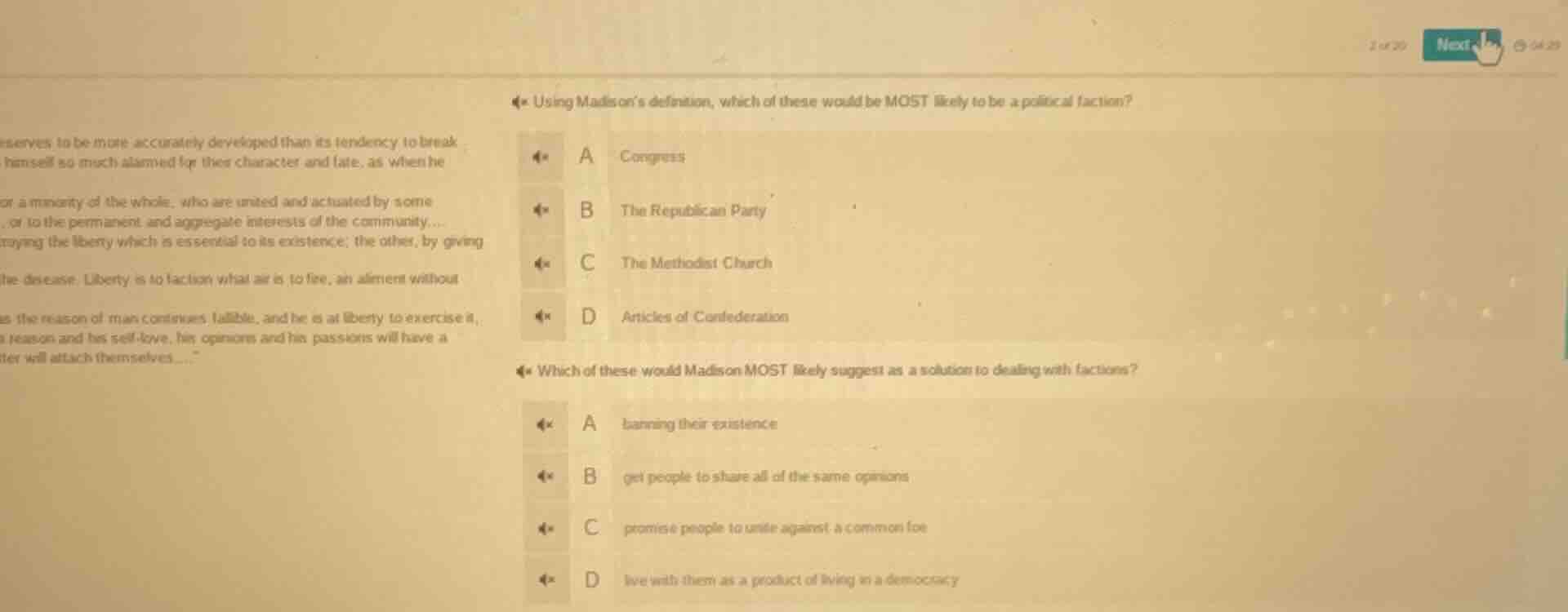
eserves to be more accurately developed than its tendency to break himself so much alarmed for their character and fate, as when he or a minority of the whole, who are united and actuated by some or to the permanent and aggregate interests of the community... troying the liberty which is essential to its existence; the other, by giving he disease. liberty is to faction what air is to fire, an aliment without as the reason of man continues fallible, and he is at liberty to exercise it, reason and his self-love, his opinions and his passions will have a ter will attach themselves...
- using madisons definition, which of these would be most likely to be a political faction?
a congress
b the republican party
c the methodist church
d articles of confederation
- which of these would madison most likely suggest as a solution to dealing with factions?
a banning their existence
b get people to share all of the same opinions
c promise people to unite against a common foe
d live with them as a product of living in a democracy
For the first question: Madison defined a faction as a group united by a common passion or interest adverse to the community's good. The Republican Party is a political group organized around shared political interests and goals, fitting this definition. Congress is a governmental body, the Methodist Church is a religious group, and the Articles of Confederation was a governing document, none of which fit the faction definition as closely.
For the second question: Madison argued that eliminating liberty (to ban factions) or forcing uniform opinions is impossible and undesirable. Instead, he accepted factions as a natural product of liberty in a democracy, and proposed controlling their effects rather than eliminating them, meaning living with them as a democratic product.

Snap & solve any problem in the app
Get step-by-step solutions on Sovi AI
Photo-based solutions with guided steps
Explore more problems and detailed explanations
- B. The Republican Party
- D. live with them as a product of living in a democracy