QUESTION IMAGE
Question
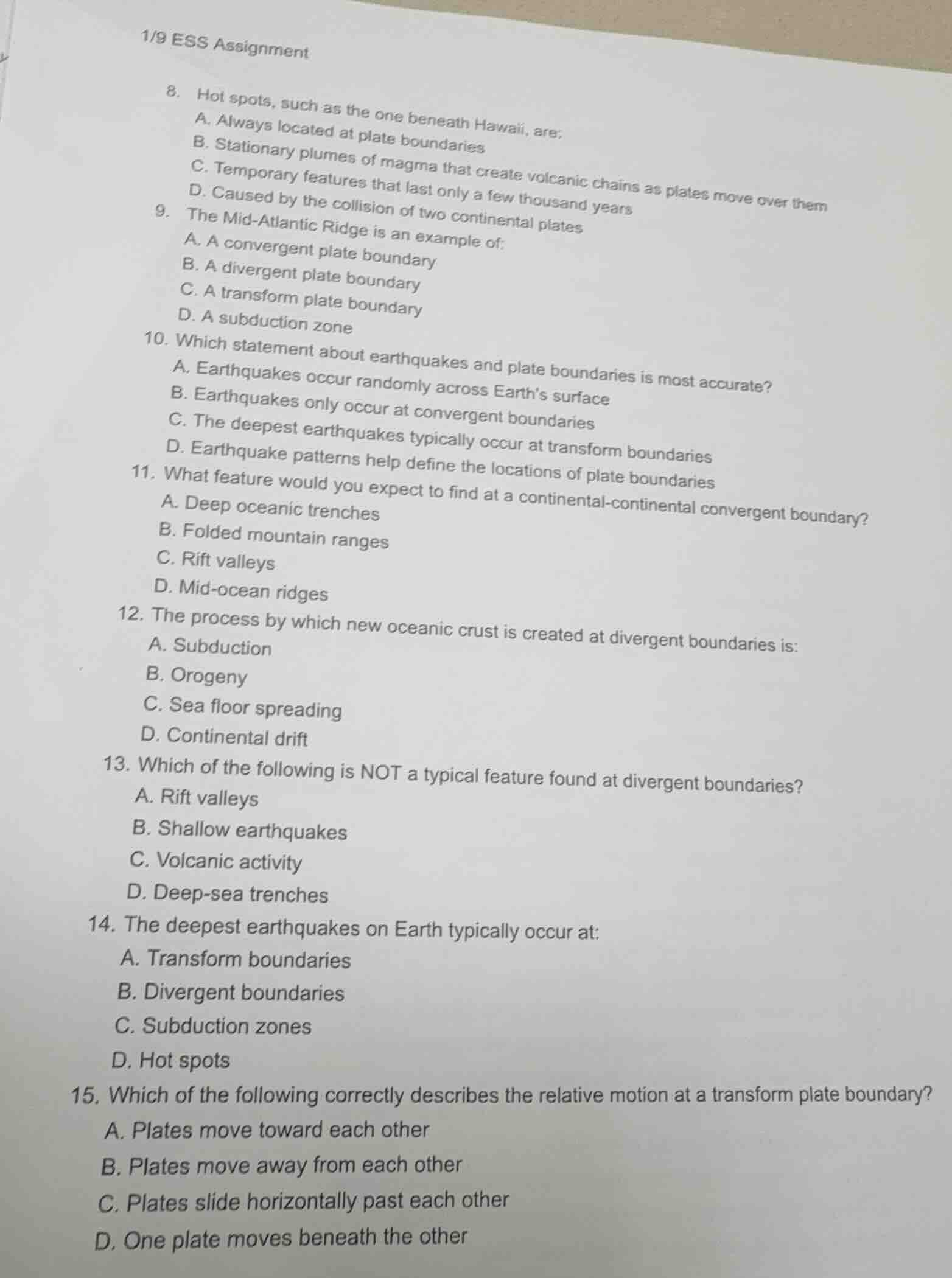
1/9 ess assignment
- hot spots, such as the one beneath hawaii, are:
a. always located at plate boundaries
b. stationary plumes of magma that create volcanic chains as plates move over them
c. temporary features that last only a few thousand years
d. caused by the collision of two continental plates
- the mid - atlantic ridge is an example of:
a. a convergent plate boundary
b. a divergent plate boundary
c. a transform plate boundary
d. a subduction zone
- which statement about earthquakes and plate boundaries is most accurate?
a. earthquakes occur randomly across earths surface
b. earthquakes only occur at convergent boundaries
c. the deepest earthquakes typically occur at transform boundaries
d. earthquake patterns help define the locations of plate boundaries
- what feature would you expect to find at a continental - continental convergent boundary?
a. deep oceanic trenches
b. folded mountain ranges
c. rift valleys
d. mid - ocean ridges
- the process by which new oceanic crust is created at divergent boundaries is:
a. subduction
b. orogeny
c. sea floor spreading
d. continental drift
- which of the following is not a typical feature found at divergent boundaries?
a. rift valleys
b. shallow earthquakes
c. volcanic activity
d. deep - sea trenches
- the deepest earthquakes on earth typically occur at:
a. transform boundaries
b. divergent boundaries
c. subduction zones
d. hot spots
- which of the following correctly describes the relative motion at a transform plate boundary?
a. plates move toward each other
b. plates move away from each other
c. plates slide horizontally past each other
d. one plate moves beneath the other
- Hot spots are stationary magma plumes; as tectonic plates move over them, they form volcanic chains (like Hawaii's islands). They are not tied to plate boundaries, long-lasting, or caused by continental collisions.
- The Mid-Atlantic Ridge forms where tectonic plates move apart, making it a divergent boundary.
- Earthquake locations follow plate boundary patterns, which helps map these boundaries. They are not random, occur at all boundary types, and deepest quakes are at convergent/subduction zones.
- When two continental plates collide, neither subducts, so folded mountain ranges form (e.g., Himalayas). Trenches form at oceanic-continental convergent boundaries, rifts/ridges at divergent boundaries.
- Sea floor spreading is the process where magma rises at divergent boundaries, creating new oceanic crust.
- Deep-sea trenches form at convergent (subduction) boundaries, not divergent ones. Rift valleys, shallow quakes, and volcanoes are typical of divergent boundaries.
- The deepest earthquakes occur in subduction zones, where one plate is pushed deep into the mantle.
- Transform plate boundaries involve plates sliding horizontally past one another, with no creation or destruction of crust.

Snap & solve any problem in the app
Get step-by-step solutions on Sovi AI
Photo-based solutions with guided steps
Explore more problems and detailed explanations
- B. Stationary plumes of magma that create volcanic chains as plates move over them
- B. A divergent plate boundary
- D. Earthquake patterns help define the locations of plate boundaries
- B. Folded mountain ranges
- C. Sea floor spreading
- D. Deep-sea trenches
- C. Subduction zones
- C. Plates slide horizontally past each other